Heatwave Challenges Workplaces Across Europe
Monique Mosley is accustomed to hot conditions at the food factory in Yorkshire where she works, but June’s recent heatwave has made the environment unbearable.
“We make hot filled food products and it’s common that we see temperatures in the high 30s,”she said.
“Thanks to our union, our employer is offering extra breaks, but not every workplace is the same.”
The latest heatwave affecting the UK and much of western Europe has caused a range of issues, from overheated offices and disrupted commutes to school closures and hazardous construction sites where workers face risks such as dehydration, heatstroke, and other injuries.

Economic Impact of Rising Temperatures
There is increasing recognition that frequent extreme heat events significantly reduce productivity and pose a threat to Europe’s already slow-growing economies. Economists warn that without adaptation of ageing buildings and infrastructure, the climate crisis will further hinder economic growth.
Robert Marks, lead climate economist at Oxford, explained that temperatures in the high 30s and low 40s Celsius would
“likely lead to substantial productivity losses and directly disrupt labour across construction, agriculture, manufacturing, retail and hospitality and other sectors which are unable to provide a protected work environment.”
He noted that these sectors account for 27% of economic activity in the UK and an average of 35% in western Europe. Consequently, a four-day heatwave
“could reduce quarterly labour productivity growth by 1.5 percentage points in the UK and up to two percentage points in the rest of western Europe.”
The International Labour Office projects that agriculture and construction will experience the largest loss of working hours in western, northern, and southern Europe by 2030.

Research Highlights Economic Risks of Heat Stress
Researchers at the Allianz Investment Management found that extreme heat is becoming a
“structural economic risk”for Europe. Their study identified France, Spain, and Italy as the most exposed economies to the rising costs of heat stress, noting that productivity losses increase sharply above 30°C, while energy costs for cooling machinery and buildings also rise.
Under the study’s stress scenario, France could lose $240 billion (£182 billion) in economic output between 2026 and 2030, followed by Italy with $147 billion and Spain with $120 billion, amounting to a cumulative loss of up to 7% of GDP.
Katharina Utermöhl, head of thematic and policy research at Allianz Investment Management and co-author of the study, stated,
“The heatwave is not an exception, it is a direction. Extreme heat costs all of us as workers, as businesses, as taxpayers, and there is a difference between countries that adapt and those that wait. It would be better to stop treating it as a summer problem and start treating it as a permanent economic policy challenge.”
Workplace Regulations and Challenges
The heatwave has intensified tensions between employees and employers. UK workplace regulations specify minimum working temperatures—16°C in offices or 13°C for strenuous physical work—but there is no maximum temperature limit. This is partly because some workplaces, such as kitchens or foundries, are routinely hot. Instead, the Health and Safety Executive (HSE) advises employers to maintain a
“reasonable”temperature for employees.
Separate regulations apply to construction sites, requiring reasonable temperatures in indoor areas and outdoor rest zones, with workers needing protection from adverse weather conditions.
The HSE recommends measures such as rescheduling work to cooler periods, providing more frequent rest breaks and free access to cool drinking water, and encouraging workers to remove personal protective equipment during breaks.
David D’Souza, director of profession at the Chartered Institute of Personnel and Development, commented,
“A lot of organisations which have flexibility will be making use of it. However, that flexibility isn’t available to every organisation, so it provides far more of a challenge where people have to be on site or they have to wear specific protective clothing. There’s a mutual benefit to flexibility in situations like this.”

In parts of the UK, including southern England, refuse collectors have started bin collections earlier than usual, with some in Bristol beginning rounds at 4am.
In Italy, where some regions were under red alert, the Lazio region around Rome issued a directive for construction workers and delivery riders to avoid work between 12:30pm and 4pm on Wednesday. However, reports indicated that many food delivery riders ignored the order and continued deliveries.
Impact on Various Workers and Businesses
While many office-based employees have been permitted to work from home during the hottest days, numerous workers—such as nurses, bakers, transport, and shop workers—cannot perform their duties remotely.
Elusive Brewing, an independent brewery in Berkshire, paused production for much of the week due to unsafe temperatures. Owner Andy Parker said,
“We don’t want to be brewing… [It’s] north of 40 degrees in the brewery and that’s not safe for staff.”He added,
“Our brewer came in on Monday at 5am to make sure we were done by midday and we’ve cancelled Friday’s brew and moved it to next week.”
Calls for Improved Worker Protections
The heatwave has renewed discussions about the flexible working arrangements introduced during the pandemic. UK trade unions have long argued that current guidance is insufficient and have urged the government to establish maximum workplace temperatures, though ministers and business groups have previously rejected this. The Confederation of British Industry (CBI) advocates for a
“commonsense approach.”
Matthew Percival, CBI’s future of work and skills director, stated,
“Employers have a duty of care to their employees which includes managing heat-related risks.”
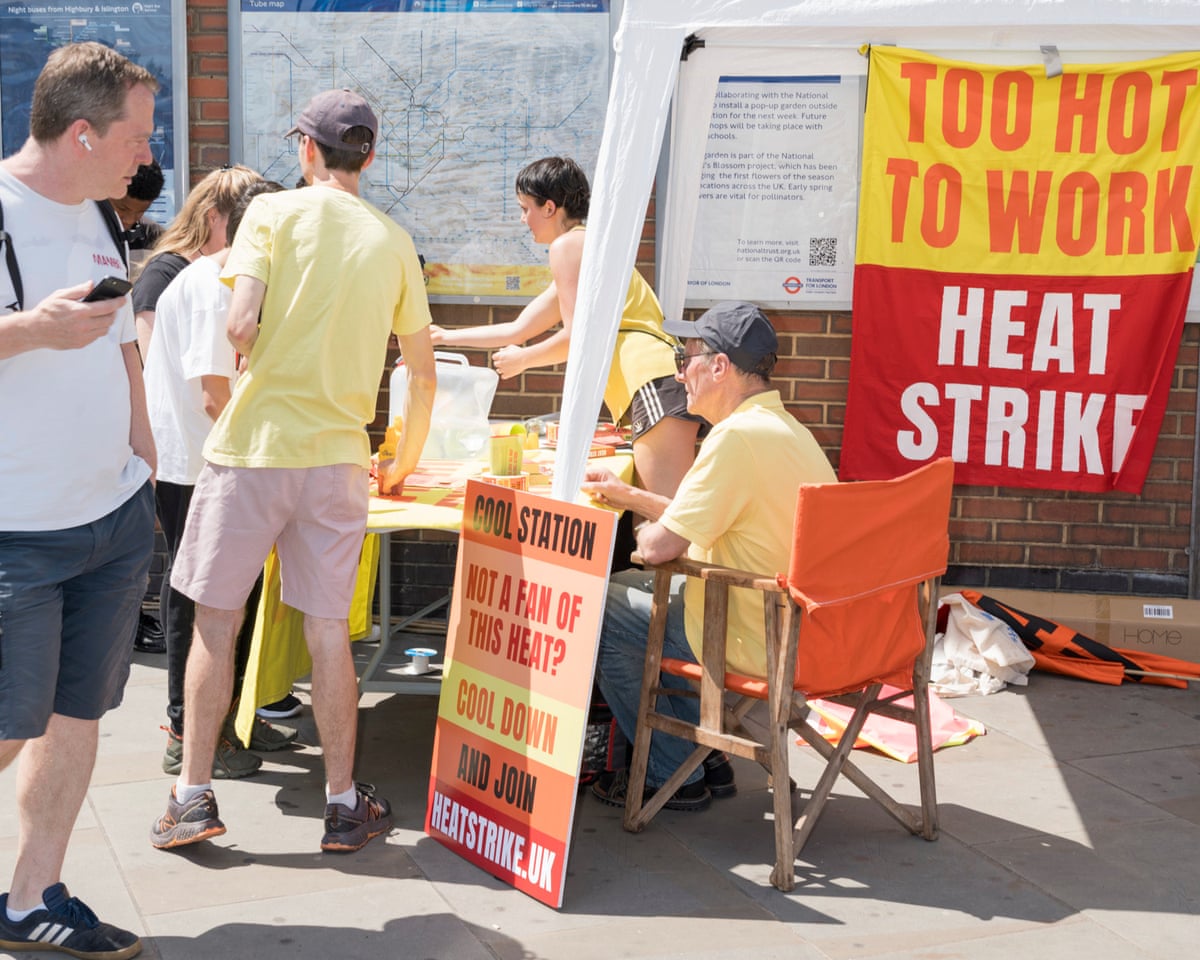
The Bakers, Food and Allied Workers Union and the Fire Brigades Union, alongside Extinction Rebellion, have called for workers to
strike on the hottest day.
International Comparisons of Heat Regulations
Although European countries such as France and Germany have experienced high temperatures for longer, they also lack a maximum legal workplace temperature. However, French authorities introduced measures last summer requiring employers to adjust working arrangements, reduce sunlight exposure in workplaces, and provide fresh drinking water.
In Germany, employers must implement cooling measures if indoor temperatures exceed 30°C, with stricter rules at 35°C.
Spain has gone further, entitling workers unable to reach their workplace due to heat to up to 22 days of paid leave, and allowing companies to temporarily suspend contracts if additional time off is necessary.
Disruptions in the UK
In the UK, workers have faced cancelled trains—following advice to avoid travel—more breakdowns, and school closures.
Employment lawyer Catrin Mills, partner at Sharpe Pritchard, explained that employees do not have an automatic right to time off if their child’s school closes.
“UK employment law does provide employees with a statutory right to take a reasonable amount of unpaid time off for dependants where there is an unexpected disruption to childcare arrangements.”She added that this leave is intended to allow workers to make alternative arrangements.
Additional reporting by Rob Davies