Introduction to the AI and Earth Conference
Es Devlin, a renowned artist and designer, has brought together spiritual leaders, AI researchers, academics, and artists to engage in pottery-making while debating diverse perspectives on the trajectory of technology and its impact on humanity.
Devlin owns a singing bowl, a bell originally used in Buddhist chanting rituals and now common in yoga classes. This particular bowl produces a frequency that creates a pleasant vibration in the temples. When Devlin strikes it at Oxford Kilns, the group gathered around the workbench falls silent, indicating a shared experience of the resonant sound.
Gathering Diverse Voices
Devlin called for order among the assembled group of artists, AI practitioners, spiritual leaders, academics, and global technology experts at the kilns during the AI and Earth conference, which she organized. She intentionally did not know the identities of the attendees, stating,
“I asked the university team to invite AI practitioners with a divergent set of viewpoints.”
She reflected on a similar practice she observed at an artists’ retreat in a monastery the previous year, where monks encouraged guests to introduce themselves by first names only. At a retreat for climate activists led by diplomat Christiana Figueres, oil company executives and activists meditated, cooked, and washed dishes together before discussing their often opposing views, facilitating the discovery of common ground.
Context of the Conference
The conference was held in preparation for the opening ceremony of the Oxford University’s new centre, the largest single building project the university has undertaken. Unlike typical university buildings that are largely inaccessible, the ground floor of this centre is open to the public and includes a gallery, cinema, two theatres, and a concert hall. The centre houses standard humanities departments such as languages, philosophy, and histories, as well as the Ethics and Practical Philosophy Department, a rapidly expanding field with which Devlin has collaborated.
The Artistic Installation and Performance
Devlin and American composer Nico Muhly have created an installation to be performed at the centre’s opening festival. The installation consists of 360 pots, including those made by participants and the public during workshops. These pots will be arranged on three circular tables among the audience beneath the octagonal dome of the centre’s great hall. Devlin describes it as,
“A vessel for every degree of difference of point of view.”
The University Chamber Choir will perform Muhly’s choral piece, which draws inspiration from verses by the 17th-century theologian and poet George Herbert. During the pottery-making sessions, participants will discuss the impact of AI on the Earth. In subsequent workshops, attendees will listen to an edited version of the conversation while continuing their work and dialogue.

Devlin’s approach integrates multiple layers of reference and meaning, often resulting in complex experiences. Whether designing theatrical sets or creating her own art exhibitions, she emphasizes co-authorship, collaboration, and audience participation, asserting that art requires collective engagement with ideas and physical involvement.
Hands-On Pottery and the Symbolism of Clay
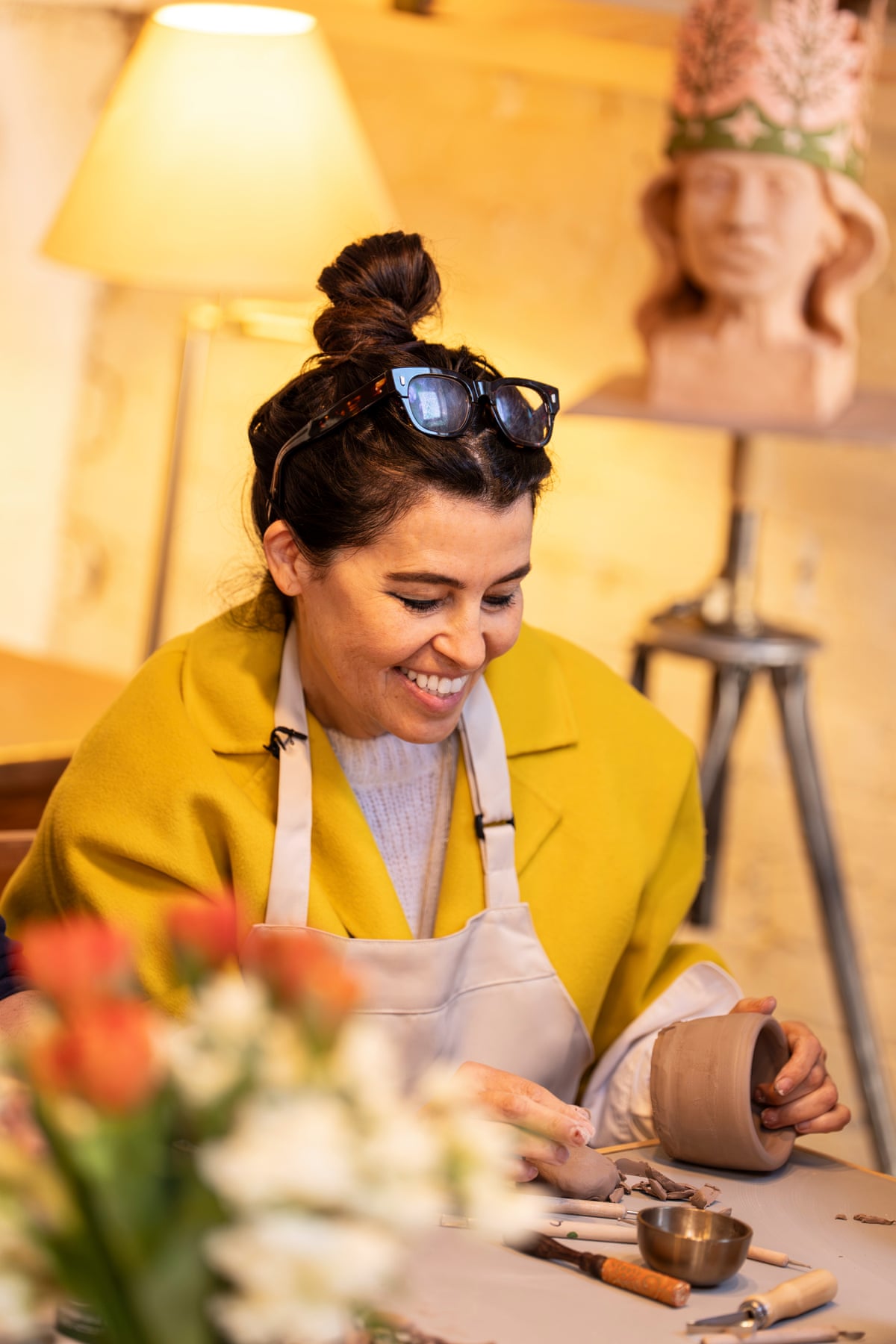
The practical aspect of the conference involves participants rolling up their sleeves and kneading clay. Two potters guide the group in coiling clay into vessels, making pinch pots, and decorating simple bowls into more elaborate pieces.
Devlin explains the choice of venue and medium,
“I felt the most appropriate place to hold the conference would be in a potters’ workshop – with our hands in contact with 160-million-year-old Jurassic clay! It’s an antidote to eyes in front of screens with our hands dancing over keyboards.”
Debate on AI Ethics and Concepts
Although participants did not know each other’s names, significant figures and concepts emerged in the discussion. Topics included Alan Turing and whether his 1950 test for machine intelligence should be updated to assess compassion. Isaac Asimov’s Three Laws of Robotics, first introduced in a 1942 short story, were also discussed. The centaur or cyborg concept by Gary Marcus, describing human-AI collaboration for specific tasks, received attention as well.
The conversation also covered the Bioo Lite, a prototype machine that converts bioenergy into electricity, grounding technology in natural processes. One participant had recently read Jorge Luis Borges’s 1945 short story “The Aleph,” about a point in space containing all other points, while another had just returned from a discussion on AI with the Dalai Lama.
A notable contribution came from one of the potters leading the workshop, who highlighted that the conversation about AI ethics is a luxury. She explained that her family originated from what is often called the developing world, where people are not consulted about AI; it simply happens to them. This remark underscored the perspective of the majority of the global population.
Reflections and Closing Thoughts
Following the conference, Devlin expressed satisfaction with the event’s outcomes. She reflected on a participant who acknowledged the logical reasons not to anthropomorphize AI but admitted an irresistible tendency to do so. Devlin herself has explored large language models for a decade and is interested in the language used to describe AI. She referenced Shoshana Zuboff’s book The Age of Surveillance Capitalism and the concept of digital shadows, which reminded her of Peter Pan losing his shadow.
Devlin concluded,
“I am aware that my art and my words and my every choice, my presence, is being used to train the algorithms that concentrate wealth among a small number of individuals, and, in spite of this – however confusing, however painful – I would like to try to stitch my digital shadow back on to my feet and dance with it myself, and invite others to dance with it too.”