

Scotland host France at Murrayfield on Saturday
When undefeated France visit Murrayfield on Saturday in the penultimate round of the Six Nations, every facet of Scotland's game will be tested.
The reigning champions, who remain the only team pursuing a Grand Slam after dominant wins over Ireland, Wales, and Italy, face Scotland and England as the only sides capable of stopping them.
A victory for Gregor Townsend's Scotland would not only prevent France from securing the Grand Slam but also position Scotland to contend for their first-ever Six Nations title in the final round against Ireland in Dublin.
So, what are the critical areas Scotland must excel in at Murrayfield?
The aerial battle
A key element of Test rugby since the escort rule change, France have excelled in aerial contests against every opponent so far.
They have kicked more than any other Six Nations side and retained possession from their own kicks more frequently, with nine more recoveries than the next best team, Ireland.
France's proficiency is not limited to regaining possession; they also capitalize on aerial contests to score directly. For example, winger Louis Bielle-Bierrey benefited from Antoine Dupont securing the ball from an Italy kick in the last round when Theo Attisogbe challenged in the air.
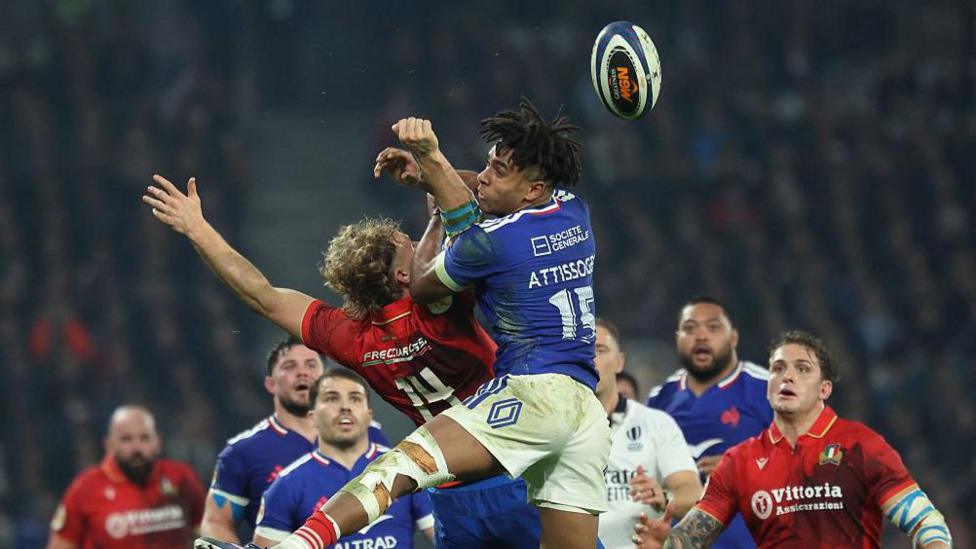
Scotland have also performed well in this domain. They rank second in the percentage of their own kicks retained, with scrum-half Ben White leading all players with 10 kicks retained.
Wingers Kyle Steyn and Jamie Dobie were instrumental in Scotland's aerial advantage over England in round two before Dobie's campaign ended due to injury.
Duhan van der Merwe returned against Wales but was substituted early for Darcy Graham, who scored a vital try from a quick restart by Finn Russell.
There is speculation that Gregor Townsend might select Glasgow's Kyle Rowe to join Blair Kinghorn and Kyle Steyn in the back three. Rowe, comfortable at full-back or wing, scored twice in the Warriors' recent defeat to Connacht and is noted for his strength under high balls and counter-attacking ability.
Regardless of personnel, Scotland must be nearly flawless in contesting kicks and covering the backfield against a France side that regularly scores from various kicks, including cross-field kicks and opportunistic dinks and grubbers.
Dealing with power game
Although not as prominent in this Six Nations as in previous years, France still possess a formidable power game.
Players such as second-row Emmanuel Meafou, standing 6ft 8in and weighing 145kg, provide more bulk than Scotland's forwards.
France's combination of power and a dynamic back row has resulted in them carrying for the most metres in total during the Championship, as well as averaging the most metres per individual carry.

Defensively, France boasts the six most dominant tacklers so far.
In their encounter in Paris last year, Scotland matched France for 60 minutes and, but for a disallowed try by Huw Jones and a French counter-attack score following a knock-on by Graham in their 22, might have exerted significant pressure late in the game.
Ultimately, France overpowered Scotland in the final quarter to secure the title comfortably.
How can Scotland prevent a similar outcome this time?
The energy from the home crowd will be influential, as will the bench composition.
Jack Dempsey's fitness could be decisive. The 31-year-old, expected to miss the remainder of the Six Nations after a bicep injury against England, has returned to the squad and appears available for selection. As Scotland's most aggressive ball carrier, his physical presence would enhance their chances.
His back-row teammate Rory Darge, who leads the tournament with eight turnovers, will also be key in disrupting France's ball.
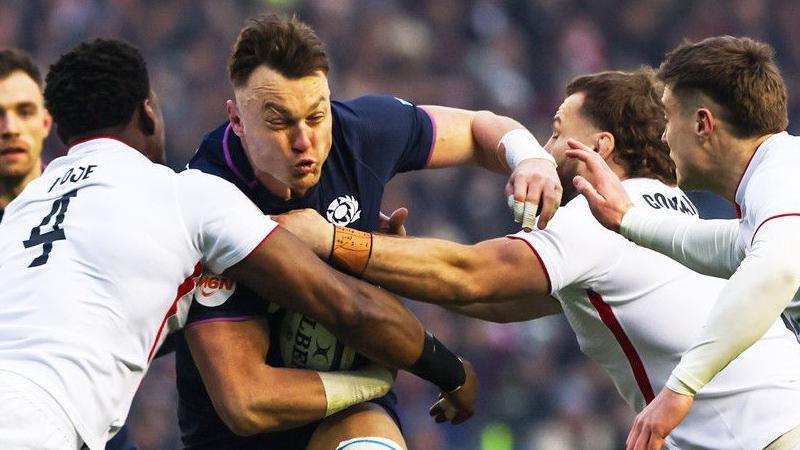
Scotland have missed the fewest tackles in the Championship so far and must maintain this defensive discipline, including tightening their set-piece.
Scotland must start quickly
Scotland began slowly against both Italy and Wales. They were punished in Rome's heavy rain despite narrowing the gap to within a score, and only escaped with a late rally in Cardiff.
A slow start against France could be decisive, as the French have consistently started matches aggressively, scoring six tries in the opening quarter across three games.
For instance, Ireland trailed 22-0 at halftime in Paris, Wales conceded a try within 90 seconds, and Italy were 19-0 behind before the half-hour mark.
While every team aims to start strongly, it is challenging as opponents seek the same fast start.
Scotland cannot afford a gradual build-up; they need a start akin to their 17-0 lead against England.
Though France is unlikely to be as lenient as England, Scotland must begin with comparable accuracy and intensity to keep the title race alive until the final weekend.
Related internet links
Listen: BBC Scotland Rugby Podcast


