

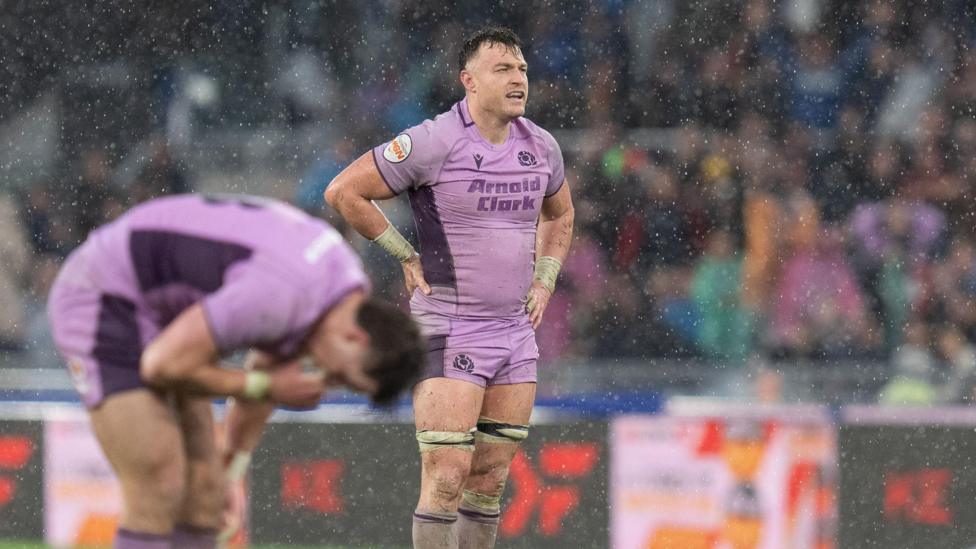
A dejected Jack Dempsey summed up Scotland's mood
Scotland Rugby Podcast: Inquest begins after Italy defeat
https://www.bbc.co.uk/sounds/play/p0mzr723
When Scotland advanced through multiple phases late in a challenging but engaging match in Rome, their critical moment arrived — the opportunity to fulfill their stated ambition of ruthlessness. They moved the ball downfield, navigating through the wet conditions and around the determined Italian players, crossing halfway and entering Italy's 22-meter area.
Was this the breakthrough? A decisive surge or a failure amid the difficult conditions of a Roman afternoon?
After 29 phases, the outcome was clear. Max Williamson was held up, resulting in a turnover to Italy and the end of the game. Italy took an early lead, while Scotland was left to reflect on another disappointing result.
"I believe in what we're doing" - Townsend
Italy capitalized on a lackluster Scottish performance in the rain-soaked conditions of Rome.
Gregor Townsend delivered a message emphasizing optimism and future improvement following the match, offering hope despite the current difficulties. He stated,
"It didn't happen. We're going to make sure it happens next week."
Such assurances have been heard before, and their impact has diminished over time.
Players spoke of introspective sessions following autumn setbacks, yet these reflections did not translate into effective action when tested.
The final minutes presented a chance to overcome adverse conditions, challenge a deserving opponent, and secure a rewarding victory, but Scotland was unable to seize it.
Italy established an early lead in challenging weather and maintained it through disciplined play.
The Italian team's celebrations reflected their determination and resilience.
This outcome is positive for the competitiveness of the Six Nations tournament, though it may be unwelcome news for Scottish supporters.
Italy's tenacity prevails in Rome
Italy secured a hard-fought victory over Scotland, increasing pressure on coach Gregor Townsend.
Under Townsend, Scotland has frequently exhibited uncertainty regarding when critical setbacks occur, whether early or late in matches, but setbacks are a consistent feature.
In Rome, the damage was inflicted early. Within the Scotland camp, there was discussion about the need for improved execution when entering the opponent's 22-meter area, a valid concern.
During last season's Six Nations, Scotland ranked second in visits to opposing 22s but last in points scored from those visits, highlighting inefficiency and mental fragility.
Early in the game, Scotland had an attacking line-out inside Italy's 22 but lost possession at the front, allowing Italy to counterattack. This marked the start of a significant struggle, particularly for players Ewan Ashman and George Turner.
While the weather conditions were poor, Scotland's error rate exceeded Italy's, with miscommunications and inaccurate throws contributing to a disorganized performance.
The early signs were discouraging, with Italy scoring first by winning aerial contests. Ignacio Brex executed a grubber kick to Louis Lynagh, giving Italy the initial advantage.
Scotland's aim to become difficult to score against was compromised early.
Scotland again attempted an attacking line-out in Italy's 22 shortly after but lost possession once more. By the twelfth minute, the situation was increasingly dire.

Italy continued to exploit aerial superiority, with Lynagh outmaneuvering Jamie Dobie to extend the lead.
Michele Lamaro, a key back-row player, passed to Tommaso Menoncello, increasing Italy's lead to 12 points. In such conditions, a dozen points carry significant weight.
Chasing in the rain induced panic and forced errors, further eroding Scotland's confidence.
Despite these challenges, Scotland managed to score through Jack Dempsey and later through George Horne.
Paolo Garbisi's kicking and Italy's collective resolve maintained their advantage.
Scotland's frequent errors contributed to the outcome in a fiercely contested match, with Italy's aggression proving decisive.
Townsend faces criticism after defeat
Coach Gregor Townsend's substitutions were 5-3 in favor of forwards, but in hindsight, a 6-2 split might have been more effective in the rainy conditions.
Questions arose regarding the decision to keep Adam Hastings on the bench throughout the match, raising concerns about selection strategy.
Set-piece struggles were evident as line-outs and scrums faltered. Ashman's foul play resulted in a penalty reversal benefiting Italy, and Finn Russell's kick went out on the full. Turner received a yellow card for an indiscretion near a ruck.
These errors undermined Scotland's momentum and did not reflect the ruthlessness the team aspired to demonstrate.
George Horne's introduction sparked hope, as his energetic play and try in the corner briefly lifted the team's spirits.
Horne's arrival energized teammates who appeared flat and demoralized.
Despite this, the optimism faded, culminating in a prolonged sequence of 29 phases that ultimately failed to produce a scoring opportunity, mirroring the stagnation experienced under Townsend's leadership.
The players' performance was disappointing, but accountability will largely rest with the coach.
Scotland has been struggling for an extended period, not just during this match.
Townsend's contract extends until 2027, with speculation about a future role at Newcastle following the World Cup. There may be rationale for an earlier transition.
The justification for retaining Townsend through another Six Nations and World Cup has diminished significantly.
Unless unexpected improvements occur, the case for ending his tenure after this Six Nations is increasingly compelling.
Townsend is currently engaged in a difficult effort to recover the team's form and secure wins to improve perceptions.
Scotland faces England at Murrayfield next Saturday, followed by matches against Wales in Cardiff, France, and Ireland, the latter two featuring returning players.
One win from five matches is a likely outcome, which would be unsustainable if realized.
The Scottish Rugby Union's decision-makers face a critical choice, though no assurances of action have been given. Townsend's repeated promises to improve, including for the Calcutta Cup, have become wearisome.


