

Reflecting on the Murrayfield Defeat and Upcoming Challenges
In his latest column, England World Cup winner Matt Dawson examines the potential long-term effects of England's loss to Scotland at Murrayfield and previews the challenge of facing Ireland at Allianz Stadium on Saturday.
Dawson recalls several Six Nations defeats that have left a lasting impact, including losses to Scotland in 2000, Ireland in 2001, and France in 2002, emphasizing how such results can be deeply disheartening.
He stresses the importance of perspective, noting that setbacks like these will occur again before the 2027 Rugby World Cup. While England will be recovering from another heavy defeat by Scotland, the championship remains within reach despite the diminished prospect of a Grand Slam.
The opportunity to secure a Grand Slam is rare, and Dawson cautions against assuming the tournament's outcome is decided after the opening weekend. He highlights the unpredictable nature of the Six Nations, where two wins could position England to contend for the championship in Paris.
There is much to focus on and anticipate, and the experience at Murrayfield is expected to contribute to England's growth as a team.
Achieving significant away victories in the Six Nations is challenging, and Saturday’s match was another such occasion where success eluded coach Steve Borthwick. Dawson points out that the World Cup will be held on neutral ground in Australia, making the ability to perform outside Twickenham and without home comforts critical.
Despite an impressive 12-game winning streak, England still need to adopt a South African mentality—expecting to win and succeed globally regardless of location.
Borthwick has yet to secure a Six Nations away win in Scotland, Ireland, or France. Most adversity arises from playing away, and Saturday’s match provided England players with more exposure to such conditions. Dawson asserts that winning a World Cup without a decisive away victory is unlikely.
Sensational Scotland stun England to seal Calcutta Cup glory
'A rush of blood to the head'
Dawson discusses the intensity of high-pressure games, where physical and mental demands increase rapidly. He references Henry Arundell’s red card incident, where Arundell, in a highly competitive moment, took out Kyle Steyn in the air.
"England found themselves in a position where they were not playing well and were losing the scraps. In those situations, you need clarity as well as competitiveness, and a red card obviously does not help to swing the momentum back."
Dawson notes that this decision was costly for England and that Borthwick will need to manage the wing position carefully, given the competition for the spot. Arundell, aged 23, is expected to recover from this setback, but the incident was reckless and poorly judged.
"What if that had been a championship decider or a World Cup knockout game? You have to make good decisions under pressure. Being in those situations more often will help players learn."
Six Nations: Scotland regain the Calcutta Cup
Error-strewn England flunk oldest Test at Murrayfield

Bewildering, bewitching, brilliant - Scotland's perfect day
'England lacked shape'
Looking ahead, Dawson anticipates England will be eager to rebound against Ireland on Saturday. He acknowledges England’s ability to perform with home support and suggests that correcting issues will be a focus in upcoming games in Rome and Paris.
He advises sometimes it is necessary to set aside a poor performance and move forward. Dawson observed that England appeared to have moved away from a kick-heavy strategy, but Scotland delivered an attacking masterclass. When England attacked, it seemed they were struggling without making meaningful progress.
He likens England’s attacking efforts to a boxer on the ropes throwing punches without landing hits, indicating a lack of structure and effectiveness.
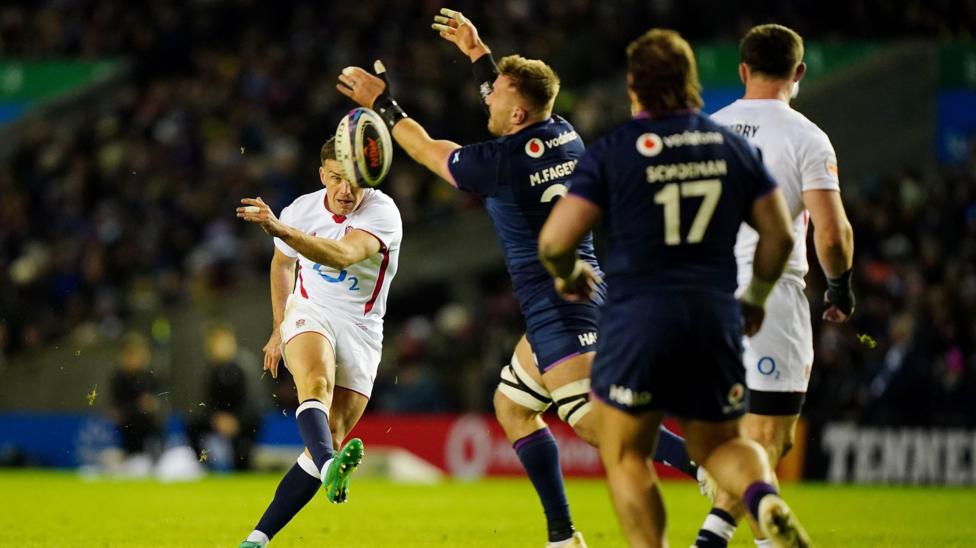
Regarding George Ford’s missed drop-goal, Dawson describes it as a last-ditch effort that resulted in what Borthwick termed a 10-point swing.
"I do not think you can blame Ford, the sequence was not set up properly and it felt like tired minds all over the place."
He emphasizes that adapting to a fast and intense game remains a learning experience for England.
Ford's missed second-half drop-goal would have made the score 24-16
Scotland players 'showed up' for Townsend - Borthwick
Ireland will come with 'best game of the campaign'
Dawson recalls that two years ago, there was significant speculation that Ireland would defeat England by 30 points at Twickenham, reflecting a disparity in team development at that time. Marcus Smith’s late drop-goal prevented an Irish Grand Slam, marking a pivotal moment in Borthwick’s coaching tenure.
Currently, England enter as favorites, illustrating how quickly circumstances can change. Despite recent heavy losses to France and a near draw with Italy, Ireland will be motivated and well-prepared under coach Andy Farrell.
Dawson expects Ireland to deliver their best performance of the campaign. He notes Scotland’s rapid turnaround from a disappointing loss in Rome to a convincing victory against England, highlighting the swift shifts possible in the tournament.
He warns that a defeat next weekend would increase pressure on England, especially with two challenging away matches remaining.
Ireland rally in second half to produce comeback win over Italy
- Six Nations fixtures, results, standings and how to follow on the BBC
- Rejuvenated Scotland sweep England aside in stunning Calcutta Cup win


