Belgium make light work of USA to set up quarter-final tie with Spain
The United States' World Cup journey began with the familiar spectacle that has characterized their matches in the tournament: a passionate and patriotic fanbase, fireworks, smoke flares, and a military flyover.
However, the American aspiration to win the World Cup for the first time ended abruptly and in a disappointing manner in the early hours of Tuesday, following a 4-1 defeat to Belgium. This loss marked the US team's heaviest World Cup defeat since 1990. The energetic atmosphere that had been a hallmark of their previous games diminished well before the final whistle, with many fans departing Seattle Stadium after Belgium's fourth goal.
The US exit at the round of 16, as one of the tournament co-hosts, came after a tumultuous few days dominated by FIFA's controversial decision to suspend Folarin Balogun's red card from the prior match, enabling him to start against Belgium.
The US team's progress to this stage had captured national attention, but the controversy surrounding Balogun appeared to dampen the positive momentum, a sentiment noted by the Belgian side ahead of the match.
"It's great to have the world on our side against the United States," full-back Timothy Castagne said before the match.
Balogun said he was not surprised the decision was "controversial".
"I accepted the decision when I was given the red card, and then I also accepted the decision when I was told I could play," he said.
"There's not too much else I can really say on the matter."
The question remains: to what extent did the Balogun saga impact the US team, and where did things go wrong for Mauricio Pochettino's side?
How much did Balogun saga impact US?
Belgium coach Rudi Garcia spoke with Folarin Balogun after the match.
Beyond the scoreline, there was a noticeable difference in the US team's performance. Under Pochettino, the team had shed its underdog status, displaying an assertive and confident style of play earlier in the tournament. Their attacking approach had raised hopes among fans that the US could defy expectations.
"We're going to win the World Cup," one supporter predicted before the match, a sentiment shared by many fans gathered outside Seattle Stadium ahead of kickoff.
Supporters also welcomed the news that Balogun, who had been shown a straight red card for a foul on Bosnia-Herzegovina defender Tarik Muharemovic in the previous round, was cleared to play. FIFA's decision to suspend the automatic one-match ban for 12 months sparked widespread criticism, including from UEFA, Belgium, and England manager Thomas Tuchel.
The controversy reached the highest levels of US politics, with President Donald Trump stating on Monday that he had asked FIFA to review the decision because he "didn't think it was a foul." Balogun, who had scored three goals in the World Cup, started against Belgium but struggled to influence the game.

Asked afterwards if he had been affected by being the focus of much of the attention in the build-up, US coach Pochettino said: "It didn't affect our performance. It's not an excuse. It wasn't our day.
"But in a personal way, what is the point to insult or receive a lot of bad messages?
"It's a rule for the federation to apply and to try [to overturn the ban]. My position was to train the team. If Balogun is available because Fifa allow for you to have the player, it's not a problem.
"I feel disappointed with too many people. They put politics and manipulation, talk about ethics and integrity [first]. If we talk about the history of this game, I am disappointed in a personal way."
Belgium coach Rudi Garcia revealed that Balogun approached him immediately after the game.
"It's not his fault, he's not the one to blame and that's what I told him," he said.
Why European backlash over Trump intervention won't worry Infantino
Red card system in disarray over Trump, FIFA and Balogun decision
Poor defending ultimately proves costly
The US attack was not the primary issue against Belgium; rather, defensive lapses were largely responsible for the heavy defeat.
Charles De Ketelaere was left unmarked in the box to score the opening goal and then managed to outmaneuver two defenders to head in Belgium's second goal shortly after the US had equalized.
The most disastrous goal was Belgium's third. De Ketelaere tackled US goalkeeper Matt Freese, who had ventured out of his area to challenge for the ball, allowing Hans Vanaken to side-foot the ball into the bottom corner from outside the penalty area. This goal gave Belgium a 3-1 lead and diminished the confidence of the US fans, many of whom began leaving in the final ten minutes. Romelu Lukaku's injury-time strike prompted even more to exit the stadium.
"There was no willingness to go for the ball," said one disappointed US supporter afterwards.
"There was nothing there. There was no drive, football wasn't alive today."
Another added: "The US had unforced errors all over. They didn't play their best game but Belgium played the way they needed to win that game. To silence the crowd like they did, they put themselves in a great spot to win."
Pochettino acknowledged that his team was not up to the task from the outset.
"Everyone saw from the beginning that we did not connect with the game," he said.
"We were never in the game, even when we scored the goal [to equalise], we conceded in the next action. It was really tough from the beginning."
What will defeat do for the World Cup's legacy in the US?
Mauricio Pochettino's contract as head coach of the US expires at the end of the World Cup.
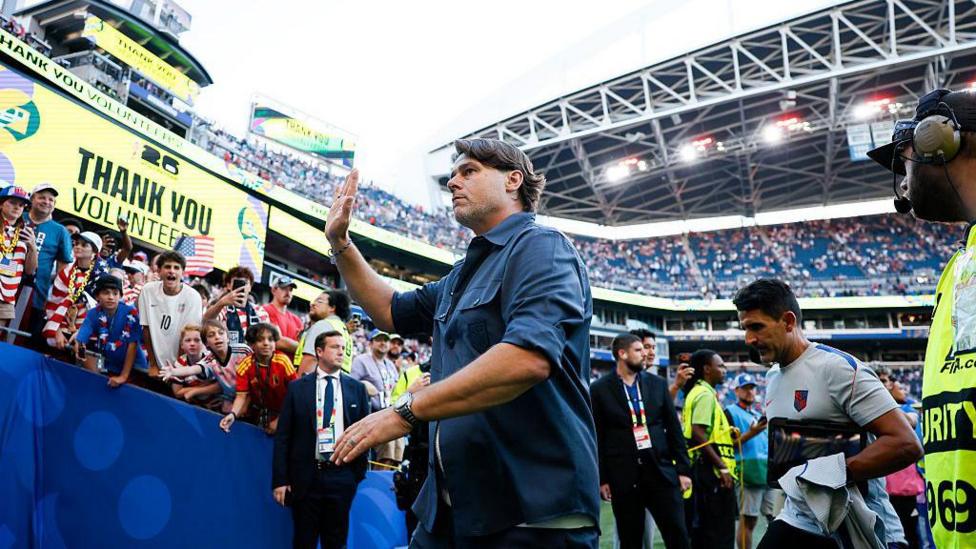
Following a somewhat subdued build-up to the World Cup, it is clear that American fans fully embraced the tournament once it commenced. Fan zones and bars across the country were frequently crowded, and the national team's jerseys were widely visible.
The team's progression to the knockout stage and their attacking style of play undoubtedly increased interest in soccer in the US. However, with the US joining fellow co-hosts Canada and Mexico in exiting at the round of 16, questions arise about the future trajectory of the sport in the country.
"This can't be a direct reflection of what we were trying to accomplish," US midfielder Tyler Adams said.
"You have good days and bad days and this was a bad day. We didn't go as far as we'd like. But if we inspire a few kids on this journey then we have done something right."
Some fans interviewed by immediately after the loss expressed the view that, once the initial disappointment fades, the past few weeks will be regarded positively, though they acknowledge there is still considerable progress to be made before the US is considered a fully established footballing nation.
"It is an amazing event we have put on and we are really excited for the future of soccer in the country," one supporter said.
"Everyone has been talking about the World Cup in this country."
Another added: "Long term we have a lot of catching up to do. There's a culture built around football and we're just not there yet."
Uncertainty also surrounds Pochettino's future. The former Tottenham manager's contract expires at the end of the World Cup, and he offered no indication of his plans after the game.
"Now it's [time] to rest a little bit, to think, to have conversations and see what the decision is from the federation and from us," he said.
"I am so happy we built a very good relationship, but now is not the moment. In the next weeks we can start to talk, if the federation wants to talk."
Pochettino reflects after USA World Cup exit.
- How to watch the World Cup on the BBC and ITV
- Everything you need to know about the World Cup