

Captain Andy Robertson to Lead Scotland Against Brazil
Captain Andy Robertson will lead Scotland as they face Brazil on Wednesday. The match will be broadcast live on BBC One and , BBC Radio Scotland, and BBC Radio 5 Live. Live text updates will be available via the app and website.
As Scotland prepare to face the iconic yellow shirts of Brazil in Miami, they are aware that a draw will secure their progression to the knockout stage of the World Cup. Even a narrow defeat could potentially see them advance to the last 32 as one of the eight best third-placed teams.
Scottish fans have recently focused intensely on the table of third-placed teams, attempting to determine the precise conditions under which the national team could advance for the first time in history.
Head coach Steve Clarke and the players are expected to be questioned about their tactical approach in light of this context. However, the question remains: how feasible is it to play with the primary objective of avoiding defeat?
The Psychology of Playing for a Draw
Throughout football history, it is rare to find coaches or players openly stating that their goal is anything less than a win. Those involved with Scotland are likely to maintain this stance in their pre-match media engagements this week, and it is reasonable to believe their intentions are genuine.
Nonetheless, the external discourse about needing only a point may have subconscious effects within the team.
"I don't believe Steve will be playing for a draw because there's a dangerous element to that. Because you're in a mode where if you do lose a goal then getting shifted out of that mind space is difficult. I've been in that situation on a number of occasions. One of them was the Czech Republic game, the 4-6-0 [in 2010], where a draw would have been a really good result. The game wasn't great and neither team threatened, but we lost the goal to a set-piece. So you can plan all you want to play for a certain outcome, but football is so random that you're not guaranteed to get that."
These insights come from former Scotland player and manager Craig Levein, who spoke to BBC Scotland. He suggests that Clarke's attitude, training methods, game plan, and team selection will have a greater impact on the players' mindset than external speculation about only needing a draw.

For example, the inclusion of winger Ben Gannon-Doak may indicate a more aggressive offensive approach.
"You get a feel as a manager where the players are. You're looking at it and you're thinking: maybe if we just put another attacking player on, it gives everybody the idea that it's time to take the shackles off and have a go."
Why Being Passive Is Not an Option
Rather than the players' mentality being influenced by the desired outcome, the issue may lie in a cautious game plan—even when the intent is to win every match.
In their previous matches, Scotland's possession statistics have been low: 46% against Haiti and 40% against Morocco. They have recorded only two shots on target so far in the tournament.
Defensively, Scotland have not frequently applied intense pressing. Against Morocco, they took an average of 25 seconds to regain possession, while Morocco recovered the ball approximately eight seconds faster on average.
Scott Allan, former Hibernian and Celtic midfielder, shared his perspective on the Scottish Football Podcast:
"When you're constantly sat off the game and you're passive, players go into a certain mindset where they start to worry, instead of having that real belief about going and creating and scoring goals. You can sit in a low block and still be aggressive. There's a point where once they [the opposition] reach here, when they make a square pass, can we go with real purpose and go and try and get the ball back?"
Scotland (black) struggled to get players forward against Morocco, as this map of their average positions shows
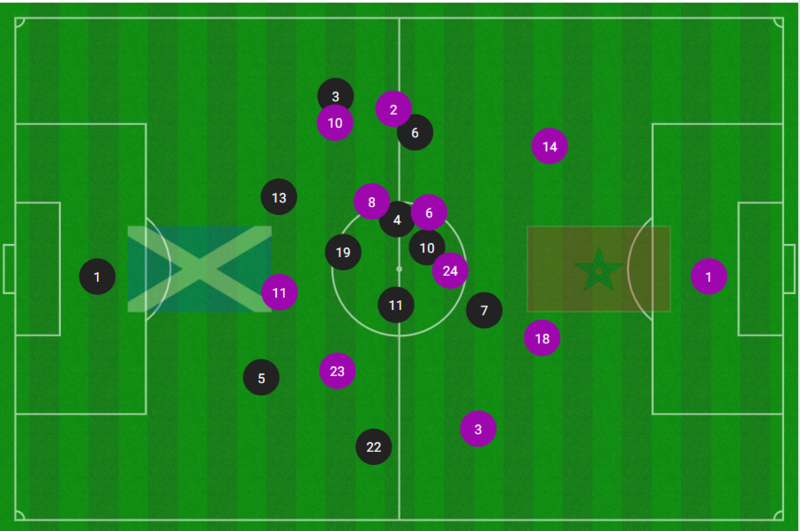
Andy Halliday, former Rangers and Motherwell midfielder, concurs that Scotland must increase their defensive urgency against Brazil.
"When you're going to be this team that wants to sit in and frustrate then try and be as quick as you can on transitions. I think we need to be a lot more aggressive than we've been off the ball. I think every chance we created actually came from us putting pressure on Moroccan players and turning the ball over at the top end of the pitch. I'm not expecting a huge difference in possession [against Brazil], but I think, out of possession, we can't just allow these top players time and space on the ball and make it easy for them to just feel their way into the game."
Kenny Macintyre is joined by Andy Halliday and Scott Allan to discuss Scotland’s narrow defeat to Morocco, examining what went wrong and whether the tactics were overly passive.
- World Cup fixtures and group standings
- How to watch the World Cup on the BBC
- Everything you need to know about the World Cup


