

Scotland Faces Sweltering Conditions in Group C Matches
Scotland will encounter high temperatures during their Group C matches in the World Cup. Hydration breaks, ice jackets, cooling towels, and isotonic drinks have been common features throughout the tournament as hot weather has influenced gameplay.
While some matches have taken place in air-conditioned stadiums or cooler climates across North America, Scotland is set to face increasing heat. Their opening victory over Haiti in Boston was played at approximately 25°C. Although Steve Clarke's team returns to the same venue to face Morocco, the earlier kickoff time by three hours suggests warmer conditions.
Forecasts predict temperatures around 27°C at kickoff on Friday (23:00 BST), with Scotland's final group game against Brazil in Miami next Wednesday expected to be even hotter. Temperatures could exceed 30°C, and with nearly 80% humidity anticipated, the conditions will feel significantly more intense.
These conditions are not unfamiliar to Scotland, who have prepared accordingly, though the heat may still influence performance. Steve Clarke has expressed comfort with training attire despite the heat.
How Have Scotland Prepared?
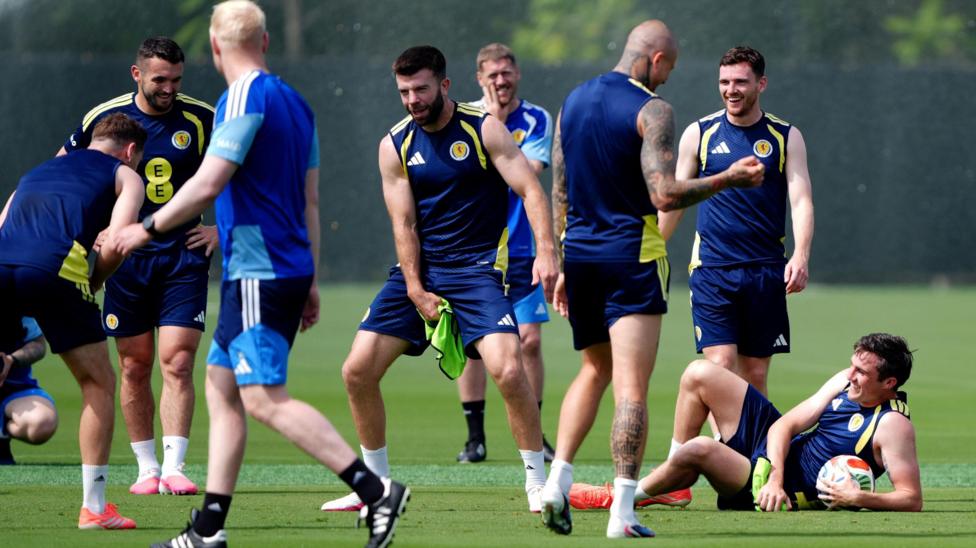
Scotland arrived early in Fort Lauderdale at the beginning of June to acclimate to the hot weather promptly. The team utilized sun cream, experienced tan lines, and employed ice buckets during training sessions before their final warm-up victory over Bolivia in New York.
Their training base is located in Charlotte, North Carolina—approximately midway between Boston and Miami—where temperatures have reached 30°C.
Prior to arriving in the United States, some squad members trained at the University of the West of Scotland, utilizing an extreme environments chamber capable of simulating Florida's conditions.
"It's 10 or 12 days that Scotland have been there so the acclimation and adaptation to the conditions has probably taken place quite nicely," Vish Unnithan, professor of sports science and exercise physiology at the university, told BBC Scotland.
"Maintaining hydration and fluid levels, but also nutritional recovery is going to be key. We know when you're exercising at the intensity these guys are exercising in the heat, the rate at which you use stored carbohydrates is much faster.
"So the nutritionists with the Scotland team will be key to making sure the carbohydrate intake is where it should be."
Unnithan also noted that since players sweat at varying rates, individualized hydration and recovery programs are implemented. Different gels and drinks are provided to suit each player's needs.
Scotland have trained in Fort Lauderdale and Charlotte for the last fortnight.
Are Scotland More Rested Than Opponents?
Morocco and Brazil feature players more accustomed to living and competing in hot climates, which may provide them an advantage. However, residual fatigue following a lengthy club season affects all teams, especially in high temperatures.

Scotland might benefit from comparatively less accumulated fatigue. Reviewing the starting lineups from the opening Group C games reveals that Scotland's players have fewer matches played over the past year.
Only Scott McTominay, John McGinn, and Lewis Ferguson had reached 50 games before the World Cup began (each with 53), whereas Morocco fielded six players with 50 or more appearances against Brazil. Brazil had three such players, with their starting lineup totaling 475 games last season compared to Scotland's 410.
Balancing freshness and match readiness is delicate. Ben Gannon-Doak impressed in Scotland's win over Haiti but was substituted at 75 minutes due to calf issues, possibly linked to limited game time this season after missing most of Bournemouth's campaign through injury.
As Clarke stated before the tournament, "this will be a World Cup where most of the 26-player squad is utilised."
Keeping Possession Key for Scotland
Scotland's approach to matches under these conditions will be critical. The game against Haiti was tense, with both teams frequently losing possession in a fast-paced encounter.
Scotland held only 46% possession against the group's weakest team. While similar statistics may occur against Morocco and Brazil, maintaining ball control is essential in heat and humidity.
Graeme Souness, who captained Scotland against Brazil in Seville's heat during the 1982 World Cup, commented to the BBC:
"The problem when you play in heat is, if you keep giving the ball away, sooner or later someone's going to punish you."
"And I just felt, in the second half [against Haiti], when we were holding on to that lead, we should have been better at that. Don't give the ball away. Good players don't."
Former Scotland striker Stuart McCall suggests Clarke may sacrifice a striker to strengthen midfield mobility and control.
"I would imagine they'll take Lawrence Shankland out and add another midfielder," he told BBC Scotland.
"Whether that's Ryan Christie or Kenny McLean, who could sit in with Lewis Ferguson and let Scott McTominay play as a number 10 a bit further forward."
Hydration breaks, occurring 22 minutes into each half, have been a significant topic during the World Cup, providing Scotland opportunities to rest.
At last summer's Club World Cup in the United States, some teams, including Bayern Munich, kept substitutes in air-conditioned dressing rooms during the first half to avoid heat exposure on the bench.
Ultimately, the weather conditions will influence both preparation and in-game strategy.
- World Cup fixtures and group standings
- How to watch the World Cup on the BBC
- Everything you need to know about the World Cup


