

Scotland boss Clarke by those who know him best
Footage from the Scotland changing room after the victory over Denmark reveals much about Steve Clarke.
Players and staff line the edge of the Hampden changing room, some standing on benches and peering over shoulders to catch a glimpse of the head coach as he delivers his speech.
Celebratory t-shirts are worn and hands hold bottles of beer, yet the celebration pauses as all eyes focus on Clarke.
There is a subtle emotion in Clarke's voice, though he remains composed as he emphasizes the significance of Scotland's achievement: qualifying for their first men's World Cup since 1998. The players remain still.
When Clarke announces they are free to visit one of Glasgow's main bars, smiles spread widely and the atmosphere erupts.
To those familiar with Clarke, this brief moment encapsulates his character: calm, measured, with a touch of humor beneath a sometimes stern exterior.
The 62-year-old from Saltcoats has his critics but has become Scotland's most capped and arguably most successful manager.
Two European Championship qualifications and now World Cup qualification, considering the state of the team when he took over, speak volumes. His rise to a respected position in Scottish football has been steady and understated, which likely suits him.
Why this World Cup will showcase 'different Steve Clarke'
You are Steve Clarke... what would you do against Haiti?
From risk of death to the oldest man at World Cup
'When he said something, people shut up'
Clarke has long been characterized as a man of few words.
His sometimes brief, clipped responses to journalists and his tendency not to smile much have contributed to a stereotype of a dour Scotsman.
However, this impression is incomplete. While the characterization may be exaggerated, it has some basis.
As a manager, Clarke has stated he prefers not to get too close to players, instead relying on senior squad members to manage the dressing room.
This was Gary Dicker's experience during Clarke's tenure at Kilmarnock from 2017 to 2019. The former midfielder noted that Clarke spoke little during his first six months but made a significant impact.
"He only spoke when he needed to but I think he was scanning and picking up everything he needed to and getting to know the place and the players," Dicker said.
By using praise and criticism sparingly, Clarke fostered an environment where every player was motivated to impress him.
His presence influenced the group without many words. Under his leadership, Kilmarnock progressed from battling relegation to competing in European football.
Pat Nevin, a friend of Clarke's from their Chelsea days, remarked that Clarke was similar as a player.
"When he said something everyone shut up and listened,"he explained.
Every Scotland player listened intently when Clarke addressed them at the team hotel before the Denmark game.
The usually stoic head coach chose that moment to harness emotion as they prepared for their biggest match in seven years together.
Players said he drew on his own background and experiences, sharing the group's journey with its highs and lows. He described the path culminating in this extraordinary chance to reach the World Cup.
"When he was finished, a lot of boys jumped off their seats and were ready to go to war," Ryan Christie said.
"I was nearly in tears, man, honestly," Scott McTominay recalled.
This demonstrates Clarke's emotional intelligence and ability to motivate players. His stoic exterior should not be mistaken for a lack of feeling for the moment.
Many who know Clarke also mention his dry wit and humor.
Though it occasionally appears on camera, it is best experienced in his company. John McGinn, one of the squad's most vibrant personalities, insists Clarke "likes a laugh" despite his serious demeanor.

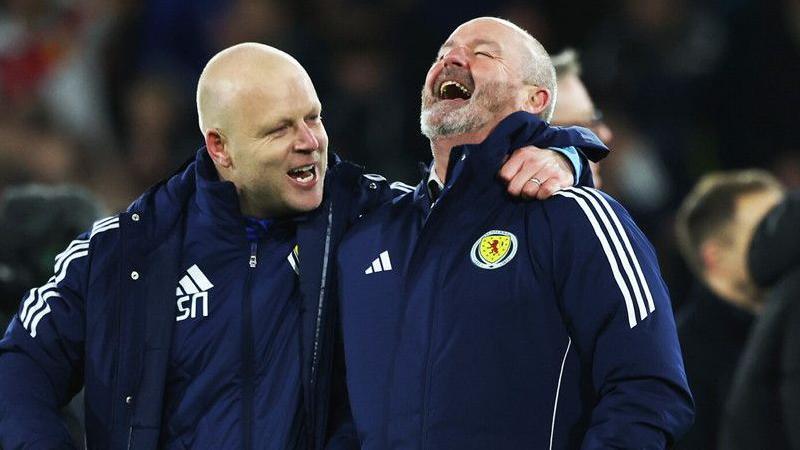
"I think after the Denmark game was one of the rare times I've seen him properly smiling and enjoy himself a little bit, which was cool to see," Christie said.
Clarke showed his softer side after Scotland defeated Denmark to reach the World Cup
Loyalty brings rewards for Scotland
When Clarke assumed the Scotland manager role in 2019, the national team had secured a Nations League play-off route to Euro 2020 but still seemed distant from ending their major tournament drought.
A 3-0 defeat in Kazakhstan during Euro 2020 qualifying led to Alex McLeish's departure, and Clarke was tasked with revitalizing a squad burdened by past failures.
From the outset, Clarke believed in forming a core group, allowing them to develop together and accumulate the experience necessary to compete for major tournament qualification.
Captain Andy Robertson, John McGinn, Scott McTominay, Kenny McLean, John Souttar, and Scott McKenna were all part of Clarke's initial 2019 squad and remain in the World Cup group. Only Souttar, due to injury, has fewer than 50 caps.
Other key players include Grant Hanley, Kieran Tierney, Che Adams, Ryan Christie, Billy Gilmour, and Lyndon Dykes. Clarke has consistently backed players despite form dips or injuries.
Both supporters and critics of Clarke frequently mention his loyalty. Critics see it as stubbornness toward certain players, while supporters view it as a core aspect of his character.
"Sometimes, I get criticised for not going outside that core group but I believe in them a lot and they've delivered a lot for their country," he said.
Clarke's playing career involved just two clubs. After five years at St Mirren, he made 421 appearances for Chelsea, winning the FA Cup and European Cup Winners' Cup in the 1990s.
Long-term relationships and stability have always been important to him. His seven years as Scotland manager have demonstrated the value of investing in the same group.
History beckons for Clarke
Former Scotland assistant coach Steven Reid, who worked with Clarke at Reading, once recounted how Clarke adjusted a cone by mere inches during a training drill.
Many who have observed Clarke on the training ground remark on his attention to detail. Clarke himself says he is most content when delivering training sessions.
Before managing, Clarke served as a coach under Jose Mourinho, Kenny Dalglish, and Ruud Gullit, making his managerial debut with West Brom at age 48.
Dicker described Clarke's coaching at Kilmarnock as leaving "no grey areas" for the squad.
Clarke's ability to unify a squad with clear instructions has been a hallmark of his management, despite occasional criticism of his conservative tactics.
Criticism peaked after Scotland failed to advance from their Euro 2024 group, losing to Hungary in their final group match without registering a shot on target.
Scotland has yet to win a match at their two previous major tournaments.
The announcement of a four-year contract extension on the eve of the World Cup received mixed reactions; some preferred to wait until after the tournament in the United States. However, the players clearly supported Clarke's continuation.
Clarke rejects claims of inflexibility. Given his regular formation changes and gradual squad evolution, his adaptability is evident.
When faced with setbacks, he has devised solutions, possibly during his favored fly fishing trips.
For example, Scott McTominay transitioned from centre-back to goal-scoring midfielder under Clarke before excelling in similar roles at Manchester United and Napoli.
Another instance is the inclusion of winger Ben Gannon-Doak, whose limited experience did not prevent him from becoming a key player in Scotland's 2024 Nations League campaign. The Bournemouth youngster has been instrumental since.
"I think I've shown consistently throughout my time that I'm prepared to try something different," Clarke told BBC Scotland.
Clarke has adopted a more relaxed approach leading up to the World Cup, citing lessons learned from the disappointing European Championships.
He will need to apply his coaching expertise, interpersonal skills, and experience to become the first Scotland manager to lead the team to the knockout stage of a major tournament.
As Clarke embarks on the next chapter of his career, such an achievement would be an ideal start.
- World Cup fixtures and group standings
- How to watch the World Cup on the BBC
- Everything you need to know about the World Cup


