

Set-Piece Goals Lead Arsenal in Premier League
Arsenal have scored 14 goals from set-pieces this season, the highest tally in the Premier League. In contrast, Manchester City have only managed one goal from set-pieces, the lowest among all Premier League teams.
Overall, nearly 18% of Premier League goals this season have originated from corners, marking the highest proportion in a decade and a 6% increase compared to last season.
Multiple factors contribute to this rise, including the types of players recruited, the involvement of set-piece analysts, and less stringent officiating, all of which have shifted corner-kick advantages towards attacking teams.
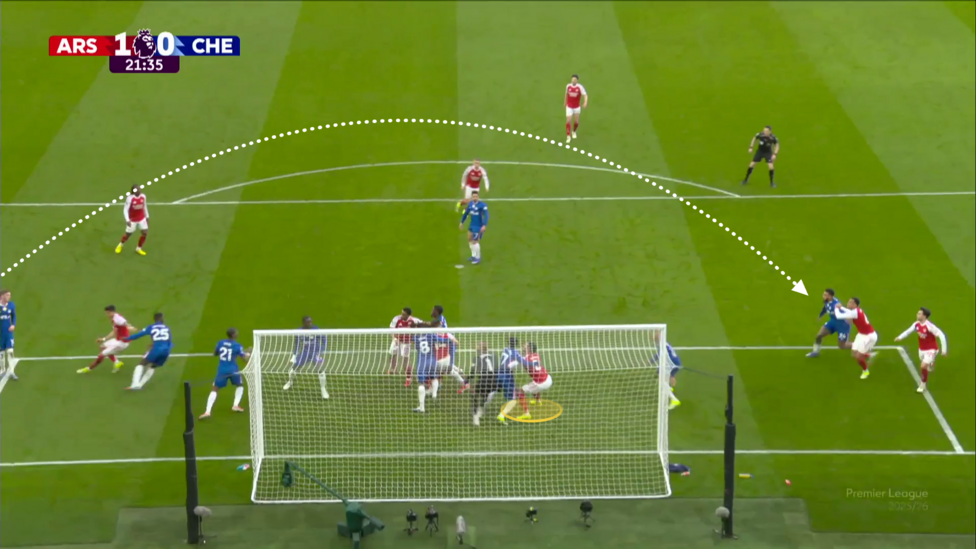
To examine the evolving trends and tactics, Arsenal's opening goal against Chelsea in their 2-1 Premier League victory earlier this month serves as an illustrative case study.
How can football's governing bodies address the complexities arising from corner-kick situations?
Are set-pieces 'ugly' or 'beautiful'? They continue to be decisive for Arsenal.
Predicting Defensive Set-Ups Is Key to Corner Success
Because set-plays are inherently predictable, teams can prepare specific routines designed to exploit typical defensive arrangements.
Occasionally, the defending team may implement an unusual tactic during corners, disrupting the attacking side's preparation.
For example, in the Carabao Cup semi-final second leg between Arsenal and Chelsea in February, Chelsea advanced three players to the halfway line when defending a corner.
As a result, Arsenal retreated players, diminishing their usual effectiveness from corners.
As Arsenal prepared to attack a corner, three Chelsea players made sudden runs to the halfway line (yellow), confusing Arsenal, who had five players positioned outside the box.
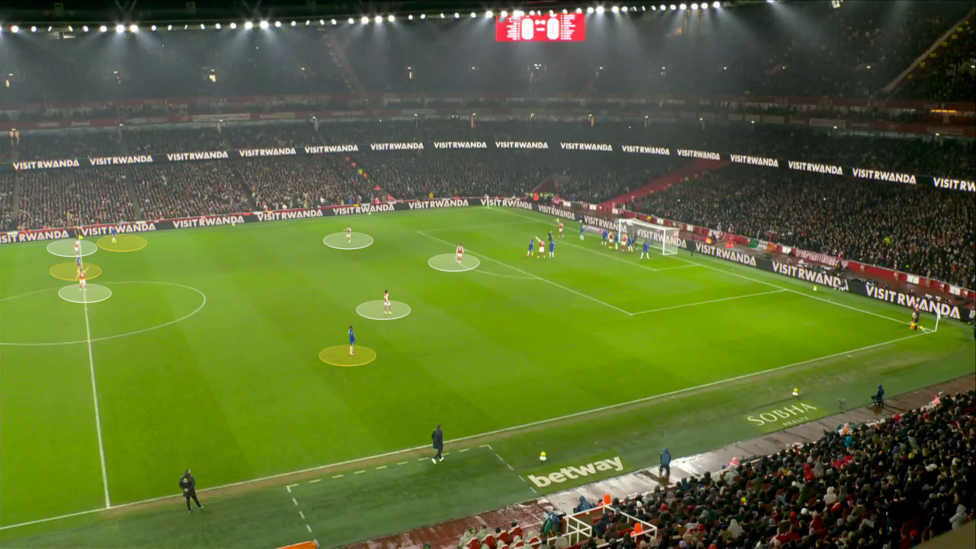
In their recent Premier League encounter, Arsenal adapted by positioning three players at the edge of the box, employing a routine that did not require all nine outfield players (excluding the corner taker).
If Chelsea had again pushed three players forward, Arsenal's routine would have remained effective, as the three players at the edge of the box could track back.
However, Chelsea did not advance players in this manner during the game.
Consequently, Arsenal's six players nearer to goal executed their routine successfully, scoring while the three players behind remained uninvolved.
This example highlights the dynamic nature of set-piece routines, with attacking teams adjusting to defensive modifications weekly and vice versa.
Arsenal's set-up against Chelsea in their subsequent match was prepared for any sudden movements upfield.
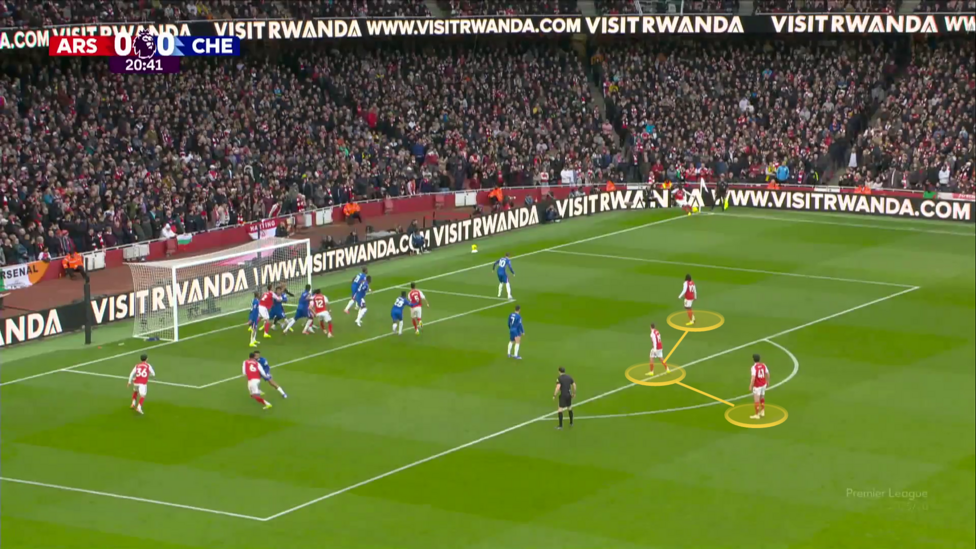
Recognising Zonal and Man-Marking Defensive Set-Ups
During their Premier League defeat to Arsenal, Chelsea employed a hybrid defensive system with five players defending zonally: Jorrel Hato and Trevoh Chalobah at the near post, Cole Palmer on the near side of the six-yard box, Pedro Neto on the penalty spot, and Joao Pedro at the back of the goalmouth. The remaining five defenders man-marked Arsenal's key attacking threats.
This defensive arrangement would have been studied by Nicolas Jover, Arsenal's set-piece coach, to develop an attacking strategy.
Zonal defenders maintain their positions rather than tracking individual players, aiming to protect critical areas within the box.
The near post is a frequent target for attackers attempting to flick the ball on, while the penalty spot is often where teams, including Arsenal, position players to make the first contact on the ball.
Predicting defensive player positions enables attacking teams to design routines that exploit available space.
With three Chelsea players stationed at the near post, Arsenal anticipated fewer defenders at the back post.
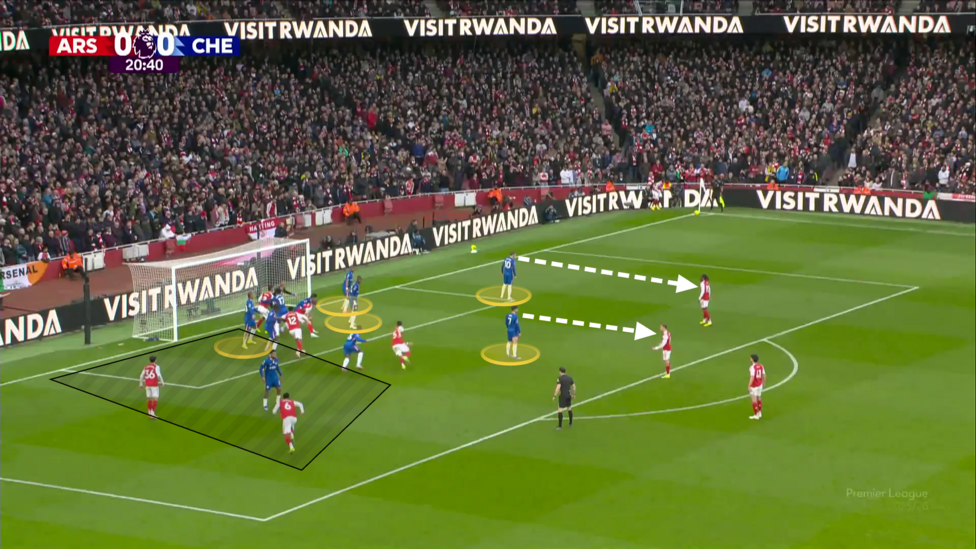
Highlighted are Chelsea's five zonal defenders, with Palmer and Neto monitoring Chelsea's wingers. This set-up leaves the back post under-manned.
Blockers and Creating Space
Arsenal's fullbacks, Piero Hincapie and Jurrien Timber, initially positioned themselves deep near the back post, closely marked by Mamadou Sarr and Moises Caicedo.
Chelsea's defenders acted as 'blockers'—a common tactic aimed at neutralising the strongest aerial threats by restricting their movement.
However, Chelsea's blocking was ineffective against Arsenal's fullbacks.
A key trend this season is exploiting man-marking through movement and creating space. Both Hincapie and Timber executed sharp sideways movements before attacking the near post, freeing themselves from their markers.
This movement drew Chelsea defenders away from the back post.
Chelsea's blockers intended to prevent Arsenal's fullbacks from reaching the near post, but the initial sideways movements allowed them to break free.
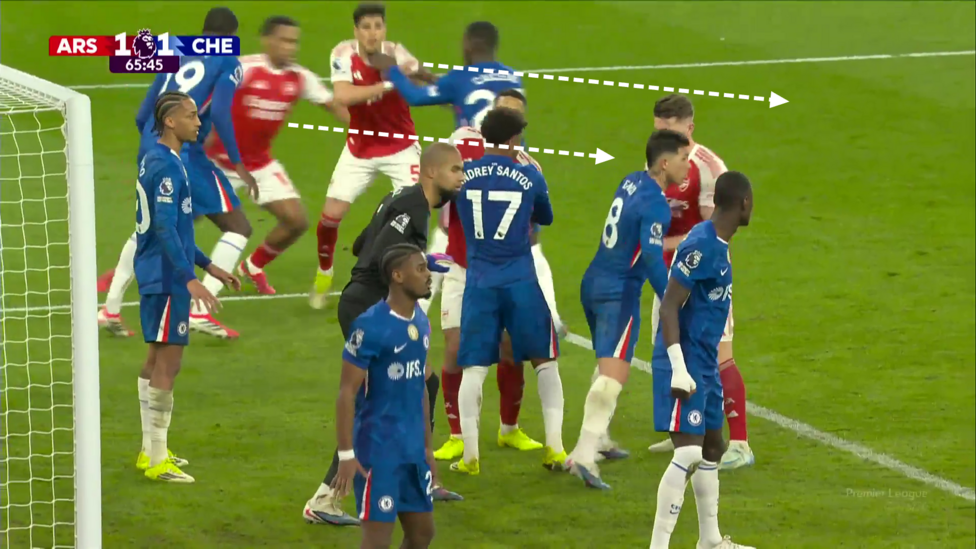
Blocking tactics also benefit attackers positioned centrally. William Saliba, man-marked by Andrey Santos, used his marker as a shield to push into goalkeeper Robert Sanchez, limiting the keeper's ability to claim crosses.
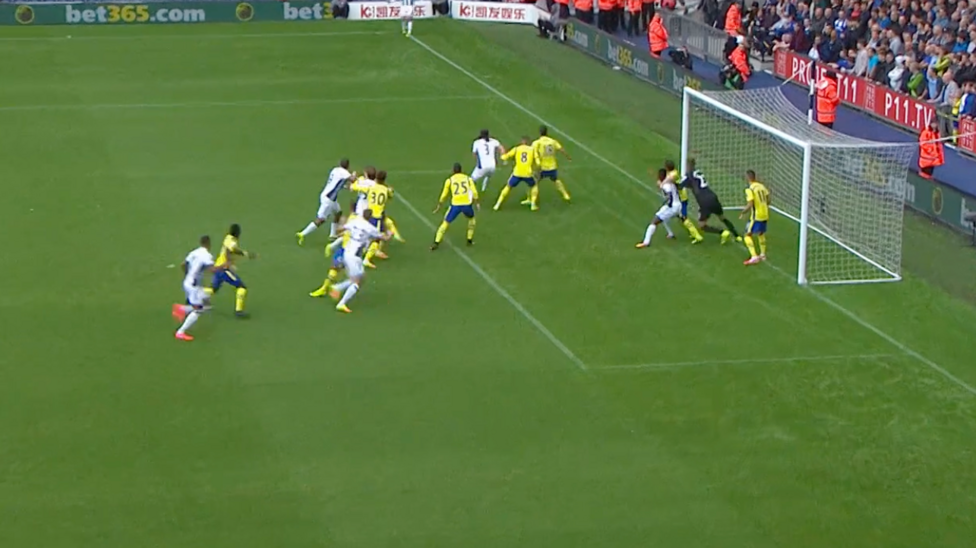
This blocking method has been effective in set-pieces for several seasons. For instance, Tony Pulis' West Bromwich Albion side, which previously held the record for most set-piece goals in a season until Arsenal surpassed it this campaign, employed similar blocking strategies.
Saliba's positioning here restricts Sanchez and Santos from effectively defending the back post.
In 2016-17, Tony Pulis' West Brom scored by attacking the back post, using a player to push an Everton defender into his own goalkeeper, preventing the keeper from coming out.
Inswinging Corners Dominate
Bukayo Saka's left-footed delivery for Arsenal's opening goal was an inswinger, a deliberate tactical choice used frequently by Arsenal this season.
Inswinging corners have become the predominant delivery type across the Premier League.
These corners curve towards the goal, and with physical play permitted and the six-yard box densely packed, goalkeepers find it more difficult to claim the ball.
Liverpool's improvement in set-piece effectiveness since the start of the year exemplifies this trend.
Initially one of the league's poorest set-piece teams, Liverpool enhanced their performance after changing their set-piece analyst and replacing Dominik Szoboszlai's outswinging corner routine with Mohamed Salah's inswingers.
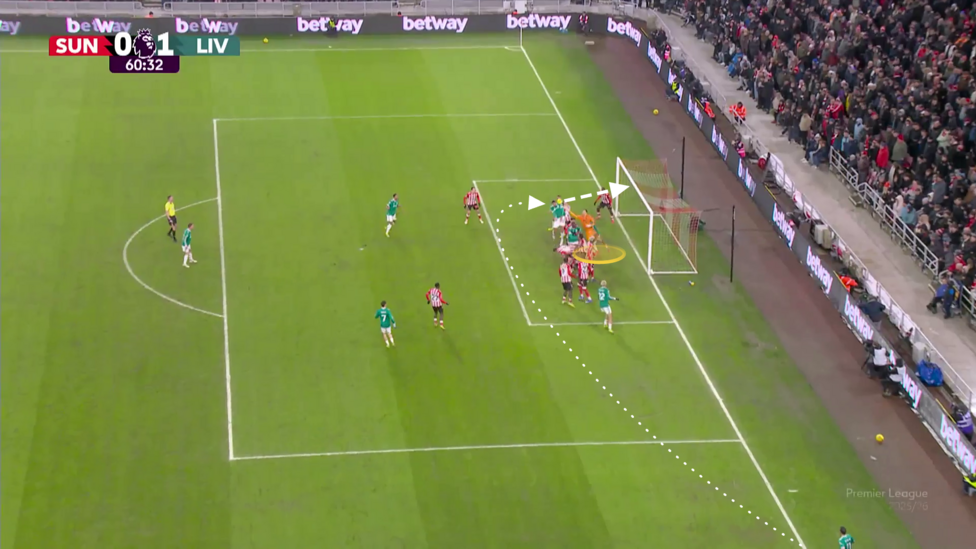
Liverpool's winning goal against Sunderland demonstrates multiple trends: the inswinging corner, a crowded six-yard box, and the goalkeeper's inability to claim the ball.
How Arsenal's Tactics Combined Against Chelsea
For Arsenal's opening goal, the inswinging corner was targeted not at the crowded near post but deeper, aiming for Gabriel, who made a rapid run from a deep starting position.
This approach provided Gabriel with momentum, making him difficult to stop despite Reece James' efforts to block his run from a relatively static position.
The decision to direct the ball deeper and have Gabriel head it back rather than towards goal likely aimed to reduce the effectiveness of Joao Pedro's zonal defending, as Pedro occupied the usual target area for first contact.
Although Pedro is a capable dueller, he was caught watching the ball, a common issue for zonal markers.
"The problem with zonal marking is that you need awareness constantly. You have to know where the ball is but also who is likely to attack your zone and when they're going to be arriving," said Stuart Reid, a freelance set-piece consultant with experience in Serie A, Major League Soccer, and the Championship.
Declan Rice, defending zonally, continuously rotated his head to anticipate attackers targeting his zone. In one instance, he stepped out slightly and won the first contact, clearing the ball.

Meanwhile, Saliba and Victor Gyokeres positioned themselves between their markers and the target zone.
As the cross arrived, Chelsea's defenders were unable to retreat because both players obstructed their path.
This tactic—playing over defenders who become blocked—is another highly effective trend across the league.
By the time Gabriel headed the ball back across the goal, Sanchez was unbalanced due to his duel with Saliba and Santos, allowing Arsenal's two central defenders to complete the scoring move.
Advancing the Limits of Set-Piece Play
While many of these concepts are not new, they are now being pushed to their limits in terms of resources devoted and what is legally permissible.
Every major club employs a dedicated set-piece analyst, and routines are designed using advanced aerial duel metrics that assign each player a probability rating based on the quality of opponents they win headers against.
This data assists teams in identifying which defenders are most critical to neutralise using blockers.
Perhaps the most significant change is the league-wide emphasis on set-plays.
Historically, smaller clubs used corner kicks to bridge the gap against wealthier teams.
Examples include the Stoke City, West Bromwich Albion, and Bolton Wanderers teams managed by Tony Pulis and Sam Allardyce, who maximised set-piece effectiveness.
Brentford also hired specialist coaches to optimise set-piece advantages earlier than many other clubs.
Nicolas Jover, who worked at Brentford before moving to Manchester City and now Arsenal, exemplifies this trend.
It is notable that Mikel Arteta, Arsenal's current manager, once played under Arsene Wenger, who publicly criticised Stoke for employing 'rugby'-style set-piece tactics.
However, Arteta and many top coaches now use set-pieces to gain a necessary mathematical advantage in top-table competition.
This analysis was developed through discussions with Stuart Reid, freelance set-piece consultant.


