

Goalkeeper Tactical Timeouts to Be Banned at World Cup
Fifa will prohibit players from leaving the field to consult coaches during goalkeeper injuries at the 2026 World Cup, according to Fifa referees' chief Pierluigi Collina. This move aims to prevent coaches from exploiting goalkeeper injuries as an opportunity for tactical timeouts.
The International Football Association Board (Ifab) has also approved a change to the video assistant referee (VAR) protocol, allowing reviews of attacking fouls occurring before the ball is in play.
The so-called 'goalkeeper tactical time-out' has attracted attention in recent years. Managers have used it to provide new instructions to players or disrupt the opposition's momentum. In November, Leeds United manager Daniel Farke accused Manchester City goalkeeper Gianluigi Donnarumma of feigning injury to "bend the rules" and interrupt play.
Typically, the goalkeeper sits on the turf and signals for the physio, prompting players to rush to the technical area for a team talk. Once the coach has given instructions, the goalkeeper resumes play.
Ifab has examined the issue but has not agreed on a law change. Instead, leagues have been invited to conduct trials during the 2026-27 season to find a solution.
Earlier this year, the National Women's Soccer League (NWSL) in the United States introduced a temporary measure requiring players of both teams to remain where they are or gather in the centre circle if a goalkeeper is injured.
Players Leaving Field for Team Talk Considered Problematic
Fifa will adopt a similar approach to the NWSL by preventing players from approaching the touchline during goalkeeper injuries. However, this addresses only part of the issue, as the tactic can still be used to disrupt the opposition's momentum.
"We had a workshop with all the coaches of all the 48 teams and we told them that referees will be proactive," Collina said.
"They will not allow the two teams to go to the benches when a goalkeeper is lying on the ground injured.
"The goalkeeper has the right to be injured, but the players do not have the right to leave the field of play to have a sort of timeout with their respective coaches."
The effectiveness of this measure at the World Cup remains uncertain, especially since there will be a three-minute hydration break in each half, providing a natural timeout for coaches.
Referees will enforce the rule, but Collina stated that no yellow cards or disciplinary actions will be issued to players who attempt to approach their coaches.
"It's quite weird that there really is only the referee, the physio and the goalkeeper on the field play," Collina added.
"All the other players leave the pitch, and it is not good."
No Goalkeeper Tactical Timeouts & VAR Checks for Corners
Under Collina's proposals, VAR will be permitted to disallow goals scored following attacking fouls committed before the ball is in play.

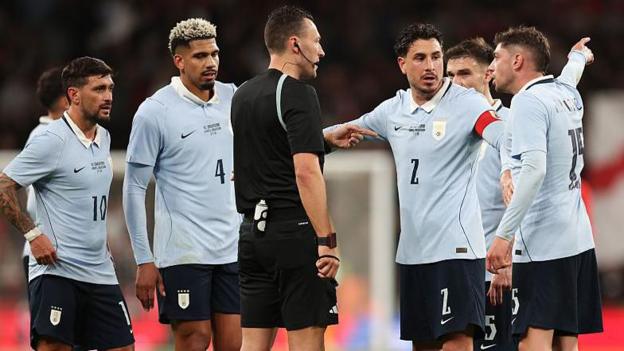
Collina requested an update to the VAR protocol to allow intervention in such cases. This change was prompted by incidents like the goal scored by England during their 1-1 draw against Uruguay at Wembley in March.
During that match, Cole Palmer delivered a corner, but before the ball was kicked, Adam Wharton blocked Jose Maria Gimenez's run. This interference allowed the ball to reach Harvey Barnes, whose shot was saved by Fernando Muslera, before Ben White scored from close range.
Previously, VAR could not review fouls occurring before a set-piece was taken. However, Ifab has now accepted the request to permit reviews of any foul that directly impacts a goal and occurs before the set-piece, including penalties or disciplinary sanctions.
This protocol will be applied at the World Cup and reassessed afterward.
"We think this is very unfair, that the goal is given when the defender is prevented from being able to defend," Collina said.
"A clear, illegal block made by an attacker. The only objective was to prevent the defender from being able to defend on his opponent.
"We are very confident to receive a clarification from the Ifab before the World Cup, saying that the VAR can intervene just before the ball is in play. We are convinced that nobody can object."
This rule applies only to attacking fouls and not to defensive fouls such as holding or pulling.
Collina also explained a new rule regarding players covering their mouths with a hand, arm, or shirt during confrontations with opponents. This action will now result in a red card, following a controversial incident involving Benfica winger Gianluca Prestianni and Real Madrid's Vinicius Jr in a Champions League match in February. Prestianni received a six-game ban from UEFA for homophobic conduct.
"If the conversation is friendly, they can continue to do it without any problem," Collina said.
"When the conversation is confrontational, covering the mouth means that you are doing something very wrong, potentially, and the sanction is the red card."
Collina added that referees will be prepared to monitor grappling inside the penalty area, with officials provided data on teams' tactical approaches.
Law Changes for the World Cup
The 2026 World Cup will feature numerous law changes aimed at eliminating tactics that slow the tempo of play and waste time.
Collina hopes these changes will reduce stoppage time compared to the 2022 World Cup, although the three-minute hydration breaks per half are guaranteed.
- Throw-in countdown (five seconds): If a player deliberately delays restarting play, the throw-in can be awarded to the opposition.
- Goal-kick countdown (five seconds): Deliberate time-wasting can result in a corner being awarded to the opposing team.
- Time-limited substitutions (10 seconds): Substituted players must leave the field within 10 seconds at the nearest point. Failure to do so results in the substitute being barred from entering for one minute, and the team must continue with 10 players.
- Off-field treatment (one minute): Players receiving treatment must remain off the field for 60 seconds, with exceptions for goalkeepers, injuries, or if the opponent is booked or sent off.
- Players covering their mouths: Covering the mouth during confrontations may lead to a red card.
Additional VAR protocol updates include:
- Corners can be reviewed quickly before the restart to confirm correct awarding; this does not apply to wrongly awarded goal-kicks.
- Second yellow cards leading to a sending-off can be reviewed; however, potential second yellows will not be reviewed.
For further information, see World Cup fixtures and group standings, how to watch the World Cup on the BBC, and comprehensive World Cup coverage.


