

Eileen Gu's Olympic Success and Global Fame
Eileen Gu has secured two silver medals at the 2026 Winter Olympics to date.
Wherever she competes, Eileen Gu attracts a devoted fanbase and extensive media coverage.
With six Olympic medals, including three golds—the latest earned in Sunday's halfpipe event—she holds the record as the most decorated freestyle skier in Olympic history.
At 22 years old, Gu is not only a leading athlete but also a global icon with significant financial success.
China embraced Gu as its 'snow princess' during the Beijing 2022 Olympics, where she was the face of the Games and delivered outstanding performances.
At 18, she became the youngest Olympic champion in freestyle skiing by winning gold in both big air and halfpipe, and she was the first athlete to win three medals in freestyle skiing at a single Games after earning a silver in slopestyle.
Later in 2022, Time magazine named her one of the 100 most influential people worldwide.
"I just like being the best. I've always wanted to do that,"Gu said at the Milan-Cortina Olympics, where she earned silver medals in big air and slopestyle earlier in the competition.
"I wanted to be the best at math when I was in kindergarten, and then I wanted to get into the best high school, and I wanted to have the highest SAT score, and then I wanted to get to the best college, and I wanted to be the best skier I could be.
Then I wanted to do every event, and then I wanted to win them all. When you get a taste of it, it's kind of addictive."
The Two Chinese-American Olympians Representing Rival Nations
Gu excels both on and off the slopes.
Born and raised in California to an American father and Chinese mother, she attended private school in San Francisco and is currently on a sabbatical from Stanford University, where she majors in international relations and has previously studied quantum physics.
Fluent in Mandarin, Gu spent summers in Beijing during her childhood.
"Sometimes it feels like I'm carrying the weight of two countries on my shoulders,"Gu remarked during the 2026 Games.
In 2019, at age 15, she changed her sporting allegiance from the United States to China, aiming to inspire millions of young people in Beijing, her mother's birthplace, ahead of the 2022 Olympics.
This decision also proved financially beneficial.
Forbes ranked Gu as the fourth-highest paid female athlete in 2025, trailing only tennis players Coco Gauff, Aryna Sabalenka, and Iga Swiatek.
Unlike those athletes, only a small portion of Gu's $23.1 million (£17.1 million) income in 2025 came from prize money—approximately $100,000 (£74,000).
Her earnings primarily stem from endorsements with brands such as Red Bull, Porsche, and Tiffany & Co. She has also modeled for Louis Vuitton and Victoria's Secret and is represented by IMG modeling agency.
In 2025, the Wall Street Journal reported that Gu and another athlete were to receive a combined $6.6 million (£4.9 million) from the Beijing Municipal Sports Bureau, totaling nearly $14 million (£10.4 million) over three years.
However, Gu's choice to compete for China has attracted criticism, not only due to the geopolitical rivalry between China and the US but also because of concerns about China's human rights record under its Communist Party government, which China denies.
Although initial controversy subsided, it resurfaced during the 2026 Games.
At the start of the Olympics, American freestyle skier Hunter Hess spoke out about the United States Immigration and Customs Enforcement (ICE) agency and ongoing tensions in the US.
In January, intensive care nurse Alex Pretti and Minnesota resident Renee Good were killed by ICE agents, sparking protests.
When asked about representing the USA, Hess said:
"It's a little hard. Just because I'm wearing the flag doesn't mean I represent everything that's going on in the US."
Former President Donald Trump responded by calling Hess a "real loser," and Gu was among several athletes who publicly supported Hess and others speaking out.
"As someone who's been caught in the crossfire before, I feel sorry for the athletes,"Gu stated.
Her critics, however, were angered by her willingness to criticize Trump but not China.
Former NBA player Enes Kanter Freedom labeled her a "traitor," stating she "was born in America, raised in America, lives in America and chose to compete against her own country for the worst human rights abuser on the planet - China."
He added on X (formerly Twitter):

"You don't get to enjoy the freedoms of US citizenship while acting as a global PR asset for the Chinese Communist Party."
When asked about China's human rights record in a January interview with Time magazine, Gu responded:
"I'm not an expert on this. I haven't done the research. I don't think it's my business."
A 'Ridiculous Perspective' and 'Disappointing Decisions'
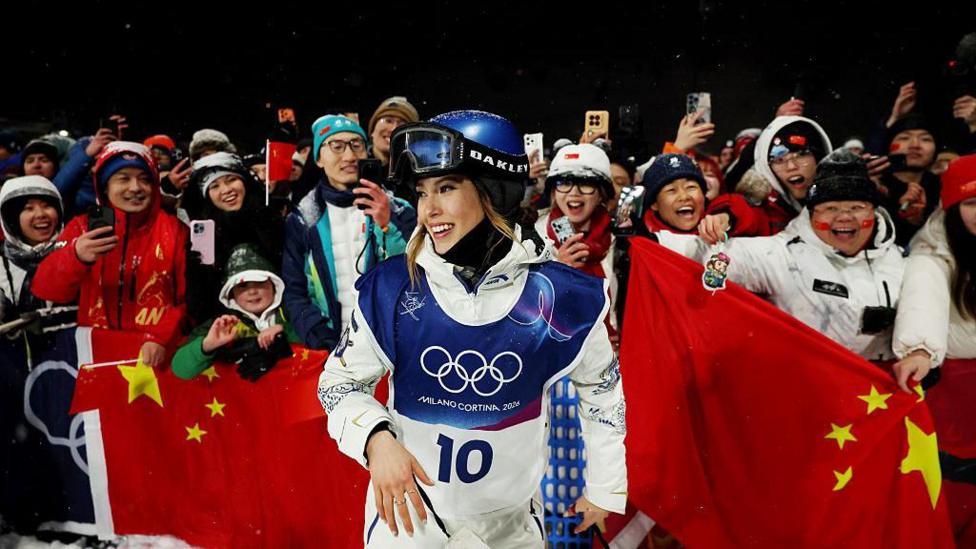
Gu has 2.6 million Instagram followers and 11.7 million likes on TikTok. At the Livigno Snow Park in the Italian Alps, she attracts the largest fan attendance of any athlete.
Wearing China's red colors, fans fill the front rows, waving flags with Gu's image and cheering her runs as if she had won gold.
After every run, Gu consults her mother, Yan, to review video footage on her phone. Yan, reportedly a successful venture capitalist who raised Gu as a single parent, is accredited at the Games and is the first person Gu celebrates with.
During the big air final on Monday, Yan was seen watching alongside former International Olympic Committee president Thomas Bach.
Gu is highly sought after by media after competitions and responds politely as she moves through the mixed zone.
However, comments she made during a press conference earlier in the week went viral when asked if her two silver medals felt like two lost golds.
"I'm the most decorated female freeskier in history. I think that's an answer in and of itself,"she replied.
"How do I say this? Winning a medal at the Olympics is a life-changing experience for every athlete. Doing it five times is exponentially harder because every medal is equally hard for me but everybody else's expectations rise, right?
So the two medals lost situation, to be quite frank with you, I think is kind of a ridiculous perspective to take.
I'm showcasing my best skiing, I'm doing things that quite literally have never been done before so I think that is more than good enough. But thank you."
"Ridiculous perspective to take" - China's Gu laughs off reporter's question
Before the Games, Gu gave interviews to Vogue and Time magazine, but reports from Swiss media had the potential to intensify competition at the top level.
It was reported that Mathilde Gremaud's coach left the Swiss team to join Gu's team just before the Games, repeating a similar move from four years earlier before Beijing 2022.
At those Games, Gremaud won slopestyle gold, narrowly beating Gu, who won big air gold while Gremaud took bronze.
This time, Gremaud again won slopestyle gold, with Gu taking silver. Gremaud withdrew from the big air after a crash, and Gu finished second.
Before the big air final, Gu used Instagram to highlight a scheduling conflict that forced her to miss a full day of halfpipe training as the only woman competing in three freeski events.
She appealed to the International Ski and Snowboard Federation (FIS) for additional training but was denied.
"This decision is disappointing to me because it seems to contradict the spirit of the Games,"Gu said.
"Daring to be the only woman to compete in three events should not be penalised. Making finals in one event should not disadvantage me in another."
understands Gu was already selected as one of 10 athletes invited to a halfpipe testing training session and had three official training sessions, more than the usual two before World Cups.
FIS stated to :
"For athletes who choose to compete in multiple disciplines and/or multiple events, conflicts can sometimes be inevitable."
Gu brought 21 pairs of skis to Livigno—seven per event—compared to the usual two or three pairs she takes to competitions.
She qualified fifth for the halfpipe final, which was postponed from Saturday to Sunday due to heavy snowfall. Her first run included a crash on her initial trick.
Gu recovered on her second run with a score of 94.00, moving to first place, and improved to 94.75 on her final run to defend her title.
Fellow Chinese athlete Li Fanghui won silver, and Great Britain's Zoe Atkin earned bronze.
"I am not a gambling woman, but if I were, I took a pretty big bet on myself,"Gu said.
"There was a chance that everything could go wrong, and I would walk away with nothing because I'm trying to do too much. But in my head I was like, 'Even if everything crashes and burns, I tried, and I will never regret trying'.
It's not being afraid to try, especially as young women too, because a lot of the time we get in our own way and there's this sense of, 'What if people laugh at me? What if I look stupid? What if it's not possible?'.
It's trusting yourself to try, and if it doesn't work, that's OK. But who knows? Shoot for the stars."
Additional Information
For a day-by-day guide to the Winter Olympics, including full schedules and medal event times, viewers can consult official sources.
Winter Olympics 2026 medal tables and live streams are available on BBC (UK only), with updates on BBC Radio 5 Live and live text commentary and video highlights on the website and app.


