Australia’s Commanding Performance at Lord’s
The final at Lord’s transformed into a display dominated by Australia, yet the Women’s T20 World Cup has been widely regarded as a significant success.
As Australia completed their power play, the atmosphere was tinged with melancholy, underscored by Adele’s somber melodies echoing through Lord’s. Phoebe Litchfield and Beth Mooney calmly enjoyed their drinks while the scoreboard showed 62 for one. Just the day before, the mood had been one of celebration and optimism.
English cricket had aspired to emulate the successes of the Red Roses and the Lionesses in 2025. The preparations were nearly flawless, but the opposition, ruthless and unyielding, won the toss and elected to bat, setting the tone for the match.
The Australian players, clad in dark green, moved across the lime-striped London grass with assuredness, as if it were their own territory. Their agile movements, synchronized ponytails, and energetic fielding were a testament to their dominance. Even their shadows seemed to conform beneath their sharp boots.
England’s Struggles Under Pressure
England had advanced to the final undefeated but largely untested, aware that the challenge ahead would be formidable. Early in the innings, Amy Jones edged a ball to fine leg, and Litchfield and Georgia Wareham chased it down with urgency, diving to stop the boundary. Though the ball reached the boundary, the effort symbolized Australia’s aggressive intent.
England appeared tense and cautious during the early overs, caught between building momentum and playing conservatively. The crowd shared this nervousness, burdened by history. England had secured the trophy once before, in 2009, when current coach Charlotte Edwards was a young captain. Australia, however, were experienced champions, having won in 2010, 2012, 2014, 2018, 2020, and 2023. In T20 World Cup finals between the two nations, Australia held a 3-0 record. As England’s innings progressed slowly, the crowd seemed uncertain about how to respond, doubting the likelihood of a successful chase.
Strong Support and Atmosphere at Lord’s
At noon, three and a half hours before the match began, queues formed outside the Rachael Heyhoe Flint gate, and importantly for the MCC, many members gathered outside the Grace Gates. In contrast to 2017, when the pavilion was sparsely occupied during Anya Shrubsole’s remarkable performance at the same venue, this time MCC chief executive Robert Lawson had issued a firm reminder to members to attend.
The pavilion’s rose pink walls were filled with members and guests enjoying a relaxed dress code. Earlier, the ECB hosted a brunch for the women’s Afghan refugee team in the Long Room, featuring warm remarks from Richard Thompson, selfies with Jay Shah, and assurances that the Afghan women would have opportunities to engage with influential figures.

Outside, the stands were packed. The final attendance was 28,887, including a group of 14 New Zealand women embracing five former White Ferns. While the fudge stall was busy, fans’ primary focus was on the players. A dedicated group, held back by stewards, applauded England’s team as they arrived in matching black jackets, entering the pavilion. Elsewhere, spectators cheered as players returned from the nursery ground wearing mirrored sunglasses. Emotional moments occurred when captain Nat Sciver-Brunt appeared for the anthems holding her baby, Theo.
Match Outcome and Crowd Engagement
It became evident that, unlike the tense finals at Lord’s in 2017 and 2019, this match lacked suspense. Nonetheless, the good-natured crowd remained until the conclusion, erupting in a loud cheer when Mooney was dismissed for 64 with only 11 runs required, the outcome already decided.
Despite the concurrent World Cup taking place across the Atlantic, this tournament has steadily gained mainstream attention. Some of England’s women featured in Vogue, photographed in the Long Room wearing training gear. Residents of Ambridge managed to attend a World Cup game at Edgbaston despite logistical challenges, including a flat tire on their minibus. Women’s cricket commentators also appeared on the television program Bargain Hunt alongside Enid Bakewell.
The crowds have been excellent, particularly at Lord’s and The Oval, and England’s performance has markedly improved since the 16-0 defeat in the Ashes 18 months prior, when the team was described by Gideon Haigh as “probably the worst team ever to be gifted a Test match at the MCG.”
Following that difficult tour, there were widespread changes, leading to the Edwards revolution, which emphasized fitness tests, fielding drills, and rigorous training.
Progress and Perspectives on Women’s Cricket
England’s 50-over World Cup victory in 2017 was a landmark moment, marked by unprecedented attendance and enthusiasm. This final, however, represented a period of consolidation and adjustment.
“It was a full house in 2017 and it did feel like a seminal moment. It will feel slightly different, because it is quite normal for us now to have that crowd. This is pretty normal now.” – Heather Knight
Women’s cricket has evolved beyond needing patronizing support. Nevertheless, Australia’s victory means they will continue to hold the upper hand over England for the foreseeable future.
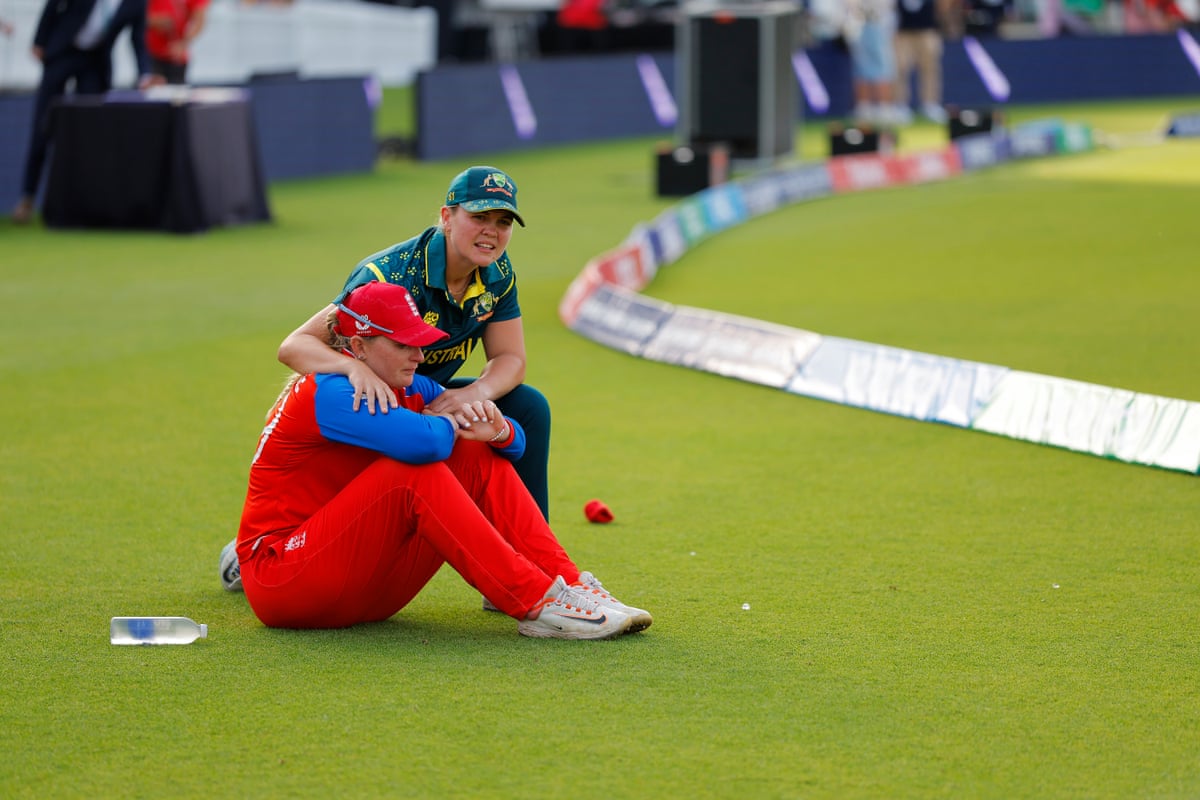
Sophie Ecclestone is consoled by Georgia Voll after England’s defeat. Photograph: Tom Jenkins/