

Robots Surpass Human Runners in Beijing Half-Marathon
Robots have advanced beyond traditional tasks such as shopping assistance, cooking, and cleaning to now competing—and winning—in half-marathons. In an unprecedented event on Sunday, humanoid robots crossed the finish line ahead of human runners for the first time during the 13-mile race in Beijing.
Unlike the exhausted human participants who collapsed after the race, some wrapped in silver foil blankets and visibly fatigued, the humanoid robots remained upright and unscathed. Observers noted that some robots appeared almost indifferent, exchanging looks as if to suggest, “Shall we go again?”
The winning robot, named Lightning and developed by Honor, a Chinese smartphone manufacturer, completed the half-marathon in 50 minutes and 26 seconds. This performance was announced via a WeChat post by the Beijing Economic-Technological Development Area, also known as E-Town, where the race began.
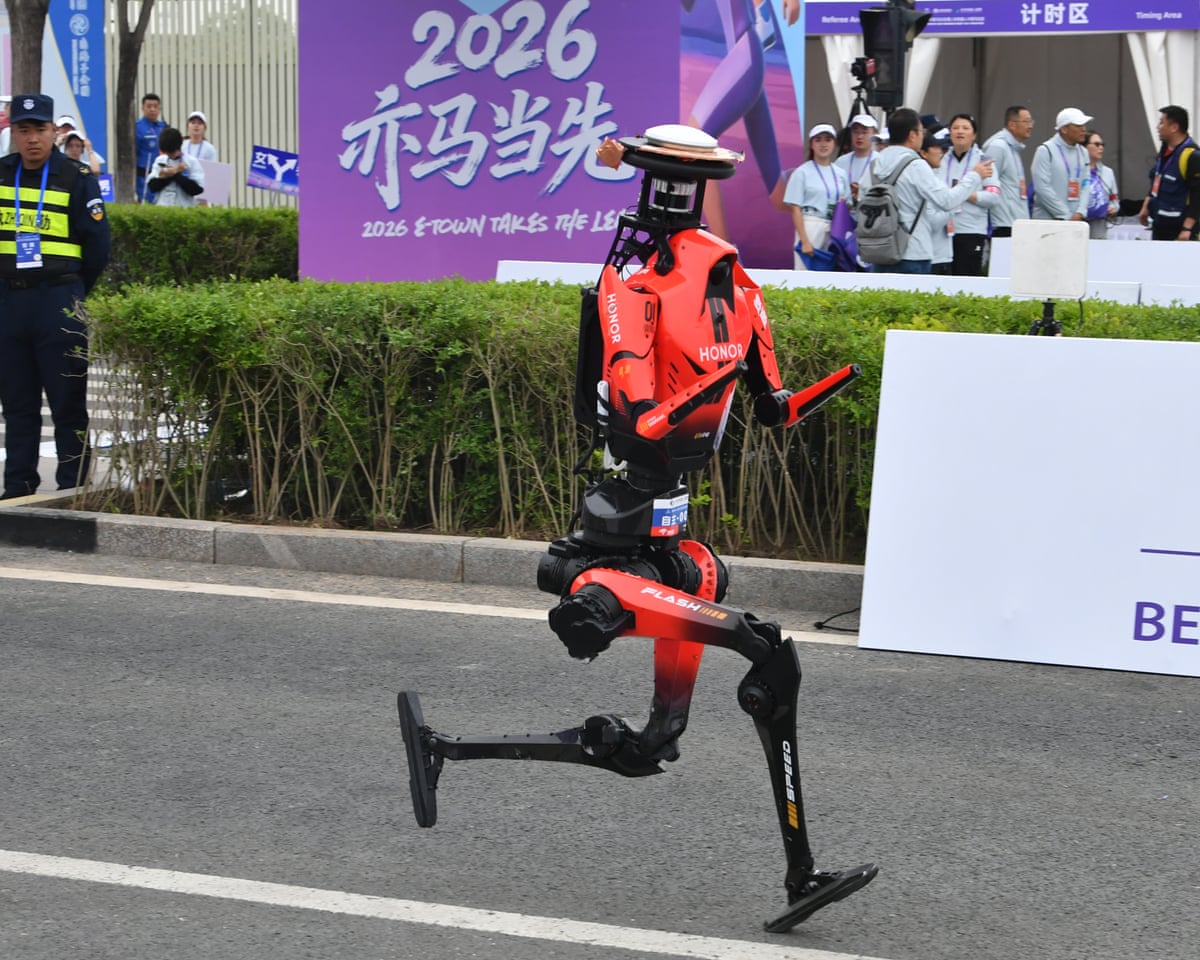
Lightning’s time was notably faster than the human world record for the half-marathon, held by Uganda’s Jacob Kiplimo, who completed the distance in approximately 57 minutes in March during a race in Lisbon.
This achievement marks a significant improvement compared to previous years. In the 2021 event, the winning humanoid robot finished in 2 hours, 40 minutes, and 42 seconds—more than twice the time of the human winner in the conventional race—and most robots failed to complete the course.
In this year’s race, several robots outpaced professional human athletes. Nearly half of the robots operated autonomously, without remote control guidance. To prevent collisions, the humanoid robots and the 12,000 human runners competed on parallel tracks.

Honor, a Huawei spin-off, secured all three podium positions with self-navigated robots that set new world record times.
Development and Technology Behind Lightning
Du Xiaodi, an engineer on the team behind Lightning, revealed that the robot had been under development for one year. The robot’s legs measure between 90 and 95 centimeters (35 to 37 inches) to emulate the stride length of elite human runners. Additionally, Lightning incorporates liquid cooling technology adapted from Honor’s smartphone products.
“Running faster may not seem meaningful at first, but it enables technology transfer, for example, into structural reliability and cooling, and eventually industrial applications,”
Du said, expressing confidence that humanoid robots would eventually transform multiple industries, including manufacturing.
Although widespread adoption of humanoid robots will require time, the event attracted considerable attention and impressed spectators.
Public Reaction and Future Implications
Sun Zhigang, who attended the race with his son and had been present the previous year, commented on the rapid progress.
“I feel enormous changes this year,”
Sun told the Associated Press.“It’s the first time robots have surpassed humans, and that’s something I never imagined.”
Wang Wen, attending with his family, observed that the robots appeared to dominate the event.
“The robots’ speed far exceeds that of humans,”
he said.“This may signal the arrival of sort of a new era.”
Human runners preparing for upcoming races may find the emergence of robot competitors disheartening. However, the robots’ performance was not without flaws; one robot fell at the starting line, and another collided with a barrier during the race.


