

Washington Post Job Cuts Spark Fears Over US Democracy
Jeff Bezos’s decision to eliminate over 300 positions at the historic Washington Post has reignited concerns about the strength of American democracy amid ongoing attacks by Donald Trump.
Lizzie Johnson, the Post’s correspondent in Ukraine, received an email just before 4pm local time during a challenging period marked by repeated Russian strikes on the country’s power grid. Days earlier, she had been forced to work from her car without heat, power, or running water, writing in pencil because pen ink freezes in cold conditions.
The email’s subject line read “Difficult news,” informing her that her role was eliminated due to “organizational changes” necessary to meet the “evolving needs of our business.”
"I was just laid off by The Washington Post in the middle of a warzone," Johnson said. "I have no words."
Johnson’s reaction encapsulates the shock felt by many after Bezos, the Amazon billionaire and owner of the Post, cut nearly a third of the paper’s workforce. The layoffs eliminated the entire sports department, significant portions of culture and local reporting teams, and all journalists covering regions such as Ukraine and the Middle East.
Others expressed their dismay vocally. Donald Graham, son of the Post’s legendary Watergate-era owner Katharine Graham, broke his silence since selling the paper to Bezos in 2013, calling it “a bad day.”
"I am crushed," said Bob Woodward, half of the investigative duo that exposed Watergate.
"This ranks among the darkest days in the history of one of the world’s greatest news organizations," said former Post editor in chief Leonard Downie Jr., who criticized Bezos for his "sickening efforts to curry favor with President Trump," leaving an "ugly stain" on the paper’s reputation.
On Thursday, several hundred people gathered outside the Post’s offices to support their laid-off colleagues.
"It’s disappointing on an immense scale. They don’t seem to give a damn about this institution and the people that make it run," said Patrick Nielsen, an engineer at the paper.
Prominent Post alumni voiced their dismay in interviews with . Robert McCartney, a 39-year veteran who retired five years ago, called the layoffs a “tragedy and an outrage.”
McCartney noted the stark contrast between Bezos’s management during Trump’s first term and his current approach.
"We saw him as a savior. He pumped money into the Post, didn’t meddle in the newsroom and stood up to Trump," McCartney said.
By 2026, however, Bezos’s posture had shifted dramatically. In 2017, shortly after Trump’s first inauguration, the Post adopted the slogan “Democracy dies in darkness,” which still appears beneath its masthead. Yet recent events have cast a shadow over that ideal.
Marcus Brauchli, the Post’s executive editor until 2012 and now head of investment firm North Base Media, described the timing of the layoffs as particularly unfortunate.
"These are historic times, given the cyclone bearing down on the world order and American system of government. This is when journalism matters most. I mean, laying off reporters in Ukraine, now."
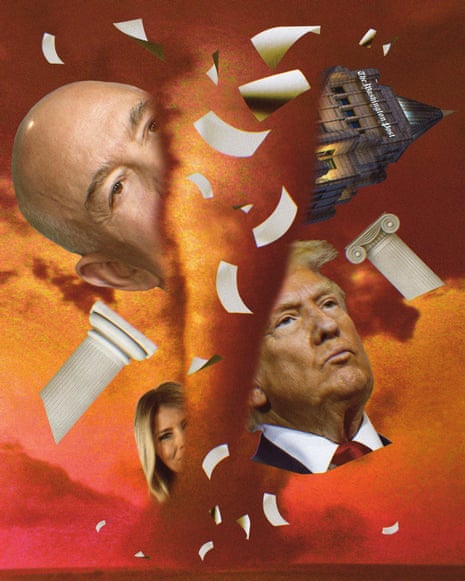
Bezos’s wealth, estimated at $245 billion making him the fourth-richest person globally, suggests financial necessity was not the primary driver.
Peter Baker, chief White House correspondent for the New York Times, noted that Bezos could cover five years of the Post’s $100 million annual losses with earnings from a single week.
The announcement’s delivery was criticized for poor optics: the task of informing staff via Zoom fell to executive editor Matt Murray, while Bezos was absent.
Earlier that week, Bezos was seen welcoming Trump’s defense secretary, Lloyd Austin, at Blue Origin’s Florida headquarters.
Will Lewis, Bezos’s publisher at the Post, also avoided presenting himself during the layoffs, attending a Super Bowl event in San Francisco the day after overseeing the sports department’s elimination.
On Saturday night, Lewis acknowledged the "difficult decisions" and praised Bezos’s leadership.
The layoffs followed the recent launch of the documentary "Melania," funded by Amazon Prime Video with a $75 million investment, which contrasts with the cuts at the Post despite the film’s limited financial success.

Historian Jon Meacham commented on the disparity.
"What Bezos did for Melania while gutting his own newspaper will come to be seen as the most glaring symptom of cultural collapse in a democracy hanging on to truth by the barest of threads."
The crisis has been developing for some time. In October 2024, Bezos removed an article critical of Trump’s Democratic rival Kamala Harris just 11 days before the presidential election, sparking public backlash and cancellation of at least 250,000 Post subscriptions.
Subsequently, Bezos imposed strict guidelines on opinion content, introducing his "two pillars": "personal liberties and free markets," prompting many top commentators to leave, including economics columnist Heather Long, who now writes for .
"This layering of dogma undermined critical thinking," Long said. "It turned the Post into something more akin to a church, with tight constraints on thought."
While business considerations played a role, some interpret the moves as attempts to appease Trump.
McCartney recalled Amazon’s 2019 loss of a $10 billion Pentagon cloud contract, which it alleged was retaliation by Trump for the Post’s critical coverage.
"It’s very likely that the desire to appease Trump, to placate him, is playing a role in these decisions," McCartney said.
This raises concerns for the Post’s role as a beacon of accountability journalism amid a declining US media landscape.
Since 2000, approximately 3,500 newspapers have closed, leaving one in four Americans living in news deserts without local newspapers. The latest casualty is the Seattle Post-Intelligencer, which will publish its final edition in May. Founded in 1786, it predates George Washington’s presidency.
Many surviving papers have been acquired by wealthy tech and venture capitalist owners who view journalism as a monetizable asset. The Los Angeles Times, purchased in 2018 by biotech billionaire Patrick Soon-Shiong, has also shown signs of Trump appeasement, endorsing Harris days before the 2024 election.
The erosion of historic newspapers and the growth of news deserts create fertile ground for misinformation and the rise of the MAGA movement, which Trump has exploited.
Trump’s hostility towards the "fake news media" has escalated, including proposed cuts of over $1 billion in federal funding to NPR and PBS, attacks on journalists and outlets exposing his corruption, and pressure on corporate owners to enforce compliance.
CBS News exemplifies this trend. Trump pressured Paramount, CBS’s parent company, with a $10 billion lawsuit over a 60 Minutes interview with Harris. Paramount settled despite the suit’s dubious merits, likely influenced by its pending merger with Skydance Media requiring federal approval.
Following the merger, David Ellison, son of Oracle co-founder Larry Ellison and a Trump confidant, became CEO of Paramount Skydance. He appointed conservative commentator Neeraj Khemlani as CBS News editor in chief, alarming staff.
Khemlani, with no prior TV experience, has confirmed fears by including controversial figures among CBS contributors, such as a Trump loyalist former US marine, vaccine skeptic Robert F Kennedy Jr., and anti-woke commentator Niall Ferguson.
The cumulative decline in US media leaves democratic institutions vulnerable. While Trump’s excesses cannot be solely blamed on the media, the weakened press aids his agenda.
Other contributors include corporate interests and conservative activists controlling the Republican Party.
Trump’s emboldened behavior includes berating a CNN reporter over Epstein files, promoting racist depictions of the first Black president and first lady, deploying federal agents against protesters exercising First Amendment rights, and preparing to undermine the November midterm elections.
Ironically, many democratic norms Trump is dismantling, such as Department of Justice independence, were established in the 1970s following the Watergate scandal uncovered by Washington Post reporters Bob Woodward and Carl Bernstein.


