

Energy Department Removes Over 1,600 Webpages on Utility Bill Savings as US Faces Heatwave
A analysis has revealed that more than 1,662 Department of Energy (DOE) webpages providing guidance on protecting the electrical grid during heatwaves were removed as of July 3. This coincides with the Trump administration’s efforts to weaken energy efficiency regulations.
Millions of Americans preparing for extreme heat now face greater difficulty accessing information on how to stay cool while saving energy and reducing utility costs. The removed pages were part of the DOE’s “energy saver” section and contained advice on energy and cost-saving measures, including tips on reducing energy use during summer months and sealing air leaks around homes.

These deletions are part of a broader pattern of removing information from federal websites that conflicts with the administration’s priorities. Other examples include data on queer and trans youth and resources from the Consumer Financial Protection Bureau.
The timing of the DOE webpage removals aligns with the Trump administration’s proposal to roll back energy efficiency standards for home appliances such as air conditioners and heaters. At least 18 webpages were removed within days of the announcement of this proposed rollback.
If implemented, the rollback would reverse decades of energy efficiency policies and significantly hinder the DOE’s ability to update appliance standards in future administrations, according to advocates.
“Having a functioning air conditioner is a health and safety issue for the elderly, for folks with health conditions, and for the very young,” said Andrew deLaski, executive director at the Appliance Standards Awareness Project, a coalition of environmental, consumer, and utility industry groups advocating for cost-effective efficiency standards.
“Ensuring that the standards are up to date helps to keep their energy consumption under control so that people can afford to operate these products,” deLaski added.
The exact dates of the webpage deletions are unclear, but researchers have noted that the removals appeared shortly after New York City Mayor Eric Adams urged residents to set their air conditioners to 78 degrees to reduce strain on the city’s electrical grid during an historic heatwave.
Details on Webpage Deletions from the Department of Energy Website
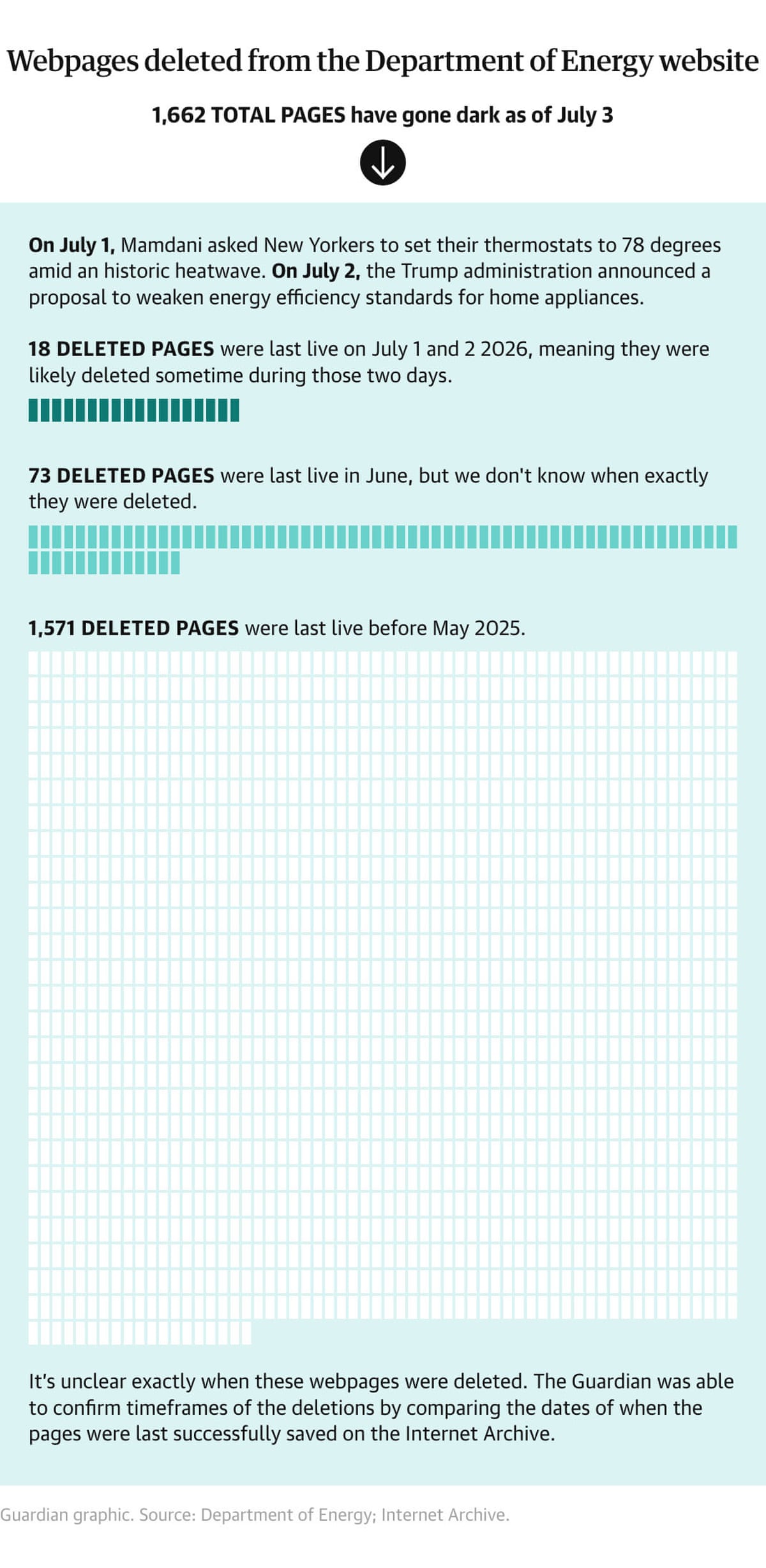
As of July 3, a total of 1,662 DOE pages have been removed.
On July 1, Mayor Adams requested New Yorkers to set thermostats to 78 degrees amid the heatwave. On July 2, the Trump administration announced the proposal to weaken energy efficiency standards for home appliances.
Of the deleted pages, 18 were last live on July 1 and 2, 2026, indicating they were likely removed during those two days. Another 73 pages were last live in June, though the exact deletion dates are unknown. The remaining 1,571 pages were last live before May 2025.
confirmed these timeframes by comparing the last successful captures of the pages on the Internet Archive.

The Department of Energy did not respond to inquiries about the timing and reasons for the webpage removals or whether they were connected to the administration’s proposal to “Permanently End Green New Scam Appliance Mandates.”
Itai Vardi, research manager at the Energy and Policy Institute, a non-profit fossil fuel and utility watchdog, described the proposed rule and webpage deletions as “just absurd.”
“It’s ironic that the Trump administration and Republicans love to talk about consumer choice as a tenet of American freedom, but they’re actually taking that away,” Vardi said. “What they’re doing here is rolling back the rules on energy efficiency, but also trying to hide helpful tips and information for the public, and it’s going to cost people more money.”
The deleted webpages contained a wide variety of advice, including ways to reduce energy consumption during summer months when bills and usage peak, and tips on sealing air leaks around homes.
More than 300 of these pages had over 160,000 pageviews in the last 30 days, based on an analysis of government traffic data from the US General Services Administration.
A Broader Deregulatory Campaign
Since the 1970s, the DOE’s appliance and equipment standards program has required manufacturers to update appliances every few years to incorporate the latest technological advances.
Andrew deLaski described the program as “a real success story,” noting that it has reduced strain on the electrical grid and lowered utility bills for consumers.
“The strain on our [electrical] grid is a lot lower than it would be, and people’s utility bills are a lot lower than they would be,” deLaski said.
An analysis from deLaski’s coalition estimates that the next round of efficiency standard updates could save each household an average of $160 annually on utility bills and significantly ease peak summer electricity demand. This would reduce pressure on an already strained electrical grid, challenged by AI datacenters and more frequent heatwaves.
This is not the first attempt by the Trump administration to weaken energy efficiency standards. Last May, the DOE sought to repeal 47 regulations comprising efficiency standards. The administration also attempted to end the Energy Star program, which certifies energy-efficient appliances, but this effort was blocked by both congressional Democrats and Republicans earlier this year.
Critics argue that the webpage removals are part of a broader campaign, outlined in Project 2025, aiming to deregulate the fossil fuel industry and diminish the federal bureaucracy.
“It’s a senseless dedication to an anti-regulatory agenda driven by what I would say are anti-regulatory zealots,” deLaski said.
’s Deleted data series investigates how critical US government information is being removed and the potential consequences. The series also works to preserve or recreate lost datasets. invites those aware of deleted or altered datasets, webpages, or government materials from the past year, or those willing to share how these changes affect them, to reach out at deleted-data@the.com.


