

When will Artemis II launch?
NASA has scheduled the first crewed mission around the Moon in over 50 years, targeting a late-night launch on Friday, 6 March (early morning in the UK). The Artemis II mission is expected to last approximately 10 days and could take astronauts farther into space than any before them.
The agency has identified four additional launch opportunities in the first half of March and five more windows during the first week of April. Earlier potential launch dates in February were ruled out after a pre-flight test, known as a wet dress rehearsal, was interrupted due to a hydrogen fuel leak from an umbilical connection between the launch tower and the rocket.
Beyond addressing technical challenges, mission planners must also consider the Moon's orbital position, which dictates the timing of launch windows. This results in a pattern of roughly one week at the beginning of each month when the rocket can be properly oriented for launch, followed by about three weeks without viable opportunities.
Who are the Artemis II crew?
The Artemis II crew consists of four astronauts: NASA commander Reid Wiseman, pilot Victor Glover, mission specialist Christina Koch, and Canadian Space Agency astronaut Jeremy Hansen as a second mission specialist.
Reid Wiseman, a US Navy veteran with 27 years of service, is a pilot and engineer residing in Baltimore, Maryland. Selected by NASA in 2009, he served as Flight Engineer aboard the International Space Station (ISS) during Expedition 41 in 2014.
Victor Glover, chosen as a NASA astronaut in 2013, previously piloted the SpaceX Crew-1 mission. He holds three master's degrees, was born in California, and is married with four children.
Christina Koch grew up in Michigan and became an astronaut in 2013. She participated in a 2019 ISS mission, setting the record for the longest single spaceflight by a woman, and took part in the first all-female spacewalk.
Jeremy Hansen joined the Canadian Space Agency in 2009 following a career as a fighter pilot. He was the first Canadian to lead astronaut training at NASA's Johnson Space Center and will be the first Canadian to travel to the Moon.
What will the Artemis crew do during the Moon mission?
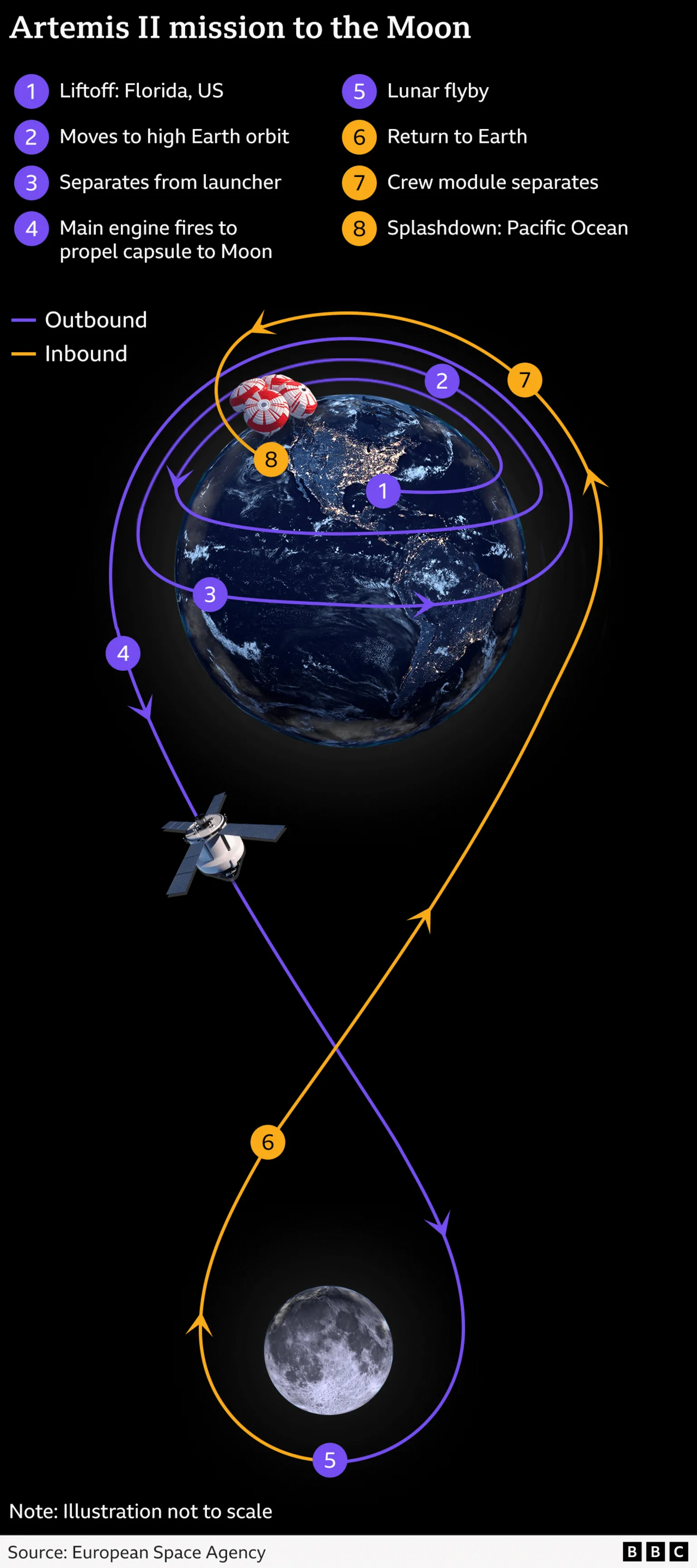
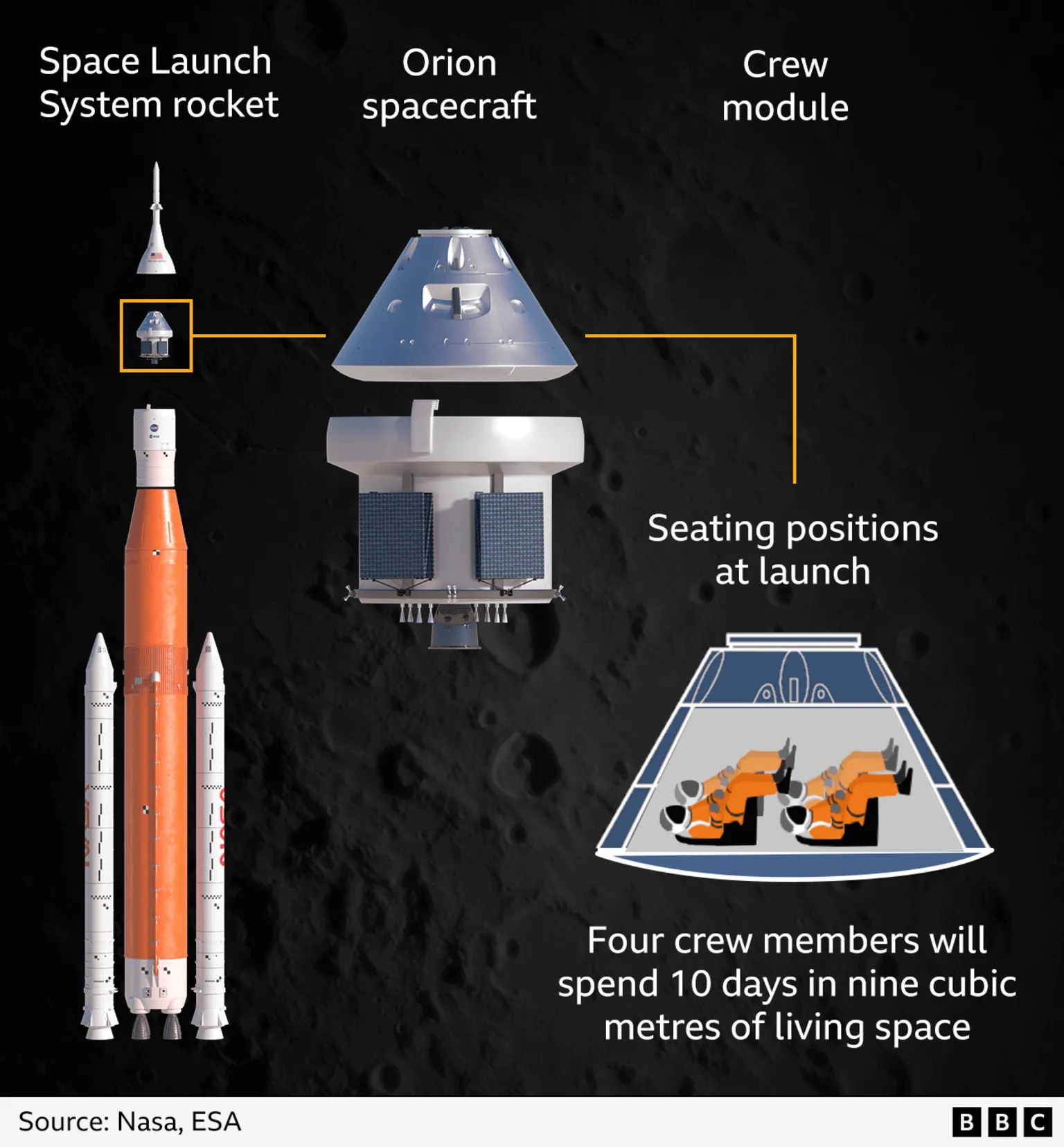
The Artemis II mission marks the first crewed flight of NASA's Space Launch System (SLS) rocket and the Orion space capsule. After achieving orbit, astronauts will test Orion's handling by manually flying the capsule in Earth orbit to practice steering and aligning the spacecraft for future lunar landings.
Subsequently, the crew will travel thousands of kilometers beyond the Moon to evaluate Orion's life-support, propulsion, power, and navigation systems. They will also serve as medical test subjects, transmitting data and imagery from deep space.
The astronauts will operate within a small cabin under weightless conditions. Although radiation levels will be higher than those on the ISS, which orbits closer to Earth, they remain within safe limits.
Upon returning to Earth, the crew will undergo a challenging atmospheric re-entry followed by a splashdown in the Pacific Ocean off the US west coast.
Will Artemis II land on the Moon?
Artemis II will not land on the Moon. Its purpose is to prepare for a lunar landing planned for the Artemis III mission. NASA aims to launch Artemis III by 2028, although experts consider this timeline highly ambitious.

The spacecraft to transport astronauts to the lunar surface has yet to be finalized. Options include SpaceX's Starship lander or a vehicle developed by Jeff Bezos's Blue Origin. Additionally, new spacesuits produced by US company Axiom are still under development.
When Artemis III eventually flies, astronauts will target the Moon's south pole. The long-term goal is to establish a sustained human presence on the Moon.
Subsequent missions, Artemis IV and V, will initiate construction of Gateway, a small space station orbiting the Moon. This will be followed by additional Moon landings, expansion of Gateway, and deployment of new robotic rovers on the lunar surface.
International collaboration is expected to increase, supporting extended human habitation and operations on and around the Moon.
When was the last Moon mission?
The last crewed mission to the Moon was Apollo 17, which landed in December 1972 and returned later that month. In total, 24 astronauts have traveled to the Moon, with 12 walking on its surface during the Apollo program. Of these 24, only five remain alive.
The United States initially pursued lunar exploration in the 1960s to surpass the Soviet Union in geopolitical and technological achievements. After achieving this objective, political support, public interest, and funding for Moon missions declined.
The Artemis program emerged from a renewed desire to return humans to the Moon, this time aiming for a longer-term presence supported by new technologies and commercial partnerships.
Do other countries plan to send astronauts to the Moon?
Several countries have expressed ambitions to send astronauts to the Moon during the 2030s.
European astronauts are expected to participate in later Artemis missions, and Japan has secured seats on future flights.
China is developing its own spacecraft, targeting a first lunar landing near the Moon's south pole by 2030.
Russia continues to discuss plans for cosmonauts to land on the Moon and establish a small base between 2030 and 2035. However, sanctions, funding challenges, and technical difficulties render this timeline optimistic.
India has also declared intentions to send astronauts to the Moon. Following the successful Chandrayaan 3 landing near the lunar south pole in August 2023, India's space agency aims to send humans to the Moon by approximately 2040 as part of expanding its human spaceflight program beyond low Earth orbit.
Additional reporting by Kevin Church and Emily Selvadurai.


