

'Toilet is go'
In the tense final hours before NASA's astronauts embarked on their historic mission, a series of technical challenges threatened to delay the launch. Among these was an unexpected issue with the spacecraft's waste-management system. Sensors aboard the Orion spacecraft detected irregular readings related to the toilet system.
Astronaut Christina Koch took on the role of plumber, carefully dismantling parts of the toilet under the guidance of mission control. Following these efforts, mission control confirmed over radio:
"Happy to report that toilet is go for use. We do recommend letting the system get to operating speed before donating fluid."
Managing waste in microgravity is a critical aspect of space travel. NASA has invested over $23 million (£17.4 million) in developing the Universal Waste Management System, designed for use by both men and women. This system includes a funnel connected to a hose that processes urine using gentle airflow to prevent spills. For solid waste, a specialized seat enables stools to be suctioned into a sealed container, with tethers and restraints ensuring crew members remain properly positioned.
The Orion spacecraft is equipped with multiple backup options, including alternative collection bags and various methods for routing liquids, ensuring redundancy in waste management.
Issue with safety systems
Additional technical concerns arose involving two critical safety systems: the flight termination system and the launch abort system. These systems are essential for protecting both the crew and the public.
The flight termination system, which allows ground engineers to destroy the rocket if it deviates from its intended path, experienced a communications issue. This was resolved by utilizing hardware components from the previous Space Shuttle program.
The launch abort system, an emergency escape tower designed to pull the crew capsule away from the rocket during launch or ascent emergencies, reported a higher-than-expected temperature reading. However, engineers determined this anomaly would not impact the launch.

With these issues addressed, the countdown was paused at 10 minutes while engineers completed final preparations. The launch director then initiated a sequence of system checks, with each engineer confirming readiness:
"Booster, go"
"GNC, go"
"Range, go"
Each affirmative response eased tension and heightened anticipation.
Finally, the crew received confirmation:
"Artemis II, this is Launch Director – you are go for launch."
"We go for all humanity," Commander Reid Wiseman replied.
The rocket then launched from Kennedy Space Center, captivating observers worldwide.
Trying to break spacecraft
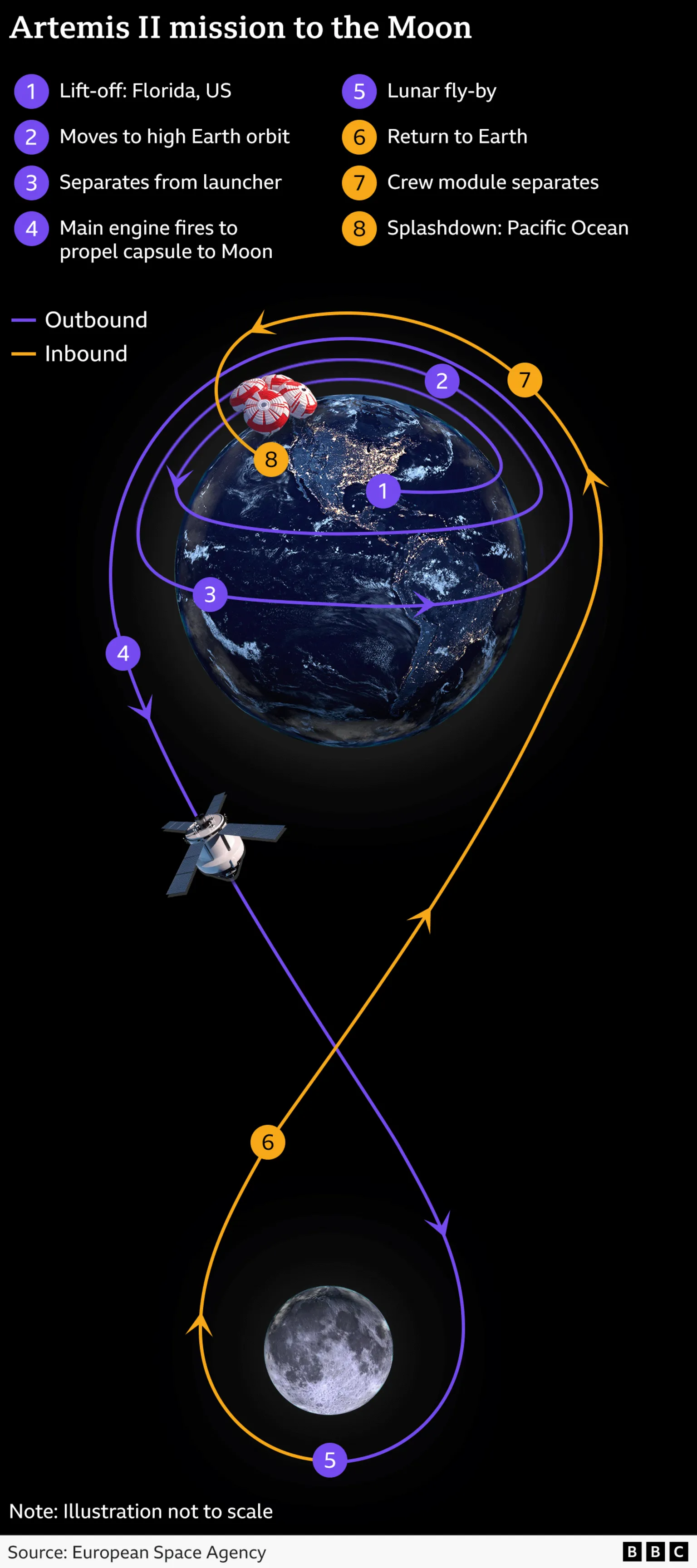
Now safely orbiting Earth, the Artemis II crew is conducting extensive tests designed to challenge the spacecraft's systems intentionally. These tests include cycling computers through various modes, switching radio communications between ground stations and relay satellites, and moving within the cabin to evaluate how the life-support system manages increasing carbon dioxide and humidity levels.
Engineers also command small thruster firings and monitor the European-built service module's responses to ensure they align precisely with predictive models.
The purpose of these rigorous evaluations is to confirm the spacecraft's integrity and reliability before committing to the trans-lunar injection burn that will send the crew toward the Moon. Should any test reveal unexpected issues, NASA is prepared to abort the lunar trajectory and use Orion's engine to return the astronauts safely to Earth.
Additional reporting by Esme Stallard and Tom Bennett.


