

Artemis II Splashdown Marks Historic Return
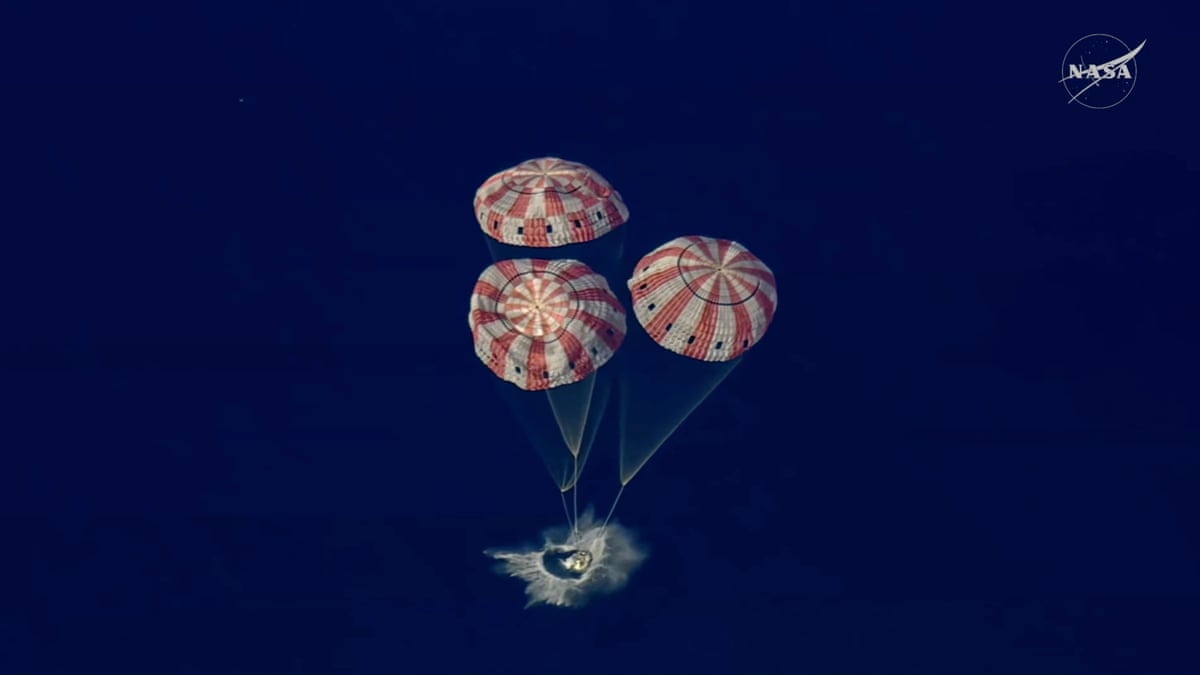
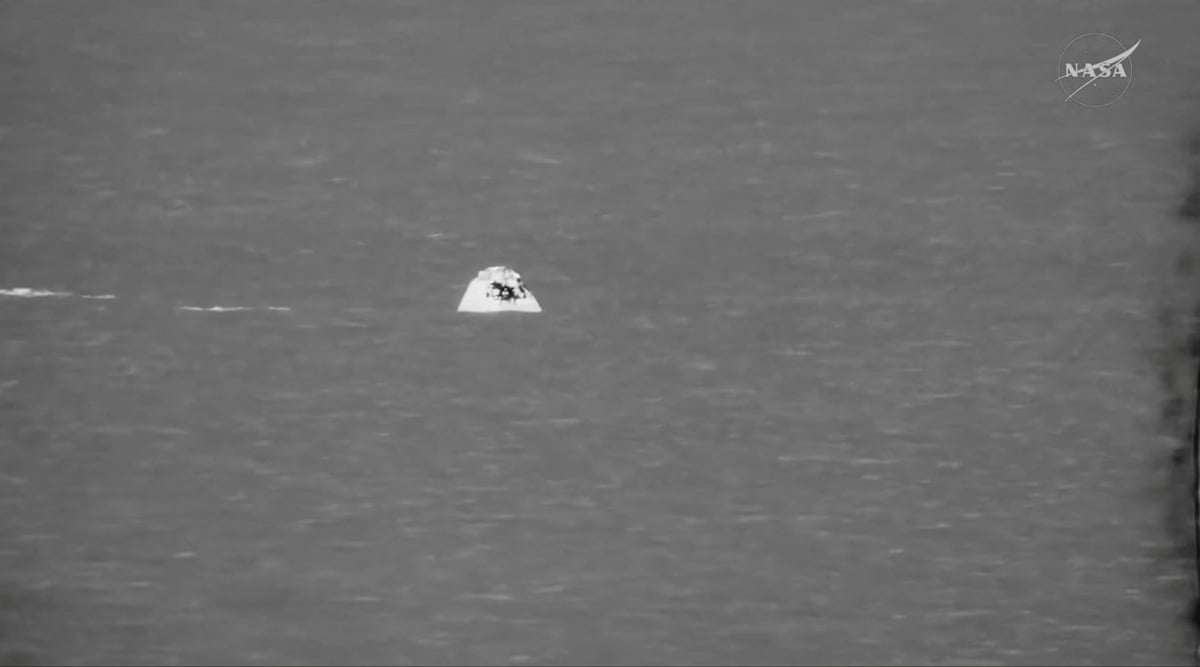
The Artemis II crew, consisting of four astronauts aboard the Orion space capsule, successfully splashed down into the Pacific Ocean off the coast of San Diego, NASA confirmed.
The spacecraft touched down at 5:07 pm local time (1:07 am BST) after completing a 10-day mission orbiting the moon and returning to Earth. During this journey, the Orion spacecraft traveled a total of 694,481 miles (1,117,659 km).
The crew includes Commander Reid Wiseman, pilot Victor Glover, mission specialist Christina Koch from NASA, and Jeremy Hansen from the Canadian Space Agency. They are the first humans to travel to the moon and return safely since the Apollo 17 mission in December 1970.
These four astronauts join an exclusive group of only 24 individuals who have traveled to the moon and returned safely to Earth.
As the Orion capsule descended below 17,000 miles from Earth’s surface, Commander Wiseman described the view of the planet, saying:
“There’s a great blue hue to it. It’s beautiful.”
Following the splashdown, a recovery team from the USS John P. Murtha was prepared to retrieve the Artemis crew. Using boats, they approached an inflatable "porch" attached to Orion's hatch. The astronauts were then transferred to the naval ship by helicopter.
NASA’s Milestone in Cislunar Spaceflight
NASA has demonstrated its capability to safely send humans to and from cislunar space—the region between Earth and the moon—and plans to build on this achievement to advance the Artemis program toward a crewed lunar landing scheduled for 2028, 56 years after the last such mission.
Meanwhile, the global public experienced a rare moment of unity during the 10-day mission, enjoying stunning video footage and images of the lunar surface and Earth from orbit. The astronauts also shared profound reflections on their observations.
Christina Koch shared her impressions of the moon during Orion’s closest approach at 4,067 miles (6,545 km) above the lunar surface on Monday:
“I just had an overwhelming sense of being moved by looking at the moon. It lasted just a second or two and I actually couldn’t even make it happen again, but something just threw me in suddenly to the lunar landscape and it became real.
“The moon really is its own unique body in the universe. When we have that perspective and we compare it to our home of the Earth, it just reminds us how much we have in common. Everything we need, the Earth provides, and that, in and of itself, is somewhat of a miracle.”
Koch became the only woman to travel to the moon and back during this mission of firsts. Jeremy Hansen became the first non-American astronaut to participate in such a mission, and Victor Glover became the first person of color to do so.

Together with Commander Reid Wiseman, the crew traveled farther than any humans before them, reaching 252,756 miles—over 4,000 miles beyond the previous record set by the Apollo 13 crew in April 1970.
Challenges and Moments of Levity
The 695,000-mile voyage was not without difficulties. The Orion capsule’s toilet experienced malfunctions multiple times, requiring the temporary use of urine collection bags and inflight repairs performed by Christina Koch, who also served as the mission’s plumber.
There were also lighter moments. On Easter Sunday, the crew held an Easter egg hunt inside the spacecraft, searching for packets of dehydrated scrambled eggs hidden throughout. The mission’s official mascot, a plush character designed by eight-year-old Lucas Ye from California, appeared regularly during crew press conferences.
Emotional Dedication and Mission Operations
One of the most emotional moments occurred on Monday when the crew proposed naming a previously unnamed lunar crater after Carroll Taylor Wiseman, wife of Commander Reid Wiseman and mother of their daughters Katey and Ellie, who passed away from cancer in 2020. Jeremy Hansen struggled to express the dedication, prompting visible emotion among the astronauts.
During the operational phase of the mission, the astronauts evaluated Orion’s life support systems, radiation detectors, next-generation spacesuits, and tested procedures essential for future deep-space missions and NASA’s long-term Artemis program goals, including plans to build a lunar base within the next decade.
Precision in Re-Entry and Recovery
The first splashdown of a returning moon crew in over five decades represented a critical milestone. Although less visually dramatic than the fiery launch from Kennedy Space Center in Florida, the landing required detailed planning, precision, and flawless execution.
Following modifications to the heat shield after the uncrewed Artemis I mission in November 2022, NASA was confident that the Orion capsule could withstand temperatures up to 5,000°F (2,760°C) during its 25,000 mph re-entry into Earth's atmosphere. Mission managers selected a steeper, direct re-entry path to reduce thermal stress.
A sequence of parachute deployments at various altitudes slowed the spacecraft from 25,000 mph to 325 mph, then to 130 mph, before the three main parachutes deployed. These canopies, with a combined area of 80 yards (73 meters), further decelerated the capsule to a 17 mph splashdown speed.
Coast Guard and Navy recovery teams were positioned to cover a landing zone approximately 550 miles in diameter. After medical evaluations following hatch opening and a brief stopover at a San Diego military base, the crew’s next destination was Houston’s Johnson Space Center, where they reunited with their families. The astronauts had last been there on March 27.

Legacy and Future Inspiration
The four astronauts join the 24 other individuals—previously all American men—who traveled to the moon and back during the nine crewed Apollo missions between December 1968 and December 1972.
Nicky Fox, Associate Administrator of NASA’s Science Mission Directorate, highlighted the mission’s significance during a briefing with reporters:
“Our four Artemis II astronauts, Reid, Victor, Christina and Jeremy, took humanity on an incredible journey around the moon and brought back images so exquisite and brimming with science, they will inspire generations to come.”


