Prepared for the Worst: The UN’s Asteroid Alert Director
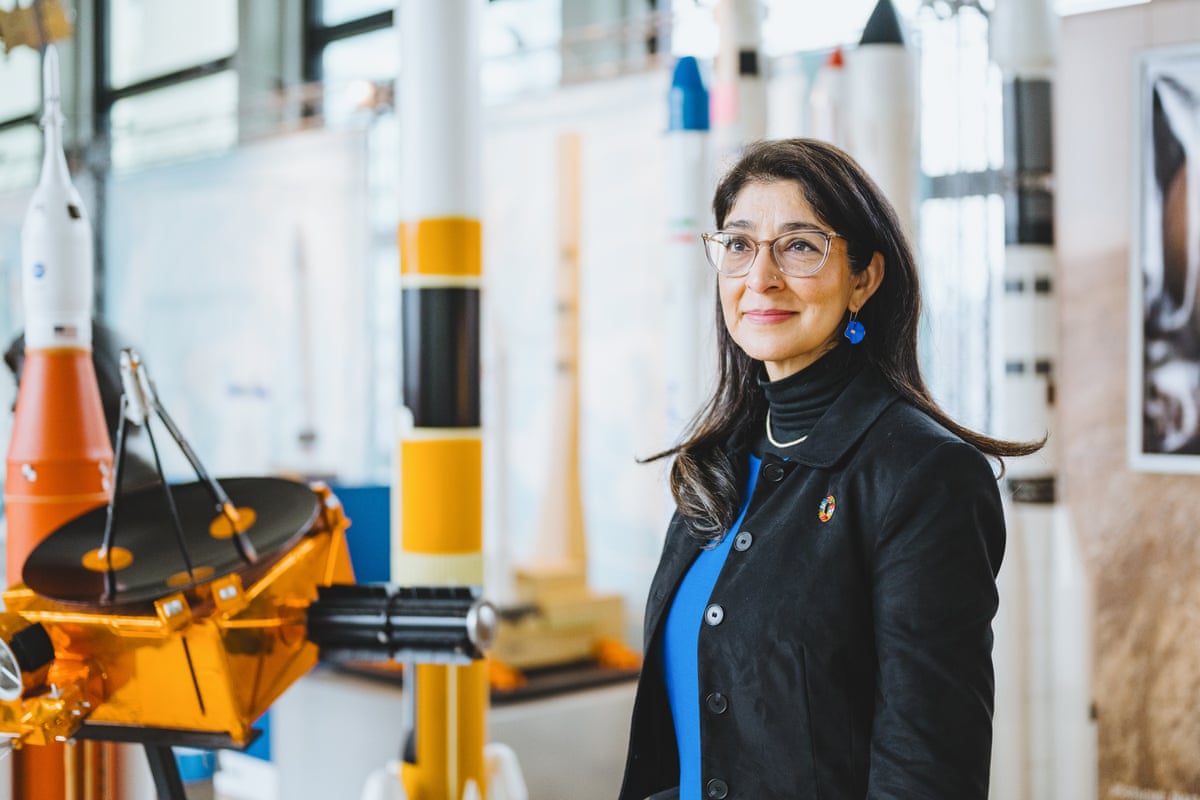
Aarti Holla-Maini, director of the United Nations Office for Outer Space Affairs (Unoosa), is the key figure responsible for alerting the world if a significant asteroid threat to Earth emerges. Just over a year ago, she faced such a scenario, testing her preparedness for a potential planetary strike.
Based in Vienna within a modest 1970s concrete tower near the Danube River, Holla-Maini, a British lawyer with extensive experience in the satellite industry, had undergone rigorous training, including drills and table-top exercises. These preparations were essential for her role, which demands precise knowledge of the procedures to follow if informed about a large asteroid on a possible collision course with Earth—an event she refers to with a touch of humor as “Armageddon.”
In the event of such a threat, Holla-Maini’s responsibility is to immediately notify the UN secretary general, who then disseminates the information to the UN’s 193 member states, encompassing virtually every government worldwide.

When Simulation Became Reality
Although issuing asteroid warnings is not a routine task, in late December 2024, Holla-Maini found herself in the midst of a real alert. While between official trips, a colleague informed her that the situation was genuine, not a drill.
“This wasn’t a simulation or a drill,” Holla-Maini recalls. “It was real.”
On 27 December 2024, a robotic telescope in Chile detected a distant asteroid, initially estimated to be the size of a small building. Such discoveries are common, and scientists typically track these objects to refine their Earth impact probability (IP). The asteroid, designated 2024 YR4, was publicly known before Unoosa’s involvement.
However, 2024 YR4’s threat level grew over the following three weeks as additional observatories tracked it and updated calculations. Its IP increased from less than 0.05% to over 1% for a potential impact in 2032. This rise, combined with the asteroid’s size, met the criteria for Unoosa to issue its first global notification since establishing a planetary defense collaboration in 2013.
Despite the low probability—effectively a 99% chance it would miss—the asteroid’s size and velocity meant an impact could release energy sufficient to devastate a city or region.
By late January 2025, Romana Kofler, Unoosa’s planetary defense programme officer, had been working late. She serves as the point of contact for planetary defense matters and had been coordinating with the International Asteroid Warning Network, a UN-supported group including astronomers, NASA, the European Space Agency (ESA), and orbital trajectory experts.
“We had trained for this with simulations, but this was the real thing,” says Kofler. “The adrenaline kicked in.”
After briefing Holla-Maini, they quickly drafted a letter to António Guterres, the UN secretary general, marking Unoosa’s first real-time test of an international response to an asteroid threat.
Real-World Asteroid Threats
The danger posed by space objects is not theoretical. In 2013, a 20-metre-wide asteroid exploded over Chelyabinsk, Russia, releasing energy equivalent to 500 kilotonnes of TNT. The resulting shockwave shattered windows across thousands of buildings, injuring over 1,200 people due to flying glass and debris. The fireball was 30 times brighter than the sun, causing immediate skin burns and demonstrating that even relatively small asteroids can cause mass casualties without warning.
For a brief period last year, 2024 YR4 represented the most significant near-term asteroid threat since the 2004 discovery of Apophis, which initially received a level four rating on the Torino scale but was later downgraded to zero after further observations ruled out any impact risk. The Torino scale ranges from zero (no risk) to ten (certain collision threatening civilization).

2024 YR4 reached level three on the Torino scale, activating the Space Mission Planning Advisory Group, another UN-endorsed body tasked with developing strategies to protect Earth. One proposed method is deflecting asteroids by colliding spacecraft with them, a technique successfully demonstrated in a recent mission.
Unoosa’s Broader Role and Challenges
Despite its critical planetary defense role, Unoosa’s daily operations often focus on less dramatic but equally important tasks. Pronounced “Younoosa,” the agency is relatively small, with 35 employees working at the Vienna International Centre, a quieter UN hub compared to Geneva or New York.
Founded in the late 1950s during the early space age, Unoosa was created to prevent the extension of Earthly political rivalries into outer space. Today, its small team manages a broad mandate as governments and private companies increasingly pursue space activities.
Holla-Maini transitioned from 25 years in the commercial satellite sector to the complex environment of the UN, where she frequently travels internationally to conferences and oversees responsibilities including promoting international space law and regulation amid growing competition.
Unoosa runs the Space for All programme, which helps countries without space capabilities access orbital benefits. Its disaster and emergency response initiative, UN-Spider, provides satellite imagery to nations facing natural disasters.
Unoosa’s role as the official registry for satellites launched into Earth orbit has become increasingly vital. With over 10,000 satellites currently in orbit and many more planned, near-Earth space is becoming congested and hazardous.
The agency often functions as an informal “hotline” for potential satellite collisions, a role complicated when satellites belong to countries without diplomatic relations.
Holla-Maini recounts a tense incident in June when the Malaysian Space Agency contacted Unoosa on a weekend about a non-manoeuvrable Malaysian satellite on a collision course with a North Korean satellite. The two were only 75 metres apart, creating a highly dangerous situation.
“It was a ‘really hot’ situation,” says Holla-Maini.
With no direct communication channel to North Korea, Unoosa sent information to known North Korean email addresses, which received no reply.
“The best you can do is send whatever notes and information you can to every official point of contact that you have,”she explains. Unexpectedly, the North Korean satellite moved out of the collision path without bilateral communication.
Punching Above Its Weight
Whether alerting the world to a potentially devastating asteroid, facilitating satellite imagery for disaster relief, or preventing satellite collisions, Unoosa’s small team in Vienna operates with remarkable efficiency despite limited staff and budget.
“Because we have been in this straitjacket of not enough staff, not enough budget, it has forced the office to be extremely efficient,”Holla-Maini notes.
The 2024 YR4 asteroid episode served as a valuable real-world test of Unoosa’s planetary defense role. Currently, the asteroid continues to be monitored. Although its impact probability peaked above 3% in February 2025, it has since declined to a negligible level.
“All of a sudden,” says Holla-Maini, “it was gone.”