

Senior UK Ministers Criticize Rent Freeze Proposal
Senior ministers have strongly criticized the proposal to freeze private sector rents for one year, shortly after Rachel Reeves was reported to be considering the policy.
Steve Reed, the housing secretary, and Matthew Pennycook, the housing minister, are among the latest government officials to oppose the idea, which has also been dismissed by Downing Street.
The divisions within the government over the rent freeze have fueled speculation regarding Reeves’s position following reports over the weekend suggesting that the prime minister intended to dismiss her after the local elections.
During Prime Minister’s Questions on Wednesday, the prime minister did not guarantee Reeves would remain in her role, although Downing Street maintains that she continues to have the prime minister’s support.
Government Officials Reject Rent Freeze
Matthew Pennycook stated on Wednesday regarding the rent freeze proposal:
“We are not doing this. It’s not a credible or serious policy proposition.”
He further added:
“I can’t remember how many times I’m on record of saying this government has no intention, does not agree with rent controls, and there are really good reasons for that.
“We exhaustively went through the evidence of countries like Sweden, Germany, cities like San Francisco. Look at the Scottish experience. Now look at what happens to rent increases outside of tenancies where you have that form of control.”
Some experts argue that while rent controls may reduce rents for regulated properties, they can lead to increased rents for homes outside the policy, whether in the same area or nearby.
Pennycook’s remarks followed a similar response from Steve Reed, who said:
“I’ve been crystal clear – we’re not doing it.”
Political Implications and Speculation on Reeves’s Future
The immediate rejection of the rent freeze proposal has reignited questions about the chancellor’s future within the government.
Kemi Badenoch, the Conservative leader, questioned the prime minister in the House of Commons on Wednesday:
“This is not a serious way to run the economy … Will he listen to businesses, listen to the country, and reshuffle the chancellor?”
Labour leader Keir Starmer praised Reeves but did not explicitly guarantee she would remain in her post, as he has done previously.
Downing Street later stated:
“[The prime minister has] full confidence in the chancellor.”
When asked to reiterate Starmer’s earlier guarantee that Reeves would remain until the next election, a spokesperson responded:
“That position remains unchanged.”
Reeves’s allies dismissed reports that the prime minister intended to sack her as a last-ditch effort to maintain power following significant local election losses. One ally described the reports as “bollocks.”
Reeves’s Response and Treasury Activities
On Wednesday morning, Reeves addressed an all-staff meeting at the Treasury, accompanied by her ministerial team. She thanked officials and encouraged them to continue advancing the government’s goal of stimulating economic growth.
Treasury sources indicated she highlighted recent policy decisions, including utility bill reductions announced in November’s budget, and reiterated her stance against a costly, reactive response to the Iran crisis.
One ally characterized the chancellor’s tone as “massively upbeat” and forward-looking, promising forthcoming details on artificial intelligence policy and the United Kingdom’s relationship with the European Union.
Concerns Over Government Stability and Market Reactions
However, a source close to Reeves’s team suggested they were unsettled by reports of divisions within Downing Street regarding whether to conduct an immediate reshuffle following next week’s local elections.
City investors are closely monitoring Labour’s internal conflicts, with some warning that the prospect of a leadership contest could further increase yields, or interest rates, on government bonds.
A research note from analysts at investment bank Jefferies described next week’s polls as “the local elections markets can’t ignore.”
Yields have already risen sharply since the outbreak of the Middle East conflict, as investors fear higher inflation and rising interest rates, which could erode much of Reeves’s fiscal rule flexibility.
The government’s borrowing costs increased again on Wednesday amid concerns over a prolonged conflict, with 10-year gilt yields closing at their highest level since 2008, exceeding 5%. Reeves’s allies argue that the risk of gilt market instability is a strong reason to retain her in office.
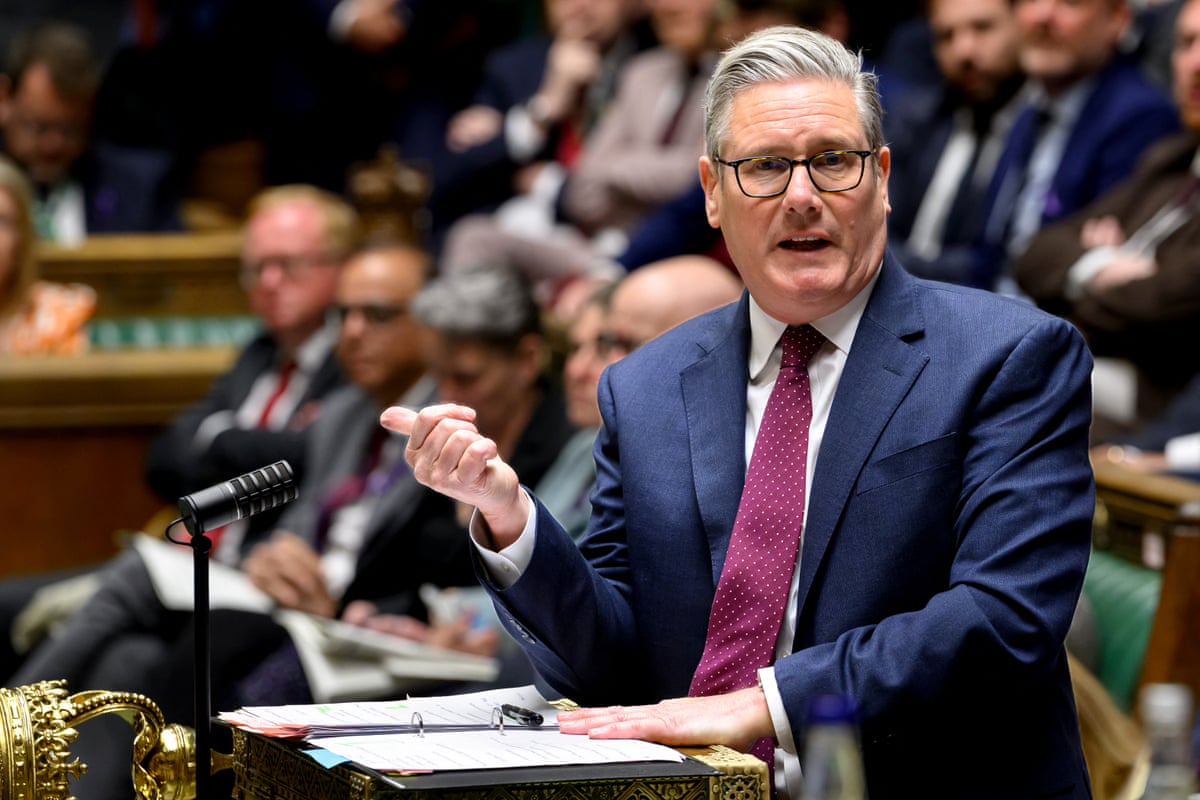
Keir Starmer during Wednesday’s PMQs. Photograph: House of Commons/AFP/


