

UK Heatwave Expands North and West as Temperatures Rise
Temperatures are forecast to reach 35C (95F) on Thursday as the current heatwave extends further north and west across the UK.
The third heatwave of the year, which began earlier this week, is not anticipated to set new temperature records; however, the duration of the heat will make it notable.
On Wednesday, temperatures peaked at 33.8C at Heathrow Airport under strong July sunshine. Wales recorded 31.2C at Cardiff Bute Park, Scotland saw 29.0C at Aboyne, and Northern Ireland reached 27.1C at Helen's Bay.
From Thursday through Friday, more regions are expected to experience temperatures climbing into the high 20s or low 30s Celsius.
Above-average heat across much of the country on Thursday is set to spread westwards and northwards
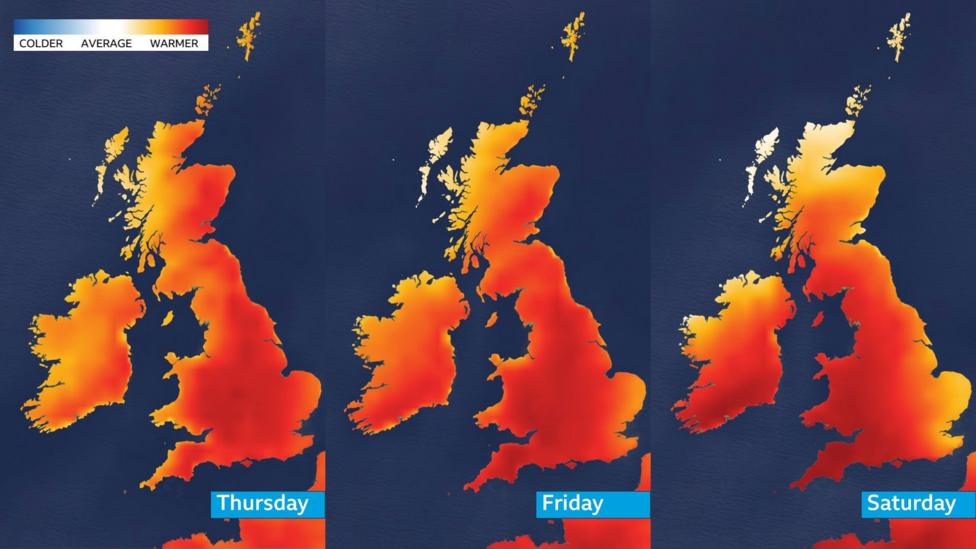
How Hot Will It Get?
The highest temperatures of this heatwave are projected for Thursday and Friday.
High pressure over the UK will maintain dry and settled conditions for most areas over the next two days, allowing the heat to intensify significantly.
However, temperatures are not expected to reach those recorded during June's heatwave, when a provisional 37.7C was recorded in Lingwood, Norfolk.
This time, maximum daily temperatures will reach 34C across parts of London and Cambridgeshire on Thursday, with some locations possibly reaching 35C.
Temperatures on Thursday will be 34C across southern and eastern England, with some areas reaching 35C.
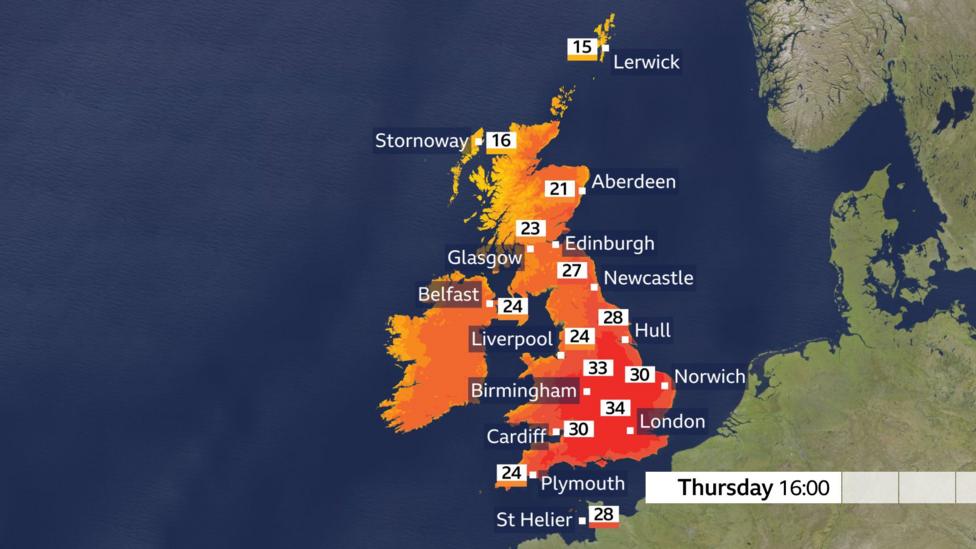
By Friday, the area of high pressure will shift further northwards, allowing the heat to extend into parts of southern Wales and the Midlands, with temperatures in the low to mid 30s Celsius.
Simultaneously, a developing easterly breeze will bring slightly cooler conditions to more eastern areas.
For Northern Ireland and Scotland, temperatures are expected to reach the mid-20s Celsius by Friday.
Amber heat health alerts are in place across parts of the Midlands, eastern, and southern England until 12 July.
Yellow heat health alerts are also active across northern England for the same period.
This indicates that significant impacts are likely across health and social care services, including an increase in deaths, particularly among individuals aged 65 and over or those with health conditions.
On Wednesday, the National Fire Chiefs Council (NFCC) stated that the dry and hot weather increases the risk of wildfires and advised the public to avoid using disposable barbecues in open countryside, parks, and moorlands.

"The dry and hot weather means there is an increased risk of wildfires," the NFCC said.
Six Ways to Keep Your Home and Yourself Cool in Hot Weather
No air conditioning? Here's how to get the most out of your electric fan.
Where Is There a Heatwave at the Moment?
The extensive and prolonged heat means many locations are already experiencing an official heatwave.
A heatwave is declared when specific temperature thresholds are met or exceeded for three consecutive days or more. These thresholds are:
- 28C or more across London and the Home Counties
- 26C across central England and southeast Wales
- 25C for the rest of England, Wales, and all of Northern Ireland and Scotland
Parts of the south and east of England officially declared a heatwave on Monday and have experienced temperatures of 30C or higher for the last five days.
Other areas under official heatwave conditions include parts of the West Midlands, southern, and southwest England.
A steward uses a handheld fan to cool down a spectator at the tennis at Wimbledon.

When Will the Heatwave End?
Although temperatures will peak on Thursday and Friday, a rapid cooling is not expected, with many areas retaining heat through the weekend and much of next week.
Many regions in the UK could meet or exceed heatwave criteria for the next 10 days, covering the remainder of this week, the weekend, and all of next week.
After Sunday, temperatures may begin to fall below 30C but will remain well above the July average of 18-23C.
This makes it one of the longest-lasting heatwaves since the notable year of 1976.
During 1976, multiple locations in England recorded 13 to 16 consecutive days above 30C.
The highest recorded July temperature in the UK was documented in 2022 at Coningsby, Lincolnshire.
Will There Be Another Heatwave?
Forecasters issued their three-month summer outlook on 1 June, suggesting higher-than-normal chances of hotter weather during June.
Above-average temperatures are expected for each month of July and August, with "significant bursts" of heat anticipated in the UK and across Europe.
MeteoGroup, which currently provides BBC Weather with data, points to "a few notable high temperature spikes."
According to the Met Office, having a hotter summer is now twice as likely compared to the period from 1991 to 2020, consistent with the warming climate.
- How hot a 1976-style heatwave would be today
- Are we in for a summer of serial heatwaves?
- How to get a good night's sleep during hot weather


