
UK Government Withdraws Major Education Initiative for Girls
The British government has terminated a prominent higher education programme aimed at keeping 1 million girls in school across Africa, Asia, and the Middle East, just two years after its launch.
The initiative, Strengthening Higher Education for Female Empowerment (SHEFE), was introduced by the outgoing Conservative government with a £45 million budget to expand access to higher education for 1 million students globally. The Foreign, Commonwealth and Development Office (FCDO) has now withdrawn its tender for the project.
In May, Foreign Secretary Yvette Cooper emphasized her dedication to women and girls, stating they "deserve safety and opportunity everywhere" and expressing her determination to collaborate internationally to prioritize women’s safety.
Bambos Charalambous, Labour MP and chair of the all-party parliamentary group on global education, expressed concern over the programme’s cancellation.
“I’m alarmed that a flagship higher education programme designed to empower women and girls and help them achieve their potential appears to have been scrapped because of the aid cuts,”he said.
“FCDO has acknowledged how such partnerships can transform lives, while also benefiting institutions here at home. It is vital to start thinking now about how to build back from the aid cuts to save similar projects.”
The SHEFE programme was partly designed based on evidence that girls who access higher education are up to six times less likely to marry as children and face lower risks of partner violence. Additionally, women with advanced education tend to increase their earnings.
Professionals in international development and education sectors have criticized the decision to cancel SHEFE as a further blow to the UK’s stated commitment to supporting women and girls globally.
The Home Office has also restricted visa applications from Afghanistan, Sudan, Myanmar, and Cameroon, limiting opportunities for many women whose access to education in their home countries is already constrained. British universities benefit financially from foreign students, who pay significantly higher tuition fees than domestic students.
Joseph Nhan-O’Reilly, co-founder of the Girls’ Education Challenge, remarked:
“The government talks up its commitment to women and girls but at every turn it denies the world’s most marginalised girls the thing that everyone agrees has the biggest impact on their lives and that of their communities: access to higher education.”
Earlier this year, the FCDO cancelled the tender for its planned Education for All programme in South Sudan, according to Nhan-O’Reilly. The £150 million initiative was intended to support education for girls and children with disabilities in one of the world’s poorest countries, which has one of the highest child marriage rates and the world’s fourth-lowest literacy rate.
Last year, the UK government announced the abandonment of a programme in the Democratic Republic of the Congo that had enabled tens of thousands of girls to attend school for the first time. Educational projects were also reduced in Ethiopia, Sierra Leone, Nigeria, and Zimbabwe, with the FCDO Girls’ Education Department experiencing a 51% funding cut.
A spokesperson from Bond, a UK network for organisations involved in international development and humanitarian aid, stated:
“Any cuts to programmes that support women and girls, including through education, threaten to reverse hard-won progress on ending gender-based violence and exploitation, and advancing gender equality worldwide.
Last year, polling found the majority of the UK public wanted programmes that protect women and girls’ safety to be shielded from cuts to the UK aid budget. We urge the foreign secretary to uphold her commitment to prioritising the safety, human rights and economic opportunity of women and girls around the world.”
According to UNESCO, international aid to education is projected to decline by $3.2 billion (£2.4 billion) by 2026, representing a 24% decrease. It is estimated that 6 million additional children risk being out of school by the end of the year, with 30% of them living in humanitarian settings. This number is equivalent to emptying every primary school in Germany and Italy combined.
The UK had previously been a leading advocate for global education, noted Nhan-O’Reilly, but the cuts announced last year closely followed similar reductions in the United States.
“These cuts can’t be seen on their own; they’ve set the tone and influenced the posture and level of commitment from many other donors,”he said.
The Prime Minister, Keir Starmer, announced last year that the UK aid budget would be reduced from 0.5% of gross national income to 0.3% in 2027, marking its lowest level since records began. The United Nations target is for countries to allocate 0.7%, a commitment made by former Conservative Prime Minister David Cameron in 2012 despite opposition within his party.
The 2025 cut reversed Labour manifesto pledges and led to the resignation of Andrew Mitchell, the then international development minister.
Joseph Nhan-O’Reilly commented:
“We’ve been absolutely flabbergasted and devastated by these cuts happening under Labour. They’re clearly a break in the manifesto. This was a huge mistake and betrayal of the sector.”
An FCDO spokesperson explained that the aid cuts were necessary to fund increased defence spending.
“National security is the first duty of this government,”they said.
“This does not mean stepping back from our values – protecting women and girls is now a Foreign Office priority … Funding to tackle violence against women and girls is protected this year.”
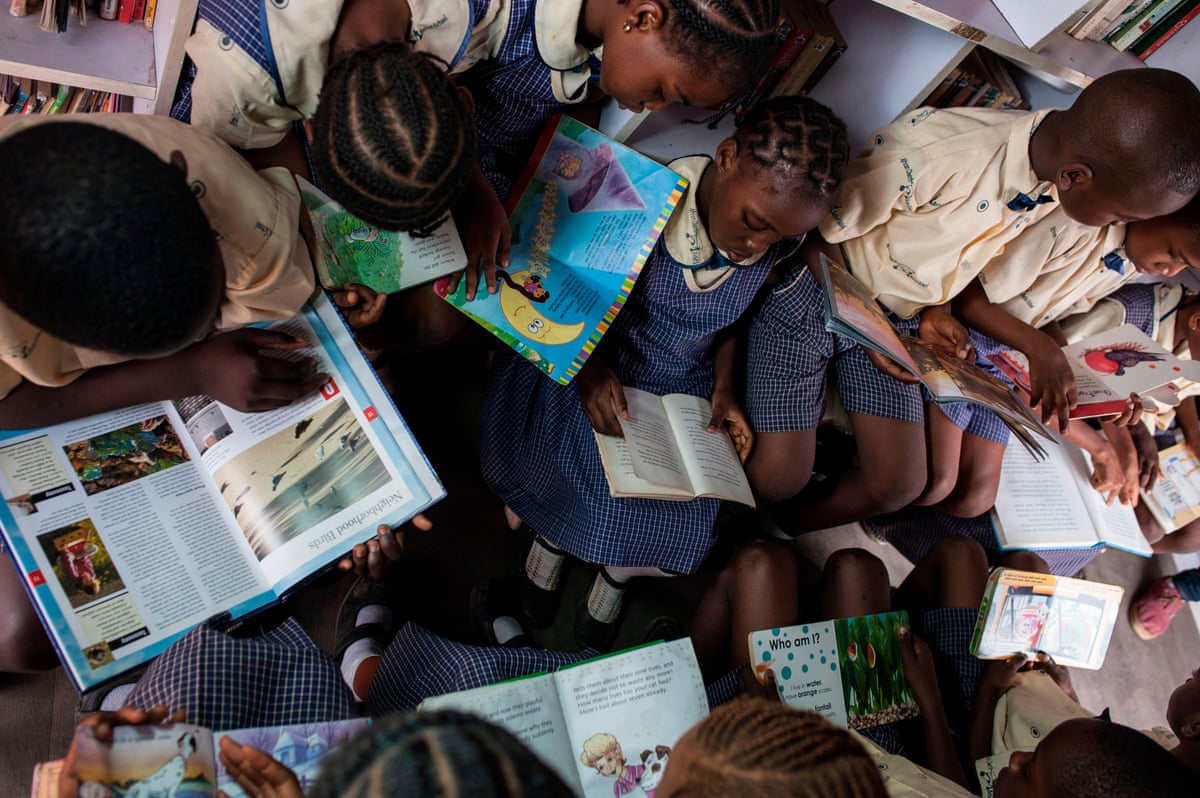
Pupils at Bethel primary school in Ifako, Lagos. Photograph: S Heunis/AFP/Getty


