

Steve Reed Dismisses Labour Rebels as ‘Usual Suspects’ Ahead of Final PMQs
Good morning. Initially, there was hope that Prime Minister’s Questions (PMQs) would not be necessary today, but it has been confirmed that there will be one, marking the final PMQs of the 2024-26 parliamentary session. This session will provide Keir Starmer with an opportunity to reflect on the legislation passed during this period.
There is some relief within government circles following the smooth passage of the vote on Kemi Badenoch’s motion calling for Starmer to be referred to the privileges committee. Our overnight coverage by Pippa Crerar, Ben Quinn, and Jessica Elgot provides further details.
Labour MPs were also encouraged by Darren Jones’ speech concluding the debate, which will be discussed later.
Last night, 53 Labour MPs did not participate in the division; some were authorised absences, while others abstained deliberately to avoid voting against the motion. Only 15 Labour MPs voted in support of Badenoch’s motion.
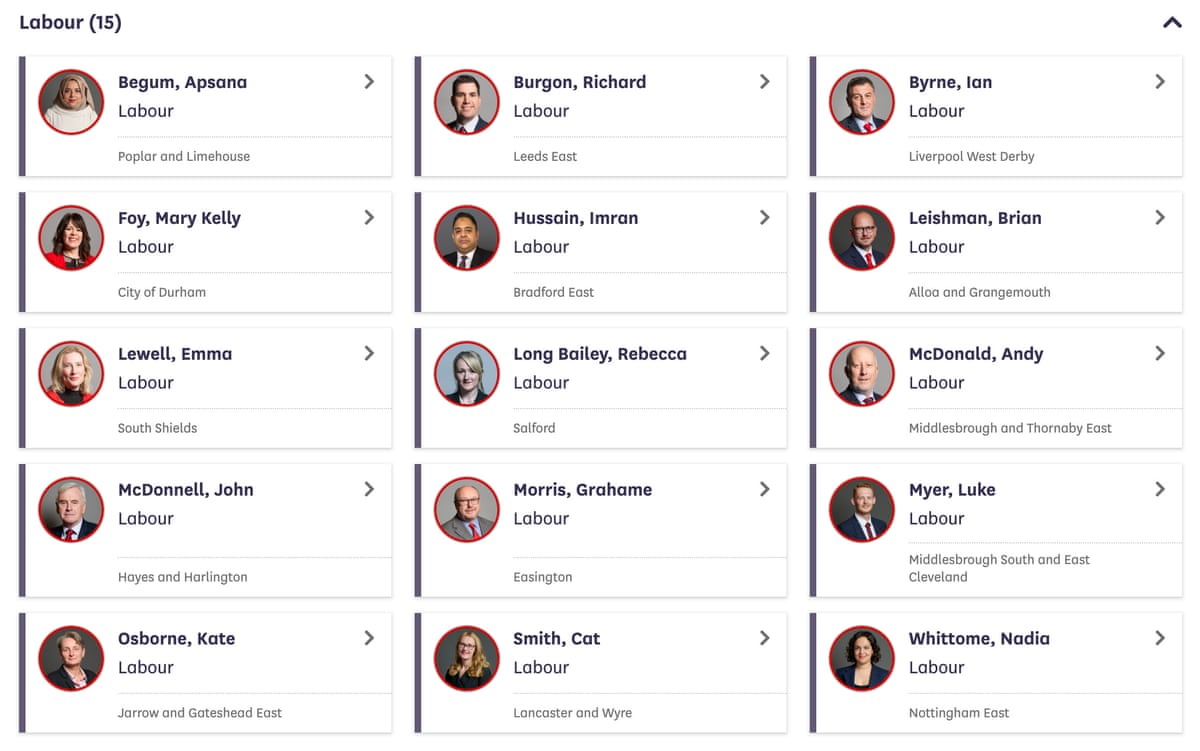
At the start of this parliamentary session, Starmer withdrew the whip from seven Labour MPs who supported an SNP amendment to the king’s speech motion, which called for the abolition of the two-child benefit cap. This action was later regarded as an overreaction, particularly since the government subsequently adopted the policy to abolish the cap. In an interview this morning, Steve Reed, the housing secretary, downplayed the likelihood of the 15 rebels from last night having the whip withdrawn. Speaking to Times Radio, Reed stated:
"There was a handful of usual suspects who did what they tend to do. I’m not in charge of discipline, I’m not too bothered about them to be honest.
You’ve got a handful of usual suspects that will repeatedly vote against the government. They’re not going to distract us.
You know, we’ve got the renters’ rights reforms coming in this Friday, which gives renters, people who rent their home, the biggest increase in protections and rights that we’ve had for a generation.
That is what voters want us to focus on, not a handful of people that go off and don’t play the team game with the rest of us.
Ninety nine percent of us are united with the prime minister so that we can focus on the issues that matter."
While Reed’s calculation is slightly inaccurate—the 15 rebels represent approximately 4% of the Parliamentary Labour Party rather than 1%—his overall point remains clear.
Here is the agenda for today:
- Noon: Keir Starmer faces Kemi Badenoch at PMQs.
- 1.15pm: Parliament prorogues with a ceremony in the House of Lords.
- 2pm: Ed Davey, the Liberal Democrat leader, holds a press conference on plans to “keep Trump, Musk and Putin out of our politics.”
If you wish to contact me, please post a message below the line during comments hours (10am to 3pm), or reach out via social media. While I cannot read all messages below the line, including the word “Andrew” in your message increases the likelihood I will see it, as I search for posts containing that term.
For urgent matters, social media is the best channel. You can find me on Bluesky at @andrewsparrowgdn.bsky.social. has a presence on Bluesky as well, though individual journalists maintain their own accounts. I still use my account @AndrewSparrow and will respond if necessary.
I appreciate readers pointing out errors, even minor typos. No mistake is too small to correct. Your questions are also very interesting; while I cannot reply to all, I endeavour to respond to as many as possible, either below the line or occasionally in the blog.
Farage Supports Blair Institute’s Call for Cuts to Mental Health-Related Benefits
Nigel Farage has expressed agreement with Tony Blair’s thinktank regarding the need for significant restrictions on sickness benefits for individuals with certain mental health conditions.
Yesterday, the Tony Blair Institute (TBI) published a report proposing “an emergency handbrake for UK welfare.” The report stated:
"On a daily basis, nearly 1,000 people in Britain sign on to benefits. As part of the government’s effort to restore trust in the welfare system, we believe it could and should pull an emergency handbrake now that will slow the rise of claimants.
The handbrake is based on a simple idea: there are certain conditions that in the vast majority of cases do not limit an individual’s ability to work, and the default presumption should be that these ‘non-work-limiting’ conditions no longer attract cash benefits.
Many of these conditions are those that have proliferated since the pandemic, particularly mental-health conditions. It is a handbrake that can be pulled now, using secondary legislation ahead of more significant reform later in this parliament."
The report did not provide a comprehensive definition of “non-work-limiting” conditions but recommended that the government develop a list. It added:
"Government should start with conditions where the evidence is strongest but where objective assessment is hardest. People with conditions such as depression, anxiety and some musculoskeletal problems show clear benefits from being in work."
Alongside the handbrake, the report recommended “targeted health and employment support for those no longer eligible for long-term incapacity benefits.”
Regarding the potential impact, the report noted:
"The potential gains from strengthening the welfare system’s gateways are substantial. If incapacity benefit claimant numbers had remained at prepandemic levels – as in most comparable countries – the welfare bill would be around £11.5bn lower by the end of this parliament. And had the number of working-age Personal Independence Payment (PIP) claimants remained at pre-Covid levels, spending would be around £19bn lower."
In an interview on the Today programme this morning, Farage expressed support for the Blair Institute’s proposals, stating:
"Where I do agree, unusually, with Blair’s Institute is that conditions like mild anxiety just cannot qualify for disability benefit. We’re going to have to get tougher on this and not everyone’s going to like it."
Farage criticised the current system, suggesting that some individuals are placed on disability benefits without the requirement to seek employment. He elaborated:
"They can be signed on at a young age to these things. They can be told effectively as young men and women that they’re victims. And if you do that to people, they’re likely to stay victims for the rest of their lives. That is the point that I’m really trying to address."
The TBI report has faced strong criticism from disability campaigners. Charles Gillies, policy co-chair at the Disability Benefits Consortium and senior policy officer at the MS Society, said:
"We’re really concerned that the Tony Blair Institute (TBI) are trying to force harmful benefit cuts onto the government’s agenda – something the PM was forced to backtrack on less than a year ago.
These plans are practically unworkable, would involve no parliamentary scrutiny and are based on a highly regressive view of disability.
The proposals would push many disabled people, potentially including those with MS, further into poverty and worsen their health.
We urge the government to remember that disabled people, campaigners and MPs didn’t stand for such harmful cuts last time, and to reject these proposals."
Good morning all! Remember to get your sunshine – it benefits your sleep by regulating your body clock, improves mood, and supports bone and teeth health. Just 10 minutes outside, or slightly longer on a cloudy day, is beneficial.
Let’s celebrate the sun and this wonderful planet we call home.
(Yes, I am for the first time listening to Radio Two’s ‘Good News Wednesday’ with Vernon Kay, featuring listeners sharing voice notes of their positive experiences.)
Andrew – might have something similar?
We do. We publish a weekly newsletter with good news updates called the Upside. You can here and access the Upside archive.
Pension Schemes Bill to Become Law After Lords Drop Opposition
Peers in the House of Lords have withdrawn their opposition to the government’s proposed pension reforms following ministerial concessions, according to the Press Association.
The upper chamber had previously refused to grant the government powers to direct pension funds on how to invest a portion of savers’ money, aiming to encourage economic growth within the UK.
After ministerial amendments introduced on Tuesday to address peers’ concerns, the House of Lords accepted the final draft of the pension schemes bill.
The portion of funds subject to these powers will be limited to 10% by value of all assets in the scheme’s main default reserves, or 5% of assets held in UK-specific descriptions.
Pensions minister Torsten Bell stated in the Commons that the government had refined the power since the last review by peers. He proposed:
"A new requirement on regulators, in this case, the Pensions Regulator and the Financial Conduct Authority, to make an assessment of barriers to pension funds investing their money into private assets."
The government would also be prohibited from exercising this power before 2028, and it would be repealed entirely by 2035.
Bell referenced the government’s pensions review, which found that the defined contribution pensions market:
"Is operating with an excessively narrow focus on cost. That excessively narrow focus can be detrimental to saver outcomes."
He explained:
"That is where the reserve power comes from – it exists because the review found and the industry itself has told us that competitive pressure focused on cost minimisation is the single biggest barrier to diversifying in savers’ long-term interest."
The changes were accepted by peers.
Liberal Democrat peer Lady Bowles of Berkhamsted commented that although she remained "still no fan of mandation," she believed the issue was now "suitably under control," with "reasonable guardrails" in place.
Shadow minister Viscount Younger of Leckie stated:
"The government have consistently argued that mandation is necessary to address a collective action problem, they will now need to substantiate that claim with robust independent evidence, and for the Secretary of State to have regard to this assessment before they make regulations."
Lady Sherlock, the work and pensions minister, said the bill would “help reshape the pensions landscape” and assist savers in obtaining better returns.
Reed Rules Out Rent Freeze After Reeves Suggests It’s Possible
On Monday, Kiran Stacey reported that the Treasury is considering a one-year rent freeze on private sector homes as part of its response to the economic impact of the Iran war.
Yesterday, while Rachel Reeves, the chancellor, did not rule out the possibility when questioned, No 10 stated it had “no plans” to implement such a freeze. This phrase is often used by the government either to indicate that a policy will not happen or that it remains under consideration but is not yet publicly discussed.
Today, the government has taken a firmer stance. Steve Reed, the housing secretary, unequivocally rejected the proposal.
When asked if the government was considering the idea, Reed responded:
"No. I think I’ve just been crystal clear, we’re not doing it."
Reed Dismisses Ambassador’s Suggestion That Starmer Might Lose Job Post-May Elections
In an interview with Times Radio this morning, Steve Reed addressed comments made by the UK ambassador to Washington, Christian Turner, who privately suggested that Keir Starmer might lose his position after the May elections.
Reed said:
"[Turner] was speaking to a group of school kids. I don’t know whether he meant it seriously, lightheartedly, but whatever it is, it’s not going to happen. He’s not Mystic Meg. We saw in the vote last night, our parliamentary Labour party, our MPs are fully behind our prime minister."
Regarding whether Turner should apologise for the remark, Reed commented:
"I don’t think people have to apologise for every single comment that they make. No."
Jessica Elgot posted the following last night about Darren Jones’s closing speech in the privileges committee debate:
"Keir Starmer had a lot to thank Darren Jones for today - he reminded his backbenches of their real enemies. Reminiscent of the Michael Gove speech at the no confidence vote called by Jeremy Corbyn, which brought his warring party (briefly) back together."
Here is an extract from Jones’s speech:
"Regrettably – we see this again today, time after time – the opposition are just trying to expand their interpretation of the prime minister’s words in bad faith, because their previous claim that the prime minister must have known about Peter Mandelson’s clearance has fallen apart in front of their eyes, and now they are grasping at straws …
[Privileges committee] investigations cannot be done every week off the back of PMQs on an interpretation of the wording of the prime minister. Instead, they must be done on very significant cases that warrant the work of the privileges committee. That is why it is important to contrast the allegations and accusations of the opposition parties, as many Members of the House have done today, with the seriousness of the situation when Boris Johnson was referred to the privileges committee in the last parliament.
This is an important precedent. In those circumstances, Boris Johnson knowingly told this House that there were no parties in Downing Street during Covid lockdowns, only for it to emerge that he had personally been at five of them and received a police fine for attending them. That is the nature of lying to this House, which he was proven to have done in the work of the privileges committee. It is not about the interpretation of a question and answer at prime minister’s questions.
This all begs the question: if there is no substance to the allegations in the motion today, what is it that is driving the behaviour of opposition parties? That question goes to the very basis of the motion before us. I have to ask: what is it precisely about this Labour government giving rights and powers to workers, renters and the disadvantaged that they do not like? What is it about this Labour government standing against unearned wealth and people who use their privilege to extract value from the system, rather than adding to it, that they do not like? What is it about a Labour government raising taxes on private jets and non-doms to raise money for our state schools, our NHS and our police and to lift children out of poverty after years of neglect by the Conservative party that the opposition parties do not want to hear? We all know why – because they are on the side of the vested interests, and we are on the side of the British people."


