
Andy Burnham Could Become Prime Minister Within the Next Month
The Scottish government has stated it has "no idea" what Andy Burnham's plan to redistribute power across the UK will actually involve, according to an SNP cabinet minister.
Burnham, who is anticipated to succeed Sir Keir Starmer as prime minister, has pledged to decentralise governance away from Westminster and Holyrood to "power up" all parts of the UK.
Public Service Reform Secretary Ivan McKee agreed that while the UK was "far too London-centric," the Labour MP's speech lacked detail.
However, he said the Scottish government was prepared to work "in partnership" with Westminster.
If no other Labour MP makes a leadership bid, Burnham is expected to become prime minister on 20 July.
He delivered a speech on Monday making his case for the Labour leadership, stating he wanted to "extend devolution in Scotland, Wales and Northern Ireland by taking power deeper down."
New 'No 10 North' Plan Will Rebalance Power in Britain, Burnham Promises
Andy Burnham vows to decentralise power in Scotland.
Writing in The Scotsman, the former Greater Manchester mayor said the key to the strategy would be the extension of the prime minister's office to Manchester, to be called the "Number 10 North."
He wrote:
"It will be the conduit through which we redistribute power and resources across the UK.
Its job will be to make power flow into places like Glasgow, Aberdeen, Dundee, Paisley and Easterhouse, not hold it back."
Burnham added that "all parts of the UK should be able to take greater public control of essential services such as water, housing, energy, and transport" – with this drawing on the model that has "transformed our bus networks in Greater Manchester."
'Catchy Lines'
Responding to Burnham's speech, McKee told BBC Radio Scotland Breakfast:
"I have no idea what he means and I don't think he knows what he means."
He said that while the Labour leadership hopeful had provided "catchy lines," ministers had not seen any details of the proposals.
The public service reform secretary noted that the UK and Scottish governments had worked well in the past to deliver city region deals – with the two administrations jointly funding major infrastructure projects in local authorities across Scotland.
But he also said there had been examples where the UK government "just breezed in and decided that they know best," telling the BBC that "clearly has not worked as well."
He added that SNP ministers had hoped for a "much more constructive relationship" with Sir Keir Starmer's government but that "had not panned out."
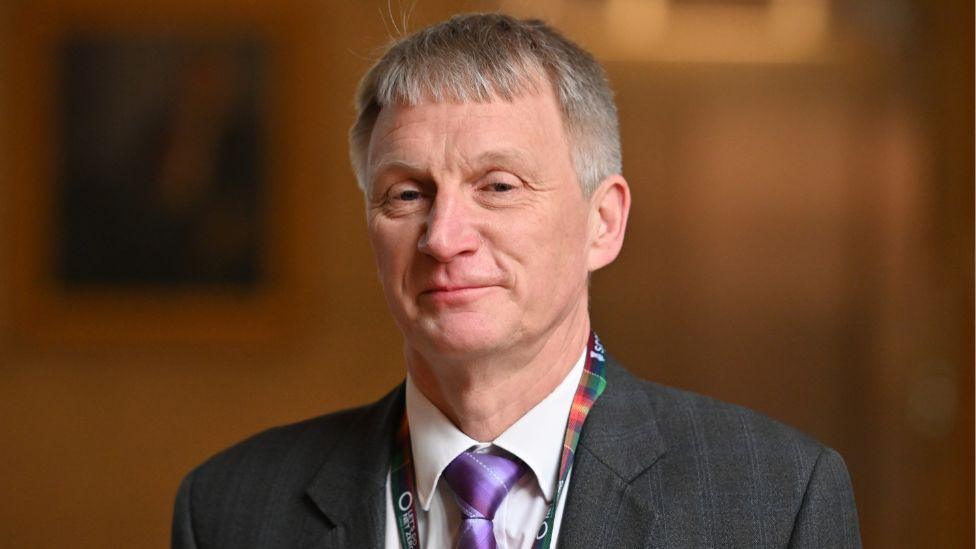
Ivan McKee says the Scottish government is willing to work constructively with the UK government.
McKee said while the Scottish government was "disappointed" with the current relationship, a change of leadership could provide the opportunity for a "new start."
He added:
"Provided there is a partnership there we are very happy to work with the UK government to do what's best for Scotland."
The Scottish government's ultimate goal is independence, but in the meantime it has called for the devolution of several key powers that remain reserved to Westminster.
McKee cited employment law, which would allow SNP ministers to set a minimum wage, as well as full control over immigration, energy policy, social security and business taxes.
On Monday, First Minister John Swinney warned Burnham that:
"Rhetoric alone will not cut it when Scotland so badly needs more job-creating powers and the ability to lower energy bills."
Devolution Hasn't 'Always Delivered'
UK Energy Minister Michael Shanks insisted Burnham's plan could "really improve people's lives – and much, much faster than we have been doing in the past two years."
He described Scotland as overly centralised, and said Burnham wanted to work "in partnership" with SNP ministers to deliver "better outcomes."
The Rutherglen MP told BBC Radio Scotland's Drivetime the strategy was to transfer power away from Holyrood and Westminster to communities "who know best" about how money should be spent there.
He said devolution had not "always delivered," and that some powers transferred to the Scottish Parliament "had not been properly used."
Shanks said that the new Labour government would examine what further powers could be devolved "but with a purpose."
He also suggested that powers could be devolved from Holyrood to local authorities, such as employment responsibilities to get young people into work.
What could Andy Burnham as PM mean for Scotland?


