

Photographer Captures Six Planets in One Image During Celestial Parade
Josh Dury, a photographer from Bristol, successfully captured an extraordinary image featuring six planets aligned in a celestial parade. The photograph was taken from a radar memorial in Worth Matravers, Dorset, on Tuesday shortly after 18:30 GMT.
The image includes Earth, Mercury, Venus, Jupiter, Saturn, Uranus, Neptune, and also the Moon, showcasing a rare planetary alignment.
A planetary parade occurs when several planets appear to be aligned on one side of the Sun as observed from Earth. This phenomenon will be visible again in the UK from sunset on Saturday.
Dury undertook a demanding four-hour journey to reach the location, which was originally expected to take two hours but was extended due to road closures.
"It was a matter of arriving on location and seeing the sun go down to get into position to wait for the sky to darken."
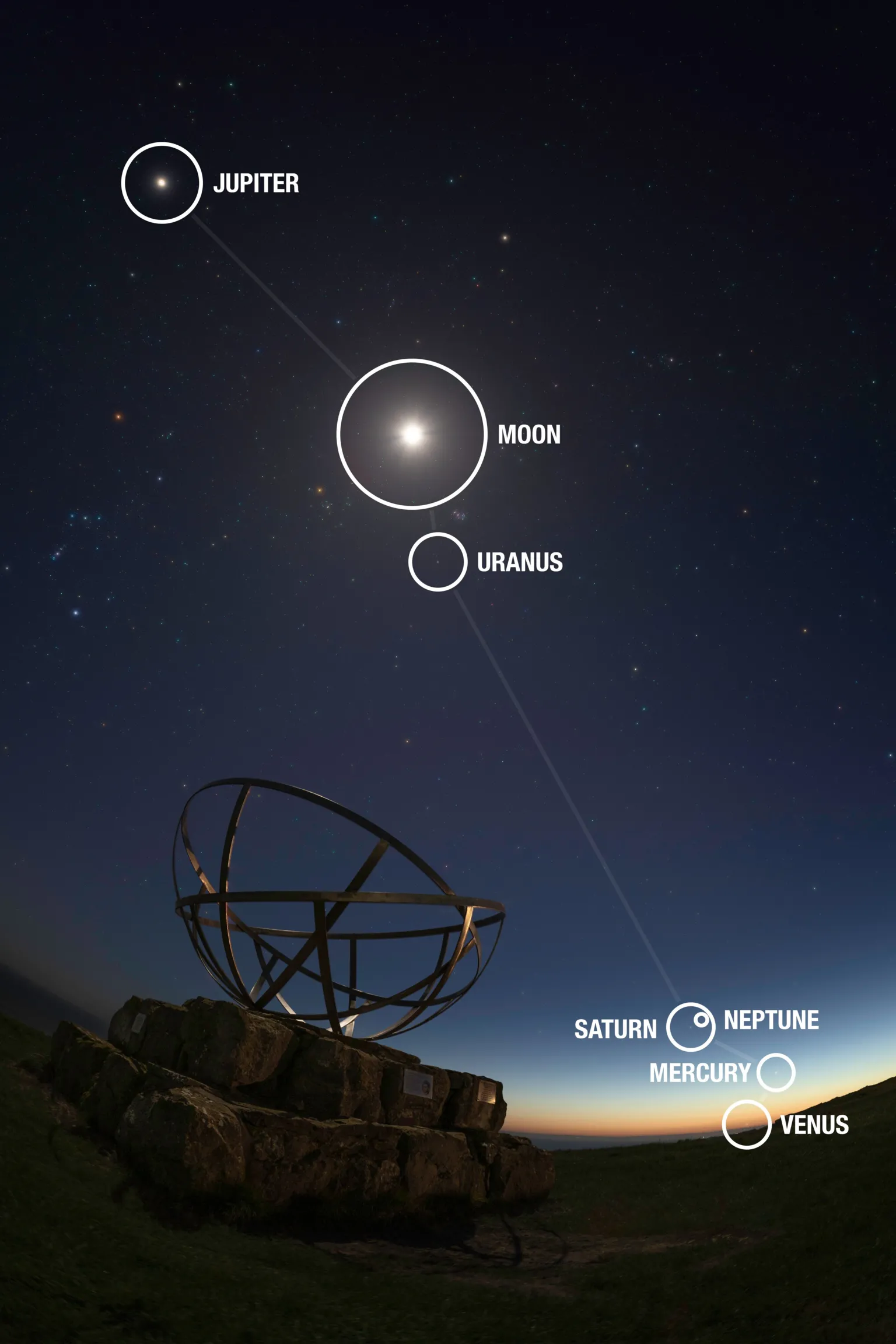
He described the process of capturing the image as a "battle against time," employing a wide-angle lens to capture nearly a 180-degree field of view. This allowed him to photograph the planets appearing like a "string of pearls" across the sky.

"It meant it was possible to capture a nearly 180 degree field of view, so you could almost capture them like a string of pearls in the sky."
Dury expressed his amazement upon capturing the shot.

"It was wonderful to see the developmental stages of the parade happen," he said.
"It's quite a rare photograph purely because it's that line-up of how they appear in the night sky.
It just really puts into perspective our place among the solar system."
What is a planetary parade?
A planetary parade refers to an event when multiple planets appear to be aligned in the sky from Earth's viewpoint.
On the upcoming Saturday just after sunset, Mercury, Venus, Saturn, and Neptune will be visible low in the western sky near the horizon.
For those without binoculars or telescopes, attending local astronomy society events may provide better viewing opportunities.
To observe the parade effectively, a location with an unobstructed horizon is recommended, especially to see Mercury and Venus, which will be positioned very low in the sky.
Higher in the sky, Uranus will be located within the constellation Taurus and will remain visible until around midnight, offering observers with appropriate equipment a better chance to spot it.
Jupiter will be the most prominent of the six planets, shining brightly in the constellation Gemini and positioned high enough to remain visible for much of the night, even in areas affected by light pollution.
For updates and more information, you can follow BBC Hampshire & Isle of Wight on Facebook, X (Twitter), or Instagram.


