

More than half of voters regard Farage as 'very sleazy', poll suggests
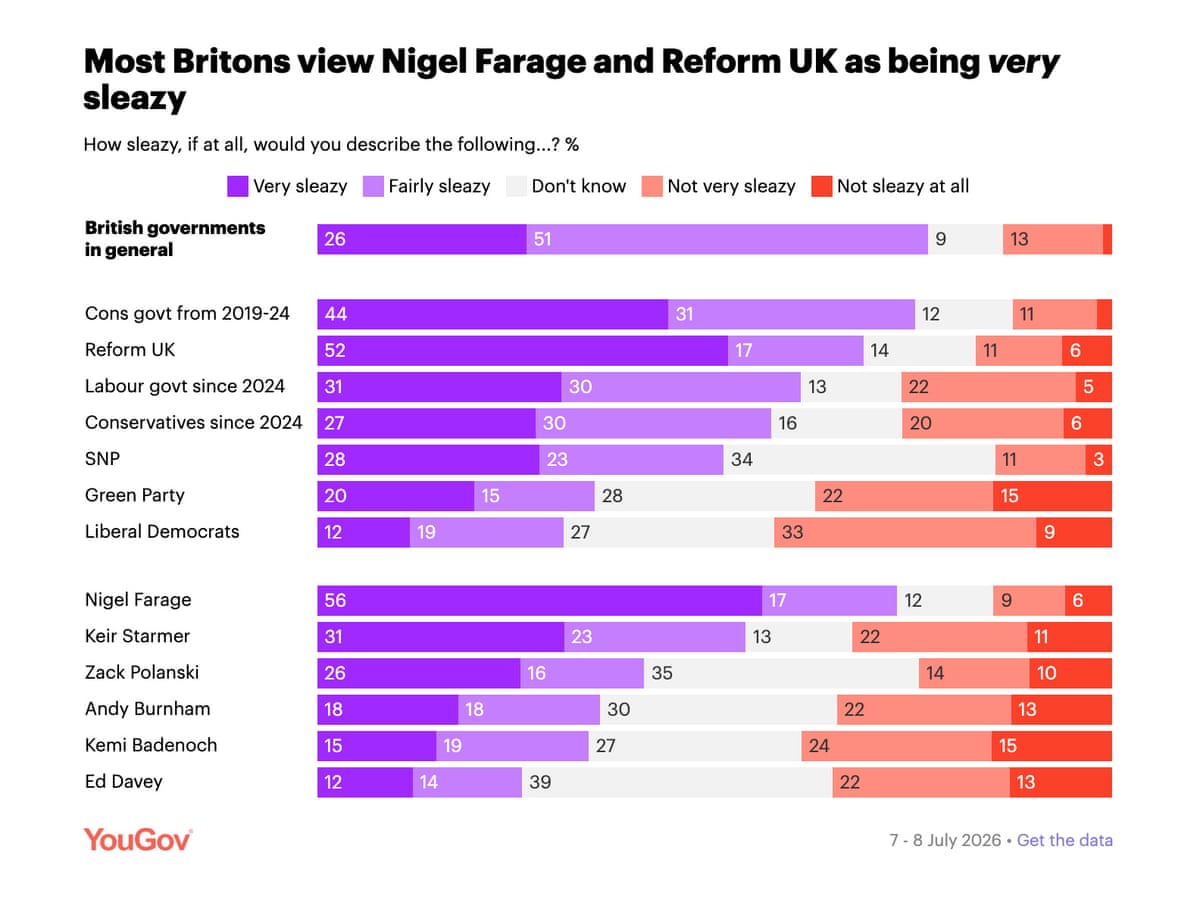
YouGov has published a poll today indicating that more than half of voters consider Nigel Farage to be “very sleazy.” On this measure, he scores significantly worse than any other party leader. Notably, 40% of Reform UK voters also regard him as “sleazy.”
Here are the figures. This chart shows the figures for parties, party leaders, and “British governments in general.”
And this chart shows how views vary depending on which parties people support.
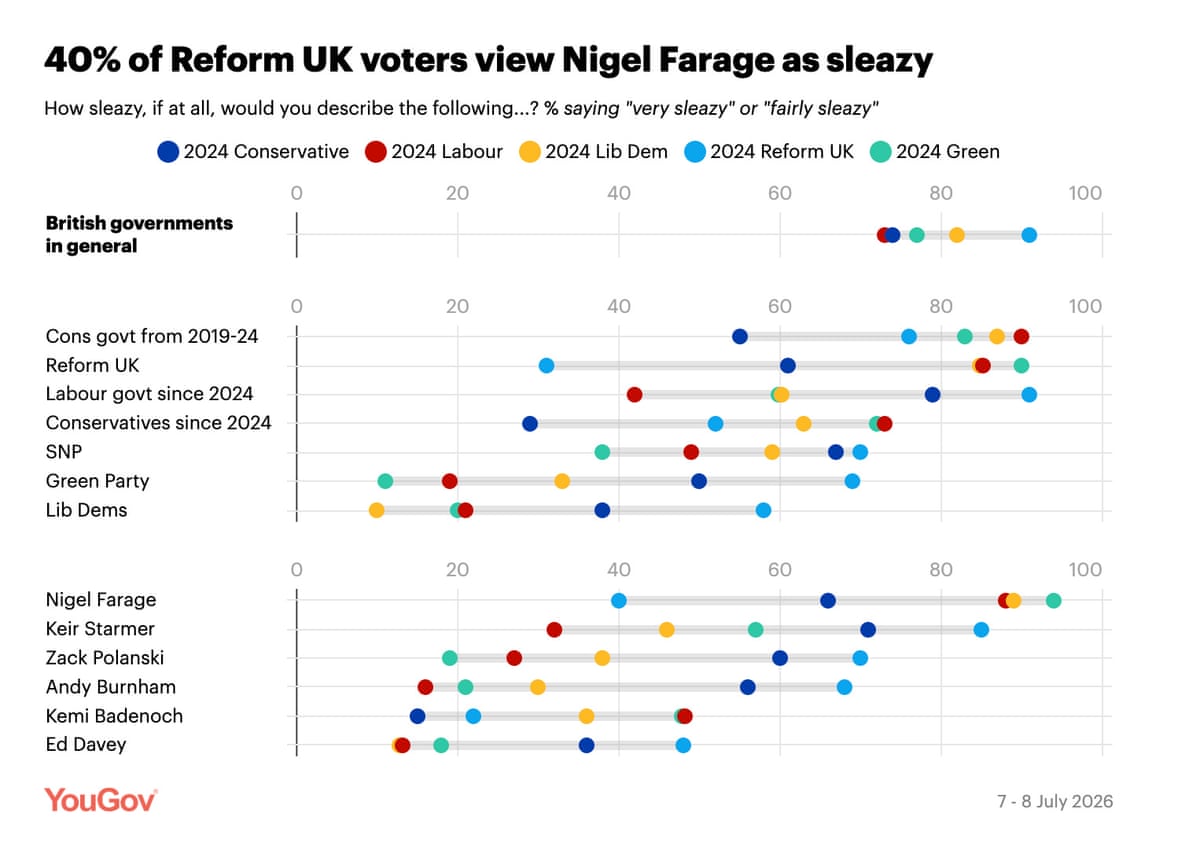
In his analysis for YouGov, Dylan Difford highlights that Reform UK’s rating on this measure has deteriorated.
Reform being viewed as sleazy is not necessarily a new thing, but the perception has grown. In October 2024, at the height of the freebie-gate scandal, half of Britons saw the party as sleazy, a clear 18 points lower than today.
However, this increase in negative perception is not limited to Reform UK. The belief that the Green party is sleazy has roughly doubled from 18% to 35% over the last 21 months, while such a view of the Liberal Democrats has also risen by seven points.
By comparison, evaluations of the current Labour government, its Conservative predecessor, or British governments in general have remained largely unchanged during this period.
One limitation of polling of this nature is that while voter opinions are always noteworthy, they are not always accurate. When respondents tell pollsters they regard a politician or party as “sleazy,” it can imply perceptions of corruption or moral dubiousness; however, it may simply reflect dislike.
For instance, this polling suggests 73% of people view Farage as either very (56%) or fairly (17%) sleazy. Yet 77% of people see “British governments in general” as either very (26%) or fairly (51%) sleazy.
Such a judgment might surprise many who seriously follow British politics. UK governments have various flaws, but by international standards they are not corrupt, and ethical standards are reasonably high. These figures likely reflect popularity more than actual morality.
Polanski says new report shows rent controls could cut poverty and save state billions, with minimal impact on landlords
Zack Polanski, the Green party leader, has welcomed research published today arguing that a well-designed rent control policy could save the government billions of pounds and lift hundreds of thousands of people out of poverty.
The report, produced by the Institute for Innovation and Public Purpose at UCL, states that if rents in England had been frozen in November 2022, the government would now be saving £2 billion annually, and average renting households would be saving £2,400 per year.
The report also refutes claims that rent controls would collapse the private rental market by causing landlords to cease renting their properties.
If Andy Burnham is serious about ending rip-off Britain, fixing our broken system and putting money back in the pockets of ordinary people – rent controls simply must be at the top of his agenda.
We hear plenty of scare stories about landlords being bankrupted by rent controls. But this research exposes that as nonsense. Over the last three and a half years, we could have saved households on average £2400 a year – while still allowing landlords to enjoy profit margins four and a half times larger than the average UK business.
We need a prime minister who is willing to control the rental market, lower prices – and doesn’t fear the bond markets. No half measures: it’s time for our next prime minister to show us what he’s made of.
The report, authored by Beth Stratford and Joe Beswick, concludes:
We conclude that the risks associated with rent controls, though significant, are manageable – and pale against the cost of inaction: spiralling housing benefit spending, rising homelessness, and entrenched poverty and inequality.
The authors note that rent controls have been effective historically.
England’s private renters face some of the worst affordability pressures in the developed world. The evidence makes clear that neither new house-building nor increased housing subsidies can realistically address the full scale of the problem. By contrast the historical record across Europe shows that the most decisive improvements in housing affordability in the 20th century came from the direct regulation of rents.
Regarding potential savings, the authors state that if the government had frozen rents in November 2022, it would have been able “to restore housing support payments to cover the cheapest 30% of local rents and would still be saving an estimated £2bn a year in housing benefit spending by now.”
This would save the average renting household £2,400 annually, “boosting the disposable income of renters in the poorest quintile by 22%,” they add.
Addressing concerns that rent controls would put landlords out of business, the authors assert that landlords would still make healthy profits even with rent controls.
For mortgaged landlords, a 20% reduction in rent reduces mean pre-tax profit margins from 70% to 64% – which means they would still be 4.5 times bigger than the mean pre-tax profit margin for UK businesses. Profit margins for unmortgaged landlords (58% of all unincorporated landlords) would be higher still. These figures do not take account of capital gains from house price appreciation.
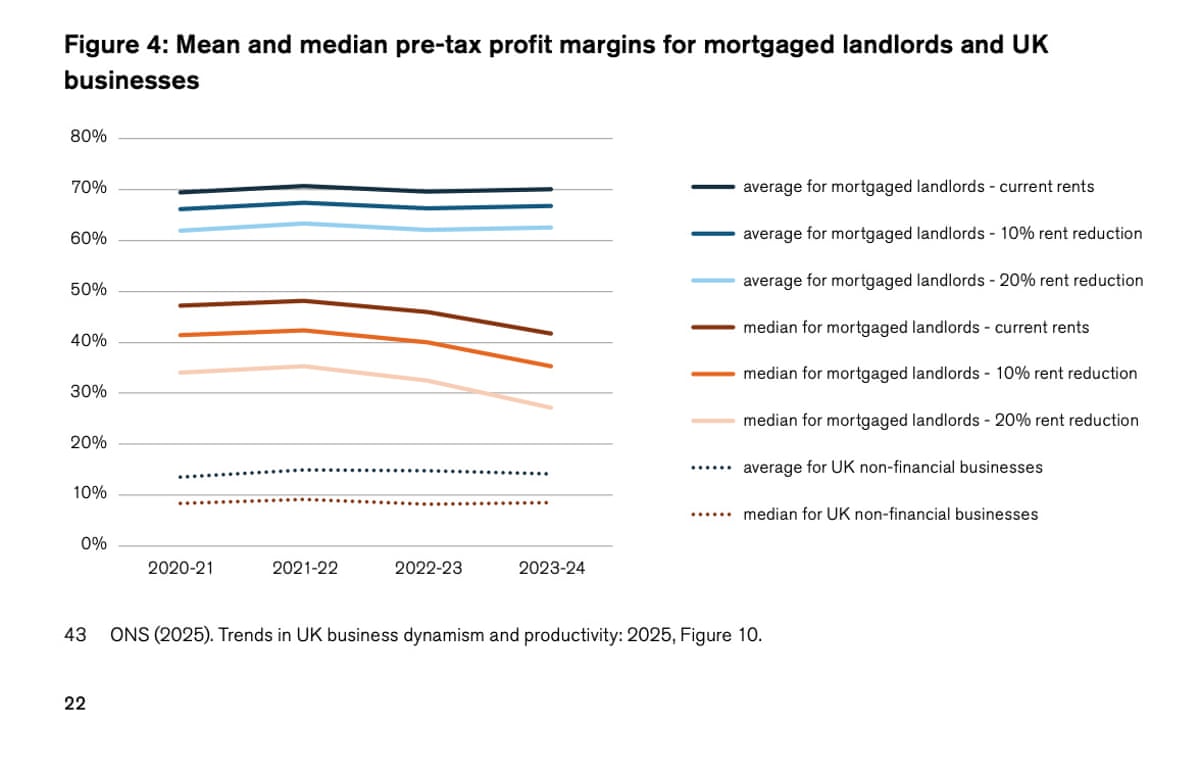
A 10% reduction in rents would cause 2.3% of landlords to become unprofitable – significantly fewer than the 4.8% of landlords tipped into loss-making by changes to mortgage interest tax relief (MITR) and interest rate rises since 2021-22.
The report recommends combining rent controls with policies granting tenants a minimum six months to find alternative accommodation if a landlord decides to sell, and giving tenants, then councils and housing associations, first refusal to buy.
It also suggests rent controls could lead to many properties being sold and acquired by councils for social rent.
Crucially, if accompanied by the right fiscal and legal framework, landlord exit presents a historic opportunity: a managed transfer of homes out of the insecure private rented sector and into permanently affordable ownership.
Richard Tice dismisses police investigation into Reform UK donations as linked to 'politically-motivated smear campaign'
Richard Tice, the Reform UK deputy leader, has dismissed the police investigation into donations worth £500,000 made to Reform UK by Fiona Cottrell as part of a “politically-motivated smear campaign.”
Speaking on Times Radio this morning, he stated he was unaware of the police investigation until it was reported today. He added:
I’ve known the Cottrell family, my family have known the Cottrell family, and the broader Hesketh family for 50 years, a very successful aristocratic family.
And, as far as I’m concerned, she’s a permissible donor. And that’s the end of it.
And this is a politically-motivated smear campaign by people who wish us ill.
Boris Johnson pays tribute to Ann Widdecombe, saying she could 'move Tory audiences to ecstasy'
Boris Johnson, the former Conservative Prime Minister, has joined others in paying tribute to former minister Ann Widdecombe, who has died.
I am sad to hear about the loss of Ann Widdecombe, a heroic Brexiteer and a great speaker who could move Tory audiences to such ecstasy that she was a very hard act to follow.
(When a politician praises a colleague who has died, sometimes their remarks reveal how they wish to be remembered themselves. This may be an example.)

William Hague, who had Widdecombe as his shadow home secretary when he was Tory leader, said:
So very sorry this morning to hear of the death of Ann Widdecombe. She was a great friend and a unique personality. Her enthusiasm, clarity and warmth will be much missed.
Priti Patel, home secretary under Johnson, also commented:
Ann Widdecombe was a much-loved member of the Conservative family. She was principled, always stayed true to her values and her faith and had a great sense of humour. Her authentic and no-nonsense approach to politics has stood the test of time and she will be remembered as one of the most captivating, engaging and memorable politicians of her generation.
It was a privilege to work closely with her while she was in William Hague’s Shadow Cabinet and to call her a friend. May she rest in peace.
Additional tributes to Widdecombe, including from Kemi Badenoch, are included in our full story.
Count Binface 'carrying hopes of nation' in Clacton byelection, Burnham jokes
Andy Burnham has humorously endorsed Count Binface, the satirical candidate who appears to be Nigel Farage’s main opponent in the Clacton byelection. “Count Binface, you are carrying the hopes of a nation,” Burnham said at an awards ceremony. The Sun has reported on this.
On X, the right-wing social media platform, many Nigel Farage supporters claim Binface is the establishment candidate in the byelection. Rael Braverman, whose wife Suella is Reform UK’s education spokesperson (and who has held the posts of home secretary and attorney general), stated:
Binface is an establishment tool.
Burnham’s comment is likely to fuel these claims.
Immigration policy is one area where Andy Burnham faces significant challenges as he prepares to become Prime Minister. Other stories about Burnham’s potential actions upon taking office include:
Jim Pickard, George Parker, and Jennifer Williams report that Burnham is considering appointing a deputy Prime Minister based in Manchester to oversee his No 10 North office. The deputy Labour leader, Lucy Powell, is reportedly well-positioned for this role.
Burnham is expected to spend several days a month in Number 10 North. Caroline Simpson, chief executive of the Greater Manchester Combined Authority, has been lined up to run the new office.
But the transition team has also raised the idea that the new unit could be given political direction by the next deputy prime minister, who would be based in Manchester, according to people close to the situation.
Burnham has deliberately refrained from naming any cabinet members, leaving Whitehall in suspense even as access talks have begun between the incoming prime minister and civil service chief Dame Antonia Romeo.
Lucy Powell, the elected deputy leader of the Labour party and a Manchester MP, is considered the leading candidate to become deputy prime minister, ideally placed to work from Downing Street’s northern office.
John Bew, a former No 10 foreign policy adviser, has suggested Burnham could face an international crisis within weeks of taking office. Bew said:
I’d say there’s a high likelihood of a series of quite challenging contingencies happening.
One is a horizontal or vertical escalation from Putin over the course of this summer and beyond because the war [in Ukraine] is not going well for him.
It has been reported that Bew is consulting with Burnham’s team, but not about taking a formal role in his administration.
Some ministers are lobbying Burnham to retain their positions. Sam Francis and Megan McElroy provide a summary for Politico.
Cabinet auditions continue across Westminster. Business Secretary Peter Kyle was at least direct about it, telling ’s Richard Partington that “I want to stay, I’ll just stay where I am.” He also declared Britain needs “Manchesterism.” In another not-very-subtle intervention, David Miliband used his foreign policy speech last night to restate his support for electoral reform (he previously backed the Alternative Vote at the 2011 referendum, while still an MP) and back a Burnham-style transfer of power out of Westminster (the Arguably substack has the full script). Just before Miliband spoke, Yvette Cooper revealed to Chatham House that she had spoken to Andy Burnham before heading to NATO — meaning she’s already giving him foreign affairs advice.
Returning officer names Thursday 13 August as date of Clacton byelection - one week later than Reform UK wanted
Tendring district council, which covers Clacton, has announced that the byelection there will be held on Thursday 13 August.
This represents the first setback for Reform UK, whose leader Nigel Farage is defending his seat after resigning to trigger a byelection in the hope of pre-empting a standards inquiry that could lead to a recall byelection later this year. Reform UK had wanted the byelection to be held earlier.
Announcing the decision, the acting returning officer, Ian Davidson, stated:
The electoral timetable is set out by law and so we are bound by these dates.
Potential candidates will … have four days, from Tuesday 14 July to Friday 17 July at 4pm, to submit their nominations.
Residents not already on the electoral register have until 28 July to apply to vote in time for the byelection, and until 5pm the following day (29 July) to apply for a postal or postal proxy vote.
Davidson also posted a picture of the writ he received from the Clerk of the Crown in Chancery instructing him to organise the byelection.
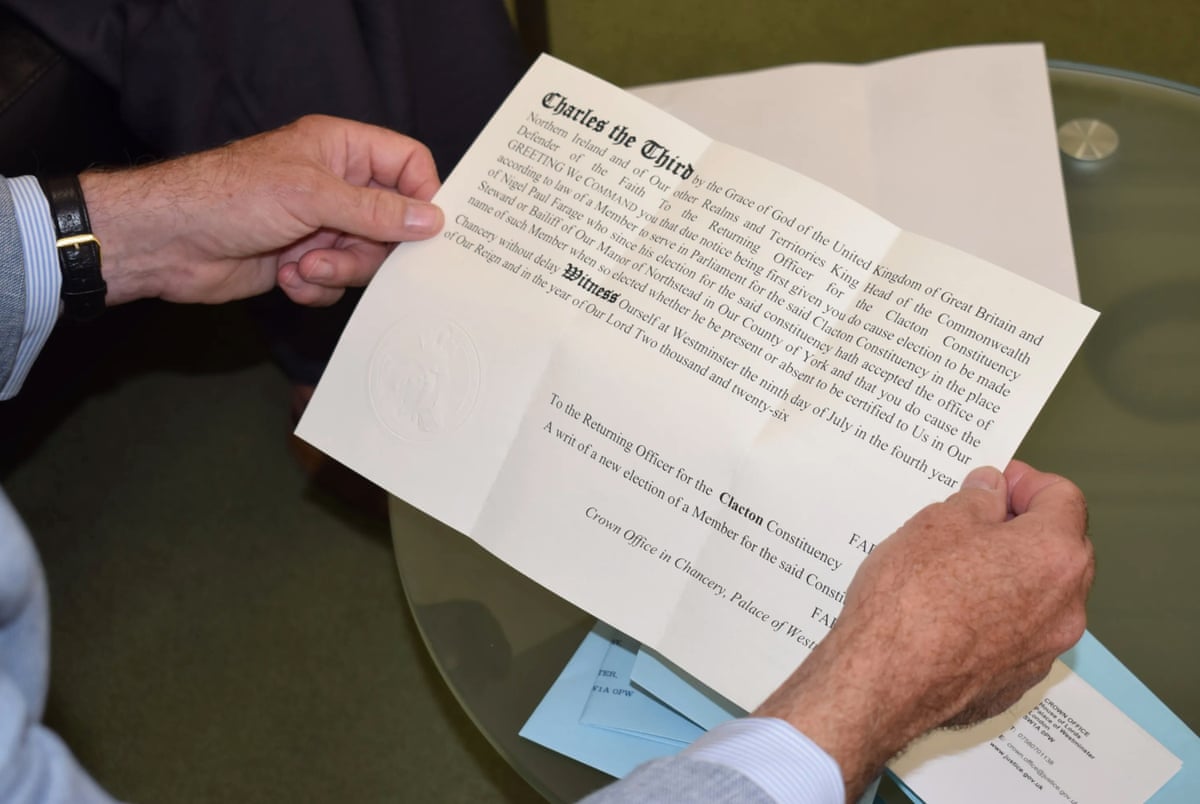
Separately, Jeffrey Donaldson, the former DUP leader, has been removed from the privy council, it has been confirmed.
In a statement, the clerk of the privy council said:
Now, therefore, by and with the advice of His Majesty’s Privy Council, it is hereby ordered, that the name of the said Jeffrey Donaldson be removed from the list of Members of His Majesty’s Most Honourable Privy Council.
Libby Brooks has written her First Edition briefing about the funding scandal. It features an interview with Anna Isaac, who broke the story about Farage’s undisclosed £5 million donation and has led ’s coverage of this controversy.
Labour welcomes police investigation into donations to Reform UK from fraudster's mother
The Labour party has welcomed news that the Metropolitan Police are investigating donations worth £500,000 made to Reform UK by Fiona Cottrell, whose son George is a convicted fraudster and a friend and aide to Nigel Farage. Anna Turley, the Labour party chair, said:
Nigel Farage can run against a bin in his distraction byelection, but he can’t hide from legitimate questions. Why did the mother of the convicted criminal who secretly bankrolled him donate half a million pounds to Reform UK? Where did the money come from? Why did George Cottrell have such a prominent role in his operation without having an actual job? It’s right that the Metropolitan Police are looking into this.
The British public know when they’re being taken for fools – if Nigel Farage could clear his name, he would have done it by now.
Burnham will be 'faster and bolder' delivering change than Starmer, Lisa Nandy claims
Lisa Nandy, the culture secretary, appeared on the Today programme this morning. She is close to Andy Burnham (they represent neighbouring constituencies) and said two things would be different when he becomes Prime Minister.
I think there will be two things that will be different under Andy Burnham.
The first is that it will be faster and bolder and he’s willing to think very differently about how we deliver that change.
No 10 for the North has attracted a lot of interest, but that really is about shifting the centre of gravity in the country, so that all parts of the country are seen and heard and are able to contribute.
But the second thing that I think will be different is that I think we will wear our hearts on our sleeve more. I think people will see us taking the fight to any system that stands in the way of them living better lives.
And I really think, at the moment, at a time when trust in the power of government to change people’s lives is very weak, that that is an enormously important thing.
'Talking tough not same as effective action' - extracts from letter from Labour MPs calling for 'refresh' on migration policy
Here are further extracts from a letter to Andy Burnham signed by nearly 80 Labour MPs urging him to adopt a more liberal stance on immigration.
The MPs claim the government’s language on immigration has been too hostile.
Immigration and asylum is a test case for how we do so. Polling in this area shows that most voters are “balancers” who understand the benefits and the costs of migration. In this group, some prioritise order and control; while others prioritise compassion, justice and rights. We must speak to both groups simultaneously and persuasively. Currently, we are seen to talk much more about control than compassion. And when we talk about compassion, progressives do not believe us because our hostile rhetoric has already alienated them. That rhetoric also raises the salience of asylum as a problem in the minds of those already anxious about lack of control. Our approach needs a refresh.
They suggest that measures introduced during Labour’s first year in office (when Yvette Cooper was home secretary) are effective.
Talking tough is not the same as effective action. The reductions in the asylum backlogs, in small boat crossings and in...


