

Government Announces Major Local Government Reorganisation in Essex
The government has declared that the existing network of 15 councils in Essex will be abolished and replaced by five new local authorities. These all-purpose councils, known as unitary authorities, are scheduled to come into effect in 2028, serving a population of approximately 1.9 million people.
Communities Secretary Steve Reed emphasized that this model was "clearly shaped by the communities across the area and reflects local identities."
The five-council plan contrasts with the proposal supported by Essex County Council, which had advocated for the establishment of just three unitary councils.
"The five unitary model creates sensible geographies that will empower each new council to deliver new housing in line with local needs.
Each unitary will also be directly accountable for delivering public services tailored to local challenges."
The government has stated that this restructuring of local councils in England aims to assist in meeting housebuilding targets and reforming public services.
Current Structure and Proposed Changes
Currently, Essex comprises 12 district and borough councils alongside three county and unitary authorities, operating under a two-tier local government system. Various proposals had been considered, including models with four and three councils for the county.
This reorganisation represents the most significant change in Essex's local government since 1974.
The county will be divided geographically into five new council areas: West Essex, North East Essex, Mid Essex, South West Essex, and South East Essex.
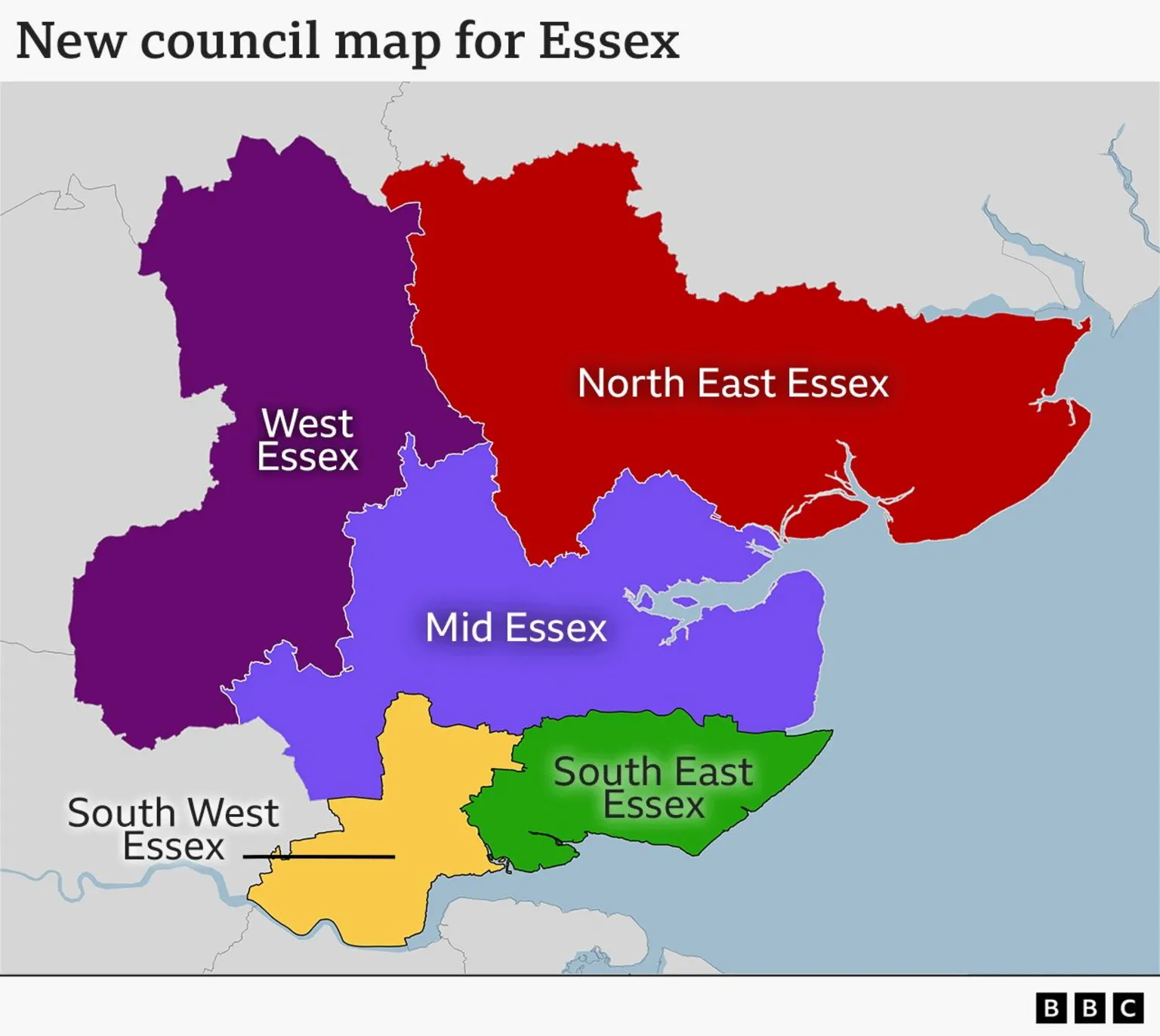
The five-council proposal has garnered broad cross-party and cross-council support, particularly from Labour, Liberal Democrats, and the Greens.

Analysis conducted by the accountancy firm Grant Thornton suggested that adopting a five-unitary council model could generate a £35 million net benefit by the fiscal year 2032-33.
Reactions from Local Leaders
Daniel Cowan, leader of Southend-on-Sea City Council and proponent of the five-district proposal, noted that his team could draw upon nearly "thirty years" of experience as a unitary authority.
"But that's where it begins and ends, because we are all coming together and we need to create a new sense of place," said the Labour politician.
Danielle Belton, leader of the Conservative Rochford District Council who had proposed a four-council model, commented on the government's decision.
"The decision from Westminster isn't ideal but we will make the best of it."
Opposition and Next Steps
There are opponents to the reorganisation. Reform UK leader Nigel Farage has expressed opposition, stating that "we should fight" the changes and prefers the current network of councils.
To assist with the transition, Essex will receive £4.5 million in government funding.
Legislation to abolish the current councils and establish the new unitary authorities will need to be passed by Parliament in the autumn.
Elections for the new councils are scheduled for May 2027, with the new authorities set to replace the existing councils in April 2028.
For ongoing updates, follow Essex news on , Facebook, Instagram, and X.


