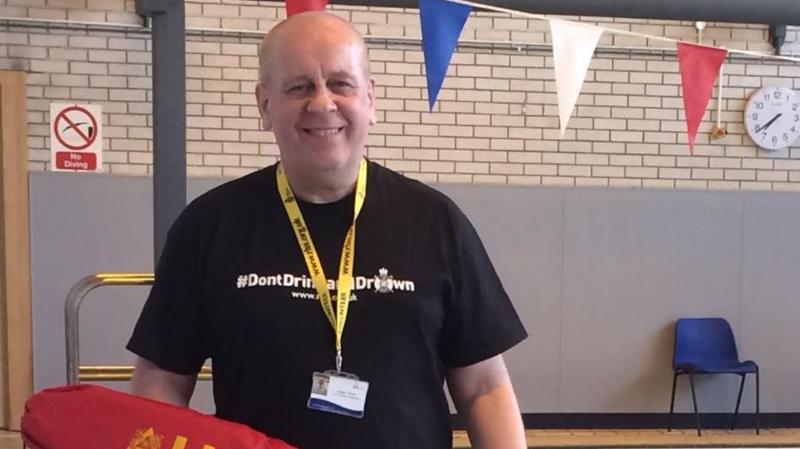
A man whose brother drowned after suffering cold water shock has recalled how the bereavement "ripped [his] family apart". Doug Thomas' brother Gordon drowned at the age of 19 while in the Royal Navy, after going into Falmouth harbour in 1972.
Doug said Gordon could swim, as was required for the Navy, but died after suddenly entering water below 15°C and experiencing a rapid, involuntary cold water shock response. He has now joined other families who have experienced children, parents or siblings dying in water to support an urgent call to reduce drownings as part of a new strategy.
Figures show there are around 600 water-related deaths in the UK every year, while in Wales there is an average of one drowning every week at coastal and inland waters.
Doug Thomas has been a water safety campaigner for nearly 50 years following his brother's drowning
Doug, who was one of nine children, was 12 years old when Gordon died.
"The warship was out in the bay and so the 12 naval officers were on one boat, 12 in another, and for some strange reason my brother dived out of his boat and attempted to swim to the other boat," recalled Doug.
"This was the middle of the night and he had been drinking with other naval officers and whilst attempting to swim my brother drowned in his Navy uniform."
"It devastated my parents and ripped the family apart," added Doug.
"They separated seven years later."
Doug, 66, from Swansea, has been a water safety campaigner for nearly 50 years following his brother's drowning, and volunteered as a lifeguard for more than 30 years.
How does Doug want water safety taught?
Doug said there is more education now and more knowledge, but he wants key water safety messages to appear in all schools. He said the plan is to get those messages into schools and colleges, and to encourage children to learn and be aware of the dangers of swimming in open water.

He said that is especially important in places like harbours, lakes and quarries, which are not lifeguarded, and noted that more drowning incidents have been seen during the heatwave.
"There is more education now and there is more knowledge, but we want these key water safety messages to appear in all schools, that's our plan, get them into schools, colleges, and encourage children to learn, you know, to be aware of the dangers of swimming in open water," said Doug.
"Especially in places like harbours, lakes, quarries, which aren't lifeguarded, and we have seen more drowning incidents during the heatwave."
Doug said he wanted to "get the key messages out there" including not to swim in open water which is not lifeguarded "or can lead to cold water shock which can be fatal".
Why is drowning a growing public health challenge?
Eight in 10 victims of accidental water-related deaths in Wales are male, with accidental drownings most frequent in young men aged 20 to 29. In recent weeks, there have been two deaths at Llyn Geirionydd, Conwy.
The body of a 21 year old man was recovered from the water on 7 July, while the body of another man was recovered from the water last week. Earlier this month, a teenager died after becoming submerged by the current in the River Wye during a Duke of Edinburgh Award expedition.
Families with lived experience of water deaths have now joined forces with Welsh government, charities, landowners, activity providers and campaigners to launch the Wales Drowning Prevention Strategy.
Keith Reid, Deputy Chief Medical Officer for Wales, said: "Every drowning is a tragedy that leaves a lasting impact on families, friends and communities, and one life lost is one life too many. By bringing together public services, schools, colleges, communities, charities and partners across Wales, we can strengthen our shared mission to prevent avoidable deaths in, on and around water.
"This strategy reflects our collective determination to save lives, raise awareness of water safety, and work towards a future where no family has to experience the heartbreak of losing a loved one in this way."
The strategy aims to ensure every child and young person has a water safety education and is able to swim, and to ensure drowning prevention efforts remain responsive to changing weather patterns.
Chris Cousens, Chair of Water Safety Wales, said: "Drowning remains a serious and growing public health challenge in Wales.
"We have an accidental drowning rate more than double that of the UK as a whole and despite the best efforts of Water Safety Wales members and others, fatality numbers have increased slightly since the first Wales Drowning Prevention Strategy was published.
"The launch of this strategy is an opportunity for us all in Wales to acknowledge that each of these deaths is a tragedy.
"Water Safety Wales believes one death is too many, we will reduce drowning if everyone plays their part and together, we can build a future with zero drownings where everyone in Wales can be safe in, on and around the water."