Defence Investment Plan and Funding Challenges
The Defence Investment Plan (DIP) proposes an increase in military expenditure by £15bn over the next four years. Prime Minister Sir Keir Starmer has described this as "a historic shift," although critics argue that the additional funds remain insufficient to ensure national security.
Attention has now turned to the financing of the increased spending outlined in the DIP. The Treasury has disclosed that the savings identified from other government departments do not fully cover the planned rise in defence expenditure.
This shortfall has led to discussions of a "£5bn defence black hole," which could present a significant challenge for Sir Keir Starmer's presumed successor, Andy Burnham.
BBC Verify has examined these figures to provide context.
Is there a £5bn hole?
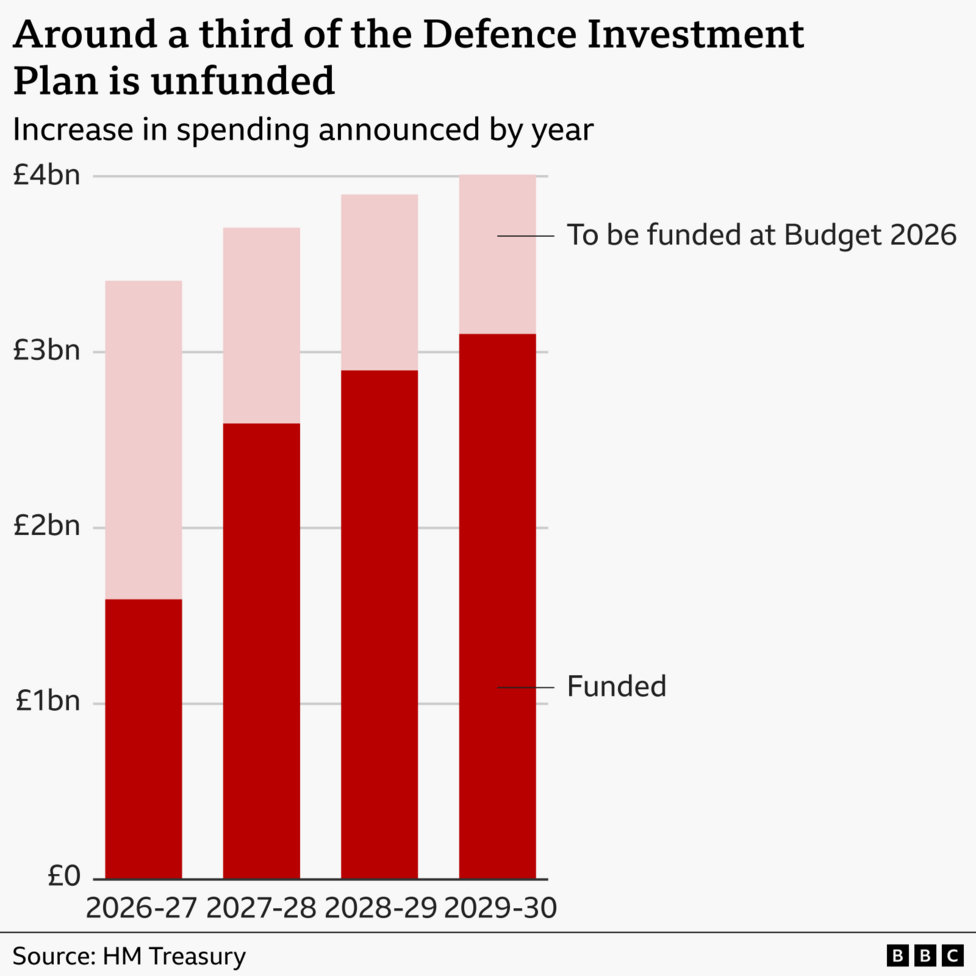
The Treasury published a table indicating that defence spending will increase by an average of £3.75bn annually over the four years leading to 2029-30, compared to previous plans following the DIP's release.
The government aggregates these annual increments to reach a total of £15bn in additional defence spending over the four-year period.
The Treasury's data also reveals that approximately £1.2bn of the annual £3.75bn increase remains unfunded and will be addressed in the upcoming Budget later this year.
Summing these annual shortfalls over four years results in a total of £4.7bn.
However, public finance experts recommend discussing budget shortfalls in annual terms rather than cumulative totals over multiple years, as the latter can exaggerate and confuse the figures.
Therefore, a clearer representation of the DIP funding shortfall is approximately £1.2bn per year.
The forthcoming Budget—expected in autumn and anticipated to be Burnham's first if he becomes prime minister—will need to address this gap through additional spending cuts, tax increases, or borrowing.
Is £1.2bn a significant amount?
Projected total Whitehall departmental spending for 2026/27 is £678bn, making £1.2bn a small fraction—about 0.17% of that total.
When compared to total tax revenues forecast at £1,170bn for 2026/27, £1.2bn represents an even smaller proportion, approximately 0.1%.
A more relevant comparison is between the funding gap and the fiscal headroom Chancellor Rachel Reeves left herself to meet her fiscal rule, which aims to balance day-to-day spending with tax revenues by the Parliament's final year.
The 2026 Spring Statement indicated a headroom of around £24bn against this target, so £1.2bn corresponds to roughly 5% of that amount.
Related questions
- Will Starmer's defence plan help the UK meet NATO's spending target?
- Will Andy Burnham's devolution plan stimulate economic growth?
- What is the current status of UK defence spending?
Ruth Curtice of the Resolution Foundation noted on BBC Radio 4's Today programme that this figure is relatively large in the context of budget gaps, highlighting that a decade ago, all new tax and spending measures announced in a Budget sometimes totaled only £2bn annually in cash terms.
However, it is important to consider that other government decisions frequently disrupt public finance forecasts, such as the regular last-minute decisions by chancellors over the past 16 years to freeze fuel duty instead of increasing it in line with inflation.

The Institute for Fiscal Studies (IFS) estimates that extending the fuel duty freeze through 2029-30 would cost approximately £5.5bn annually.
How common are these funding gaps?
Government ministers argue that it is not unusual for spending decisions to be made with financial implications that are funded in subsequent Budgets.
For example, last year Chancellor Rachel Reeves reversed cuts to the winter fuel payment without specifying the funding source.
Significant spending during the Covid-19 pandemic, such as the furlough scheme, was announced outside of Budget processes.
In 2018, then-Prime Minister Theresa May announced a substantial five-year NHS funding package, leaving the details of financing to the next spending review and Budget.
"It's not that unusual," says Thomas Pope, chief economist at the Institute for Government (IFG). "It's not best practice but it does happen."
He further commented that the funding gap created by the DIP is relatively "modest" compared to historical spending decisions made between Budgets.
How credible are the other promised savings?
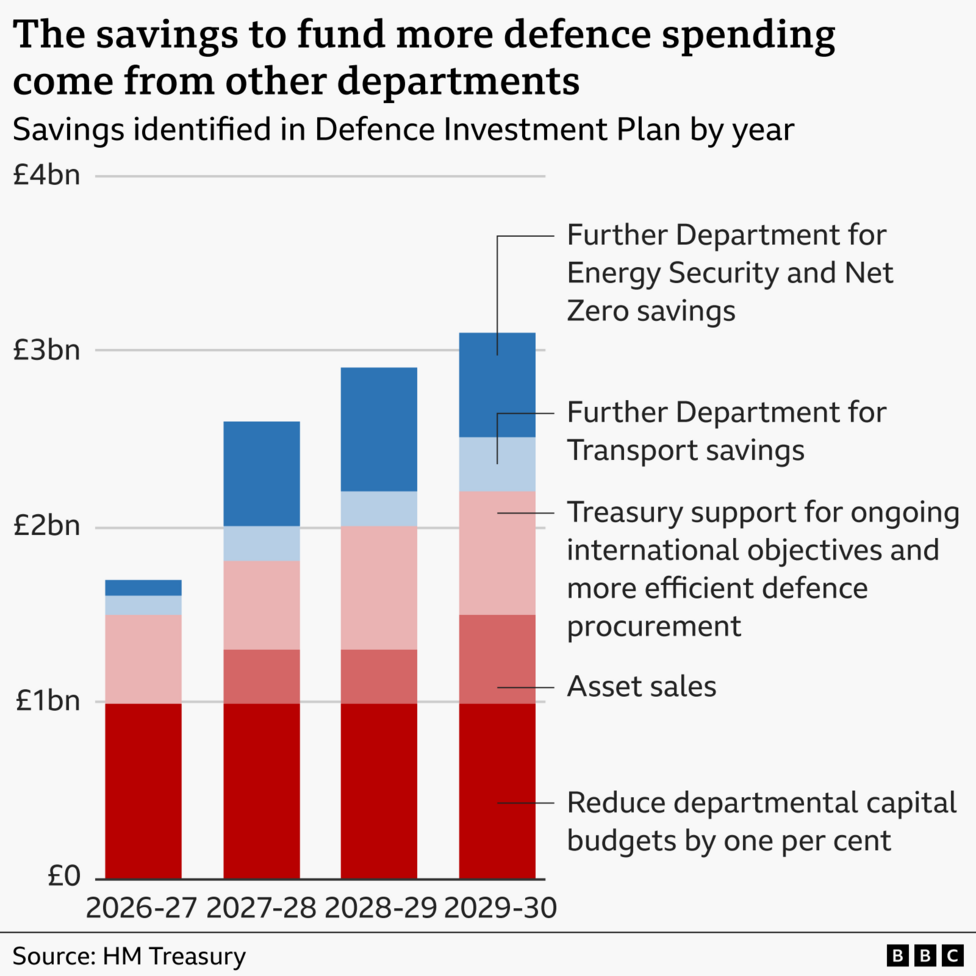
The Treasury reports that it has reduced all other Whitehall departments' capital spending budgets by 1% over the next four years, generating £1bn annually to support increased defence funding.
Additional cuts include average annual reductions of £500m in the Department for Energy Security and Net Zero and £200m in the Department for Transport, which will affect road investment.
Public sector asset sales, such as government-owned land, are expected to raise approximately £275m per year on average over the next four years.
Another source of savings, averaging £600m per year, comes from "Treasury support for ongoing international objectives and more efficient defence procurement." This entails the Treasury assuming responsibility from the Ministry of Defence (MoD) for future financial commitments to Ukraine if a ceasefire occurs.
While this may free resources for the MoD, it effectively shifts costs to another public sector area.
"If these new Treasury responsibilities require any spending, this will need to be paid for from somewhere else, potentially squeezing other budgets further," says Max Warner of the IFS.
These savings are planned to be achieved through measures including automating 20% of the MoD's human resources and finance departments by 2028 and reducing expenditure on consultants.
Additional efficiencies are expected from accelerating the use of Artificial Intelligence, with around £50m per year anticipated from "digital" efficiencies.
The largest efficiency savings, approximately £1bn annually, are projected to result from reforms in "acquisition," which refers to the procurement of new defence equipment.
Historically, defence procurement has been a significant source of budget overruns for the MoD.
Public finance experts caution that these savings are not guaranteed.
Carl Emmerson, a partner at consultancy London Economics, noted that the government already has ambitious efficiency targets embedded in its 2025 Spending Review settlements with departments, which set budgets for upcoming years.
"This just makes that challenge harder," he said.
Thomas Pope of the IFG added,
"Sometimes efficiency savings just means cuts and doing less and therefore delivering slightly less."