

Middle East Crisis Live Update
Hello and welcome to our live coverage of events in the Middle East.
Hours before the ceasefire between the US and Iran was set to expire, Donald Trump announced on Tuesday that he would extend the ceasefire while awaiting a “unified proposal” from Tehran, even as the US military continued its blockade of Iranian ports.
The White House also postponed Vice-President JD Vance’s planned trip to Pakistan for a second round of truce talks with Iran, which has expressed reluctance to engage in further discussions.
Iran has stated that the US must lift the blockade of its ports for negotiations to resume. However, Trump and Treasury Secretary Scott Bessent both warned on Tuesday that the US Navy blockade would remain in place. Tehran’s stance is that it will only participate in talks if it believes discussions in Islamabad will produce tangible results.
Following Trump’s unilateral announcement, Pakistan’s President Shehbaz Sharif expressed gratitude towards the US president for extending the ceasefire with Iran, stating that it would allow ongoing diplomatic efforts to continue.
In a post on X, Sharif said he was expressing thanks “on my personal behalf and on behalf of Field Marshal Syed Asim Munir” for Trump’s “gracious acceptance” of Pakistan’s request to extend the ceasefire.
Oil prices fluctuated before Trump’s announcement, with the price of Brent crude rising from under $95 to about $100 during the day. It settled at $98.48, marking a 3.1% increase.
Meanwhile, Israel and the Lebanon-based Hezbollah exchanged fire on Tuesday. Hezbollah reported firing rockets and drones at Israeli forces maintaining a buffer zone in southern Lebanon. Israel responded by striking the launcher, condemning Hezbollah’s attacks as a blatant violation of the ceasefire.
The US ambassador to Israel, Mike Huckabee, will join the US delegation for upcoming direct talks between Israel and Lebanon, according to CNN. Fresh talks between Israel and Lebanon are scheduled to take place in Washington on Thursday, a State Department official confirmed.
The US Treasury’s Scott Bessent stated that due to the US blockade, “in a matter of days, Kharg Island storage will be full and the fragile Iranian oil wells will be shut in.” In a statement posted on X, Bessent said the US “will continue to apply maximum pressure through Economic Fury to systematically degrade Tehran’s ability to generate, move, and repatriate funds.”

Gen Majid Mousavi, the aerospace chief for Iran’s Revolutionary Guard, warned that oil facilities across the region would be at risk if neighboring countries allow the US to carry out attacks. He told Iranian state media,
“If southern neighbours allow the enemy to use their facilities to attack Iran, they should say goodbye to oil production in the Middle East region.”
Britain announced it will host military planners from over 30 countries for two days of talks starting Wednesday regarding a multinational mission led by the UK and France to protect navigation in the Strait of Hormuz, the Defence Ministry said.
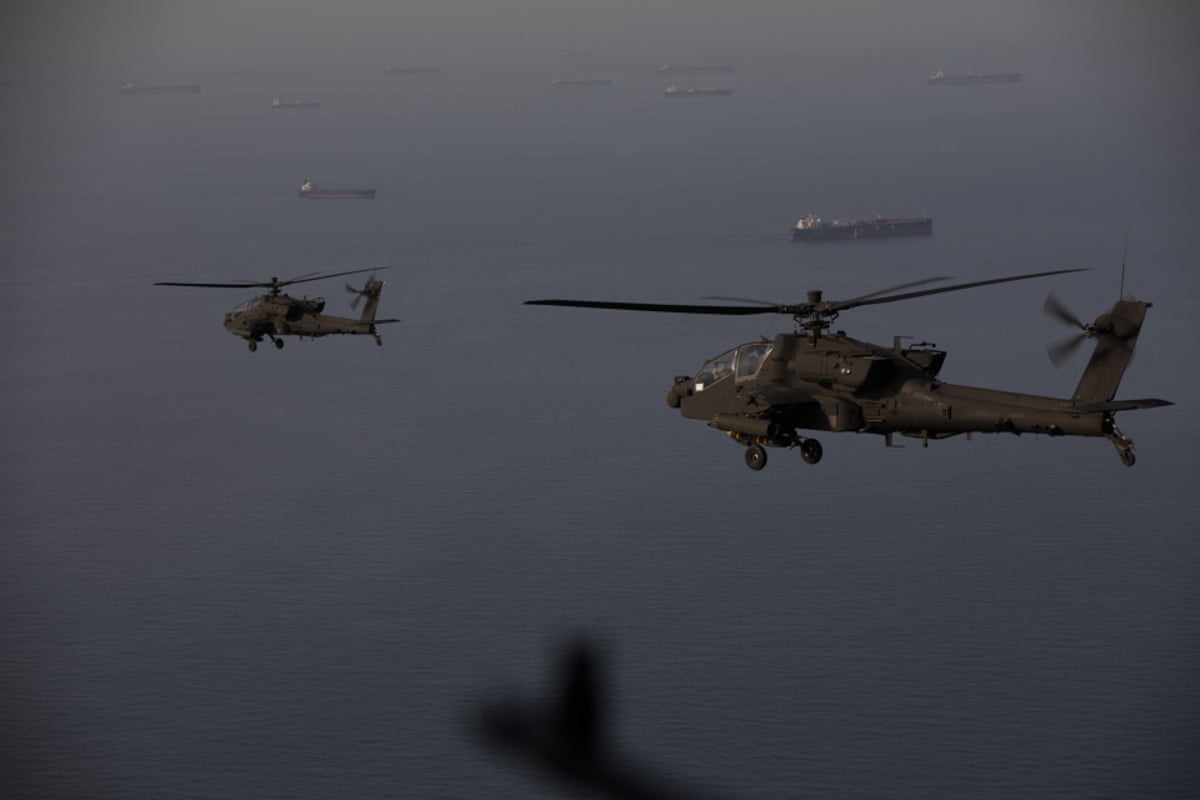
Since the conflict began, fighting has resulted in at least 3,375 deaths in Iran and over 2,290 in Lebanon, according to the Associated Press. Additionally, 23 people have died in Israel and more than a dozen in Gulf Arab states. Fifteen Israeli soldiers in Lebanon and 13 US service members throughout the region have also been killed.
Asian Shares Mixed, Oil Prices Ease
Shares showed mixed performance in early trading across Asia, while oil prices eased amid hopes that the US and Iran may resume talks to end their conflict.
The price of Brent crude decreased by 0.2% but remained above $98 per barrel. US benchmark crude fell 0.4% to $89.29 per barrel.
Japan’s Nikkei 225 rose 0.5%, South Korea’s Kospi edged down 0.2%, and Australia’s S+P/ASX 200 declined 0.9%.
Hong Kong’s Hang Seng dropped 1.3%, while the Shanghai Composite gained 0.1%. Taiwan’s Taiex increased by 1.1%.
On Tuesday, Wall Street’s S+P 500 added 1.2%, continuing its upward trend from the previous day, closing at 6,967.38.
The International Monetary Fund reported that global inflation is projected to accelerate to 4.4% this year, up from 4.1% in 2025, revising its earlier forecast of a slowdown to 3.8%.


