

Ceasefire Expectations Shattered by Israeli Airstrikes
The guns were expected to fall silent following the announcement of a two-week ceasefire aimed at halting the conflict in the Middle East. This ceasefire was declared just hours earlier by US President Donald Trump.
However, shortly after the announcement, Israeli jets executed a 10-minute aerial assault across Lebanon. This large-scale attack resulted in the deaths of at least 203 people and injured over 1,000, according to Lebanon's health ministry.
While condemnation from local and Western sources was immediate and widespread, the United States did not issue any criticism toward its ally, Israel. Iran condemned the strikes as
"a grave violation"of the ceasefire agreement and urged the US to stop Israeli "aggression".
Lebanese officials report that more than 1,700 people have died since Israel began its latest military campaign in Lebanon last month. Israel maintains that its operations target Hezbollah and aim to fulfill remaining military objectives.
Background of the Conflict
The conflict began on 28 February with US and Israeli strikes on Iran, which provoked retaliatory actions from Tehran against US allies in the Gulf region. Iran's proxies, Hezbollah in Lebanon and the Houthis in Yemen, responded with attacks against Israel.
In reaction, Israel intensified strikes on Hezbollah and ordered its troops to occupy extensive areas within Lebanon.
Ceasefire Announcement and Mediation Efforts
The two-week ceasefire was announced by Pakistan's Prime Minister Shehbaz Sharif, who has been mediating between the conflicting parties. Sharif stated that the US and its allies
"have agreed to an immediate ceasefire everywhere including Lebanon and elsewhere".
Pakistan is scheduled to host the involved parties on Friday, where a US 15-point plan and an Iranian 10-point counter-proposal are expected to serve as negotiation starting points.
Iran's proposal demands a cessation of hostilities on all fronts,
"including against the resistance of Lebanon", referring to its Shia ally Hezbollah.
However, the Israeli government, led by Prime Minister Benjamin Netanyahu, stated that the ceasefire does not encompass Lebanon. Donald Trump also indicated that Lebanon was excluded from the agreement
"because of Hezbollah", describing the conflict there as
"a separate skirmish".
Details of the Israeli Airstrikes
At approximately 14:00 in Beirut (11:00 GMT), the skies over Lebanon darkened as the Israel Defense Forces (IDF) announced that within 10 minutes it had
"completed the largest coordinated strike across Lebanon since the start of Operation Roaring Lion", the code name for the Israeli campaign against Iran.
The IDF reported targeting
"100+ Hezbollah headquarters, military arrays, & command-and-control centres in Beirut, Bekaa and southern Lebanon".
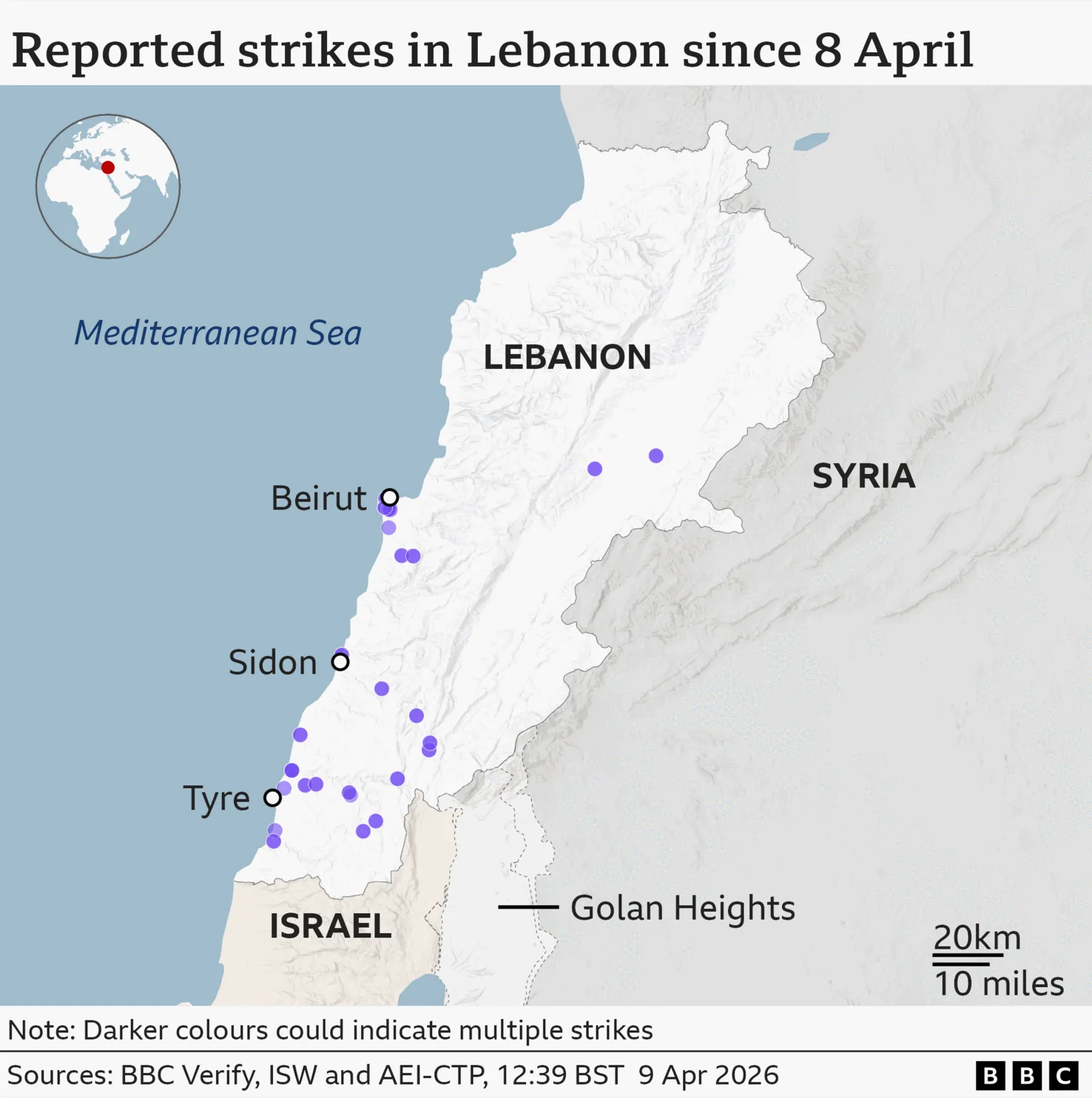
Densely populated areas in central Beirut were struck with some of the heaviest bombardments since Hezbollah joined the conflict in early March. Notably, the attacks extended beyond the traditional Hezbollah stronghold of Dahieh to include the city centre.

Casualties were also reported in the Bekaa Valley to the east, as well as in the southern regions of Nabatieh, Sidon, and Tyre.
Hezbollah appeared to be caught off guard, with their only known response being rocket fire towards Israel several hours later.
On the following day, Israel continued its operations, claiming to have killed
"70+ terrorists". The IDF also stated it had
"ELIMINATED: Ali Yusuf Harshi, the personal secretary to Hezbollah Secretary-General Naim Qassem in Beirut". These claims have not been independently verified; the BBC is unable to confirm them.
Impact on Beirut and Civilian Casualties
On a clear, sunny morning in Beirut, a somber atmosphere prevailed. Normally bustling streets were subdued as the country observed a day of national mourning. Prime Minister Nawaf Salam stated that civilians were targeted and described the casualties as
"martyrs and wounded". President Joseph Aoun characterized the event as a
"massacre".
Search and recovery operations continue at several locations.
One of the hardest hit sites was a 10-storey residential building in Tallet el Khayat, a prosperous neighborhood in western Beirut. The airstrike occurred without warning, likely catching residents by surprise since this area had not been previously targeted.
Civil defense teams are conducting thorough searches across affected buildings nationwide, though prospects remain bleak for those still missing.
Ziad Samir Itani, leading a civil defense team, remarked that this situation was
"new to Beirut". Teams are exhausted after over six weeks of continuous Israeli attacks.
"I have 22 years experience. For us, this is something like normal, but for other people, is not normal,"Itani said, adding,
"I'm sad, like everybody".
Strategic Considerations and Regional Reactions
Although Israel claims its targets were Hezbollah, it was aware that the strikes would inevitably cause significant civilian casualties.
The long-term Israeli strategy remains unclear. Even Israeli military officials acknowledge what has long been understood in Lebanon: Hezbollah cannot be disarmed by force. While the attacks may yield some military advantages, these are expected to be limited.
Within Lebanon, both opponents and supporters of Hezbollah have united in anger, viewing the attacks as unacceptable and unjustifiable.
Iran's Deputy Foreign Minister Saeed Khatibzadeh addressed the BBC's Today programme, stating that the US must decide whether it desires war or peace.
He further said that Iran would
"provide security for safe passage"through the Strait of Hormuz, a strategic waterway whose blockade has driven oil and gas prices higher. However, reopening the passage will only occur
"after the United States actually withdraw this aggression", an apparent reference to Israel's attacks on Lebanon.


