

Hezbollah Rejects US-Backed Ceasefire Terms
The Lebanese armed group Hezbollah has strongly rejected the terms of a US-backed ceasefire agreement between Israel and Lebanon.
In a forceful statement, Hezbollah's leader Naim Qassem, whose group is supported by Iran, described the negotiations as "futile" and "humiliating" for Lebanon. He stated that the agreement was categorically rejected by "broad segments of the Lebanese people."
This declaration followed the announcement by Israel and Lebanon of a renewal of their fragile ceasefire, which includes the establishment of "pilot" security zones inside Lebanon where Hezbollah operatives would be prohibited.
In a joint statement released on Wednesday by the US State Department, the three countries involved said the deal was "contingent on a complete cessation" of fire by Hezbollah.
However, responding on Thursday, Hezbollah's leader, whose group was not part of the negotiations, described the "supposed ceasefire" — interpreted as Hezbollah ceasing fire and withdrawing fighters from the southern front with Israel — as tantamount to surrender that would fulfill Israel's objectives.
Local Reaction in Beirut's Southern Suburbs
The atmosphere in Beirut's southern suburbs, a Hezbollah stronghold also known as Dahieh, reflected similar skepticism. Sami, a storekeeper who has operated his business there for 25 years, expressed doubts about the agreement.
Sami said, "You cannot have a ceasefire from one side, it's going to be an all side or no ceasefire."
He noted that strikes had occurred in Lebanon on Thursday, questioning the nature of the truce.
"This is surrender. This is not a peace agreement. This is a surrender agreement," he added.
Across the street, Hadi, whose family store has been in operation for 35 years, expressed a lack of hope, a sentiment he said had persisted across generations.
"My generation, my dad's generation, my grandpa's generation, they didn't see anything of hope from these people - not necessarily the Israeli people. You can say the Israeli government," he said.
Details of the Ceasefire Agreement
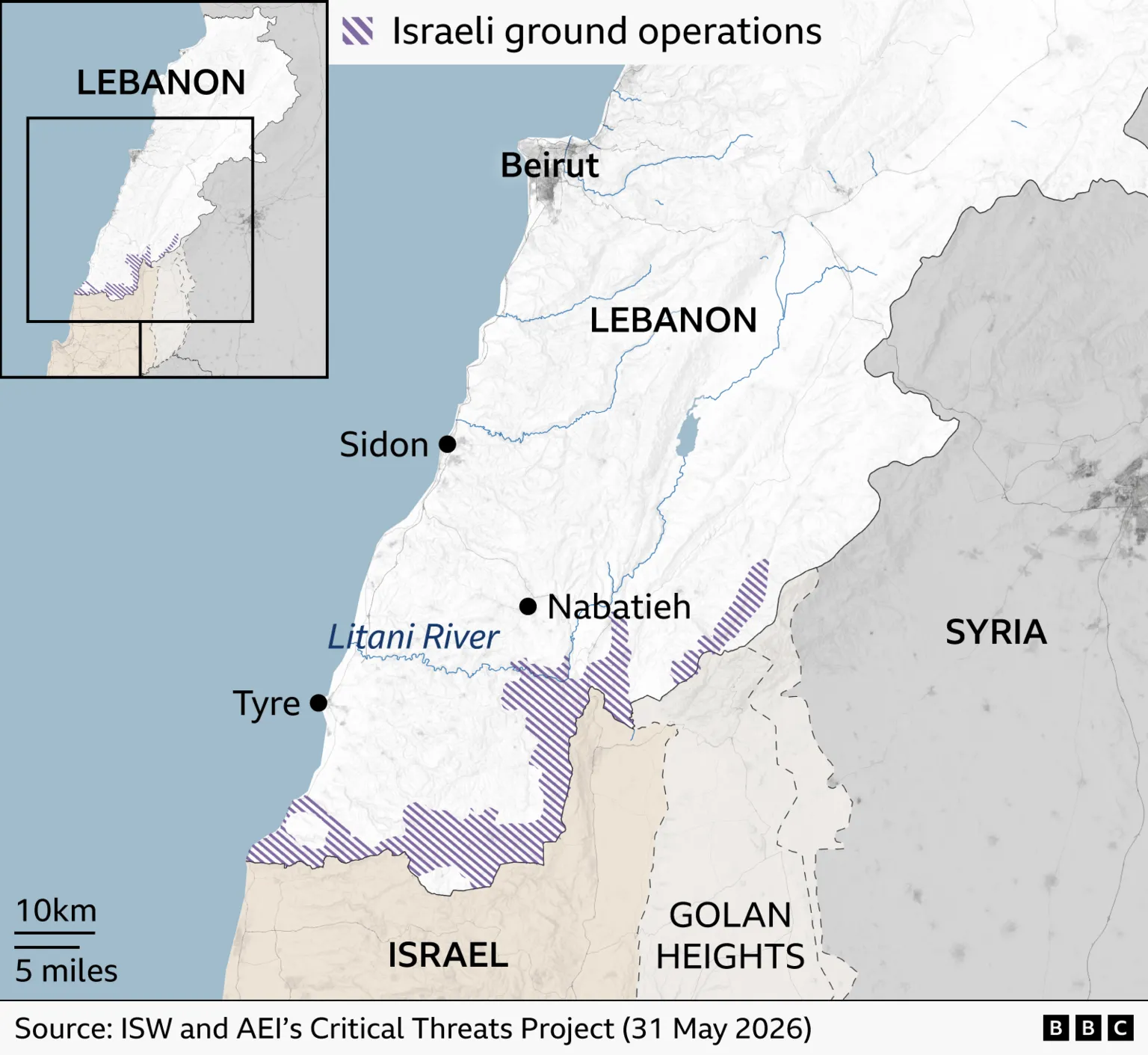
The agreement between Israel and Lebanon, reached after a fourth round of US-mediated talks in Washington, is contingent on the "evacuation of all [Hezbollah] operatives" from an area between the Israeli border and the Litani River, approximately 30km (19 miles) to the north, which is currently occupied by Israeli ground forces.
According to the deal, the US would assist in guiding the creation of "pilot zones" where the Lebanese Armed Forces would assume exclusive control of the territory, excluding all non-state actors.
The agreement did not include maps indicating the locations of the pilot zones nor explanations of how they would function in practice.
This deal followed a partial ceasefire announced on Monday, which Lebanon stated would see Israel refrain from bombing the Lebanese capital, Beirut, in exchange for Hezbollah not attacking Israel.
The representatives of the two countries are scheduled to meet again on 22 June to continue talks "with a view toward reaching a comprehensive agreement."
Hezbollah's Role and Regional Context
Hezbollah is a Shia Muslim militia, political party, and social movement, recognized as Lebanon's most powerful group.

With backing from Iran, Hezbollah has developed an armed force stronger than the Lebanese army and has engaged in multiple conflicts with Israel. It is designated as a terrorist organization by Israel and numerous other countries, including the UK and US.
Official Statements and Military Actions
Lebanese President Joseph Aoun stated that the ceasefire "could be implemented within 24 hours of its final approval" by all concerned parties.
Meanwhile, Israeli Defence Minister Israel Katz said the Israeli military would "for the time being, continue its fire and operations on the ground" to "dismantle terrorist infrastructure in the area."
Lebanese media reported multiple Israeli strikes across southern Lebanon on Thursday.
The state-run National News Agency (NNA) reported that five people were killed in air strikes on the Bekaa Valley town of Sohmor on Thursday, and another person was killed when a motorcycle was targeted by an Israeli aircraft in the town of Maaroub, near the city of Tyre.
The United Nations peacekeeping force in Lebanon (Unifil) reported that one of its peacekeepers died from wounds sustained when mortar shells struck his position near Marjayoun late on Wednesday.
Serbia's defence ministry identified the peacekeeper as Senior Sergeant Milovan Jovanovic, one of approximately 170 Serbian peacekeepers in the 7,500-strong force.
The Israeli military accused Hezbollah of firing mortars that landed inside the UN position overnight. Hezbollah has not yet commented on the incident.
The Israeli military also stated it had identified impacts from several "suspicious aerial targets" in an area of southern Lebanon where Israeli troops were operating on Thursday afternoon. No injuries were reported.
Hezbollah announced earlier that it had targeted Israeli troops and military vehicles in the Lebanese town of Qantara and the area of Beaufort Castle with attack drones and rockets on Thursday.
Background of the Conflict
Lebanon became involved in the conflict between the US, Israel, and Iran on 2 March, when Hezbollah launched rockets into Israel in retaliation for an Israeli strike that killed Iran's supreme leader. Israel responded with an air campaign across Lebanon and a ground invasion in the south.
A US-brokered ceasefire between Israel and Lebanon on 16 April failed to halt the fighting. Last week, Israeli Prime Minister Benjamin Netanyahu ordered the military to intensify strikes on Hezbollah and advance deeper into Lebanon in response to drone and rocket attacks on northern Israeli communities.
At least 3,526 people have been killed in Lebanon since the start of the war, according to the country's health ministry. These figures do not distinguish between combatants and civilians.
The United Nations reports that over one million people have registered as displaced within Lebanon, where Israeli evacuation orders cover more than an eighth of the country.
Israel reports that 26 of its soldiers and four Israeli civilians have been killed on both sides of the border during the conflict.


