Corrupt Police and Extortion Threaten Mexican Society
At around 11pm, Luis* was about to enter an Uber to return home when a police vehicle stopped nearby. One officer presented two plastic bags containing substances resembling drugs: one with a powdery material, the other with small crystals. Luis, who requested anonymity for safety reasons, had never encountered these substances before.
Despite Luis's insistence that the drugs were not his, the officers disregarded his claims. They forced him into the back of their police truck and drove off into the night.
“You’re in big trouble,” one officer warned.
The harrowing experience lasted several hours as the police transported Luis across the city, subjecting him to threats, ridicule, and sexual assault. Only after they had emptied both of his bank accounts and seized all his cash—approximately $870—was he released.
“If you tell anyone what happened, we’re going to find you,” one officer threatened Luis. “Where do you think you could file a complaint? There’ll be someone there who’s going to tell us and then we’re going to kill you and everyone close to you.”
Such experiences have become increasingly common in Mexico. Extortion ranks among the most widespread and rapidly growing crimes in the country. Between 2016 and 2025, the number of reported extortion cases rose significantly. According to the Global Initiative Against Transnational Organized Crime, Mexico is among the top five countries worldwide for extortion and racketeering, alongside Libya, Colombia, Honduras, and Somalia.

In the first four months of 2026 alone, nearly 3,600 extortion cases were reported nationwide, based on official statistics. However, the actual figures are likely much higher, as only an estimated 10% of extortion incidents are reported, largely due to fear of retaliation. This makes extortion Mexico’s most "silent" crime. It is also one of the most financially damaging, costing the country nearly $900 million annually.
Extortion impacts all layers of society, from affluent entrepreneurs to small shopkeepers coerced by criminal gangs into paying "protection fees." In some cases, known as "express kidnappings," victims are detained for a few hours until their families pay a ransom.
Criminal groups abduct—or claim to have abducted—children and even pets, explains Emmanuel Moya, an anti-corruption expert.
“They don’t discriminate against anyone. That’s why it’s so profitable, so easy to do, and so difficult to combat.”

The town of Huautla in Morelos state recently gained national attention after residents reported extortionists demanding $10 per family member monthly just to live there—amounting to two-thirds of the daily minimum wage.
“Some had five children – imagine what that means per month for a poor person or family, in such a difficult environment,” said Bishop Ramón Castro.
In the nearby city of Cuautla, known as the extortion capital of Morelos, conditions were similarly dire. Street vendors were often forced to pay protection fees to two different gangs simultaneously, according to Castro.
“Imagine a woman who sells tamales, a woman who sells ice-cream, having to pay organised crime,” he said. “This is unheard of and heartbreaking.”
When business owners cannot sustain these payments, many are compelled to shut down. Speaking out against extortion can be deadly. In October 2025, the leader of a local lime growers’ organization in Michoacán state was murdered after repeatedly denouncing extortion by criminal groups. Two weeks later, Carlos Manzo, mayor of Uruapán city, was shot dead on the Day of the Dead after publicly condemning extortion by criminal gangs and corrupt local officials.
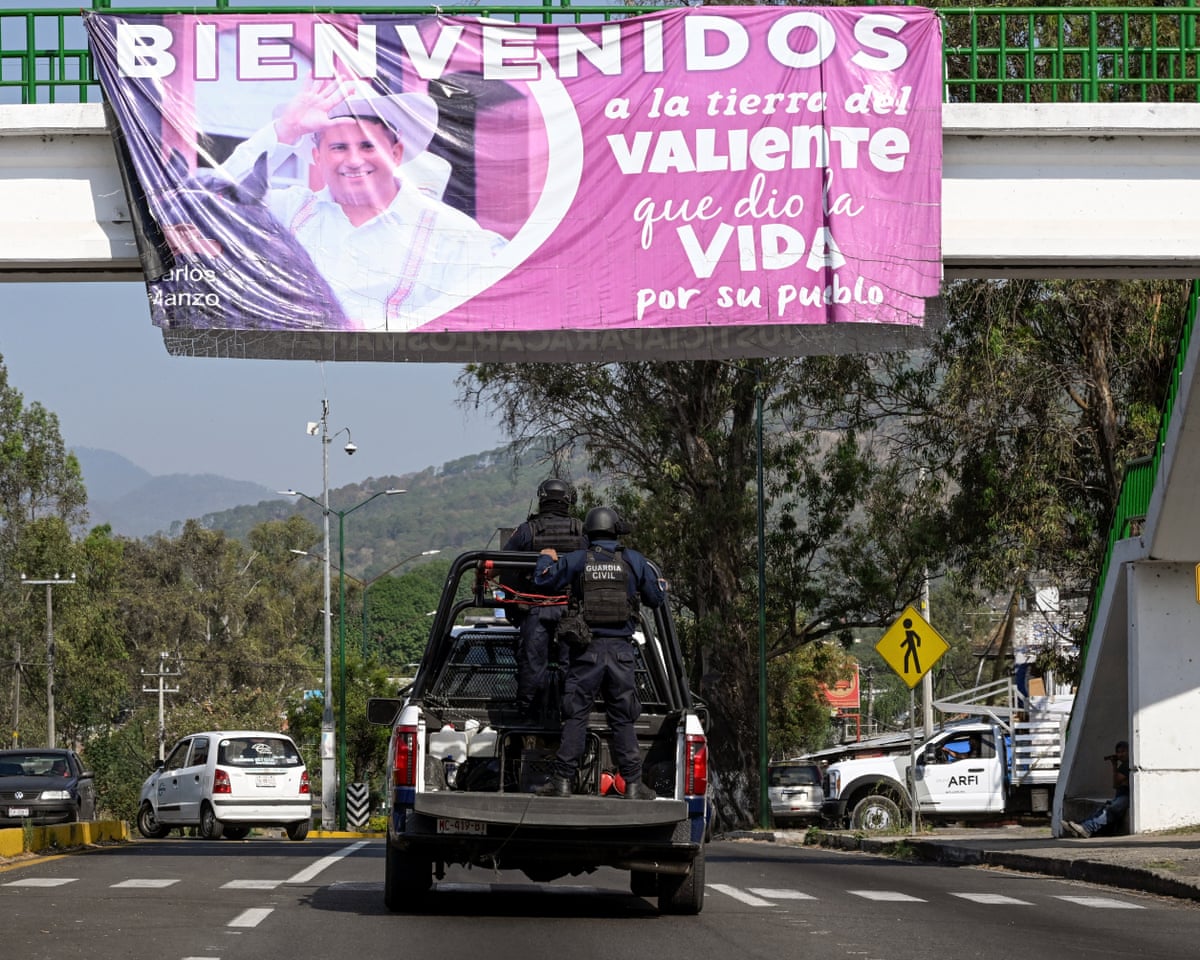
“We are surrounded by criminal groups dedicated to extortion and killing,” the mayor stated last year. “But we are going to confront them.”
President Claudia Sheinbaum has pledged to address this crisis by advocating a constitutional amendment to classify extortion as a federal crime. This change would enable prosecutors to investigate cases without requiring victims to file formal complaints. Since the launch of a national strategy against extortion in July 2025, over 1,000 individuals have been arrested.
Sheinbaum has also initiated a broad security campaign called Operation Swarm to combat corruption among local officials. While most extortion cases are linked to organized crime groups, Operation Swarm has revealed the widespread involvement of local authorities. The operation has resulted in the arrest of more than 70 officials, with at least five convicted on extortion charges.
Often, local mayors collaborate with criminal groups in exchange for bribes, while in other cases, officials engage in extortion to enrich themselves.
Like most victims, Luis chose not to report his ordeal, fearing the officers would carry out their threats. Nevertheless, the experience continues to haunt him.
“I’m very disappointed by all the kinds of violence happening in the city right now,” he said. “I really suffer every time I pass by a place where there are police officers.”