David Willey's Career and Legacy
David Willey, a distinguished BBC foreign correspondent whose career spanned over fifty years, has passed away at the age of 93. Throughout his extensive tenure, Willey reported from numerous global hotspots including Algeria, Vietnam, and China. However, he is most renowned for his role as the BBC's Vatican correspondent based in Rome, where he covered the papacies of five popes.
Recognized as one of the most knowledgeable journalistic authorities on the Vatican, Willey authored a book on Pope Francis and was honored with an OBE for his contributions to broadcast journalism. Remarkably, he continued working into his nineties, reflecting last year on the transformations within the Vatican following the death of Pope Francis.
"He was an incredible authority on the Vatican, reporting and travelling with five Popes, and was so kind, giving me insight and encouragement when I started in Rome in 2019," wrote Mark Lowen, BBC correspondent and presenter.
Early Career and Milestones
Willey began his journalism career as a trainee with the news agency, where he covered significant historical events such as the signing of the Treaty of Rome in 1957. This treaty established the European Economic Community, laying the foundation for what is now the European Union.
"I was actually there in the huge room frescoed with scenes from ancient Roman battles, when the six frock-coated founders of the Europe of the Six appended their signatures to the Treaty," Willey recalled on the 50th anniversary in 2007.
"Crowded into the room were members of parliament, city authorities and, I seem to remember, a single red-hatted cardinal from the Vatican."
Following his work with , Willey freelanced in Algeria before joining the BBC as the East Africa correspondent in 1964. His assignments later took him to Asia, where he reported on the Vietnam War and the aftermath of China's communist revolution.
Decades in Rome and Vatican Reporting
Despite his global reporting, David Willey is best remembered for his decades-long tenure in Rome. He became a leading expert on the papacies of five popes, including coverage of the 1981 assassination attempt on Pope John Paul II. In 2023, Willey met Pope Leo, the fifth pontiff he covered during his career.

During a private audience with Pope Francis in 2016, Willey presented the pontiff with a copy of the book he authored about him.
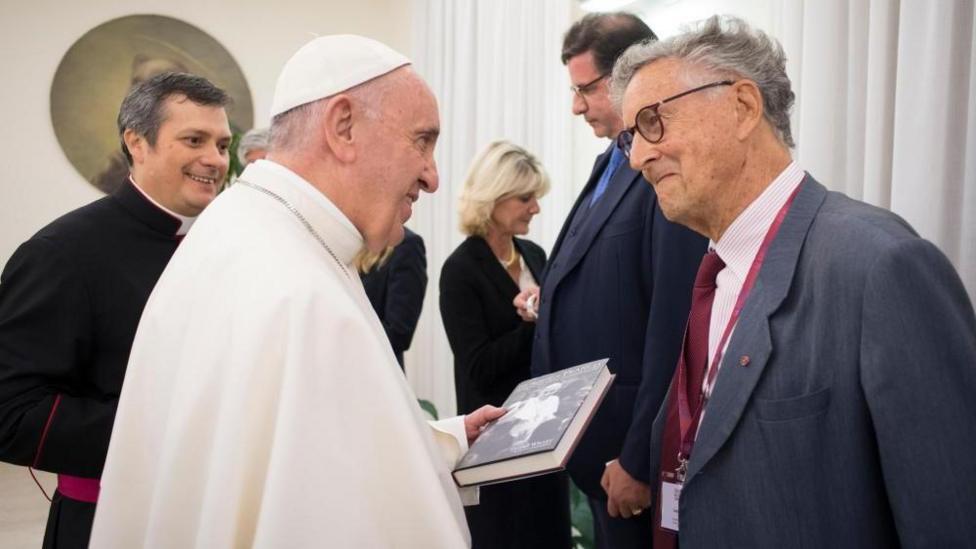
Reflecting on the Vatican's evolution and his own life within it, Willey wrote last year,
"I have suddenly realised with something of shock that I am already not only four years older than the late Pope Francis, but that my own life now extends through no fewer than eight successive papal reigns."
His book, The Promise of Francis: The Man, the Pope, and the Challenge of Change, was a significant contribution to understanding the late pontiff's impact.
Insights into Vatican Reporting
Willey first reported on the Vatican for in the 1950s, recalling the challenges of obtaining information in that era.
"We depended upon a corrupt Vatican official to get the text of an important papal speech ahead of delivery," he wrote.
"It was my job to take the bus down to the cafe opposite the main workers' entrance to Vatican City at eight in the morning one Easter Sunday to surreptitiously pick up a document that he had smuggled out."
David Willey died of heart failure in Italy, the country he called home. Until his final days, he remained insightful in his analysis, generous with his time, and an invaluable resource to the journalists who followed in his footsteps.