Trump's Arrival and Warm Welcome in Turkey
Turkish President Recep Tayyip Erdogan personally greeted Donald Trump at the airport, underscoring the US president's prominent role at the Nato summit in Ankara. The city was marked by black-clad Turkish police stationed on street corners, large blue banners proclaiming "The Key to Peace," and a ceremonial reception dedicated to Trump.
Although this is a Nato summit, it is the US president who has effectively received the metaphorical red carpet treatment. Trump has openly expressed his criticism of Nato, stating that his attendance in Ankara this year is primarily due to the summit being hosted by his friend, President Erdogan, who made a point of welcoming him in person.
Following the airport greeting, the two leaders walked arm-in-arm as a band played the US national anthem, the Stars and Stripes, while Turkish air force jets performed a flypast overhead, trailing red, white, and blue smoke.
Trump's Disruptive Statements and Nato Relations
There was always a possibility that Trump would disrupt the summit, and his provocative remarks have indeed punctuated the event, challenging the carefully constructed image of unity at this critical gathering.
Shortly after his arrival, Trump made an offhand comment suggesting that the US should consider taking over Greenland, an island that is part of the Kingdom of Denmark, itself a Nato member. He later acknowledged that his earlier comments had strained relations within Nato, which they certainly did.
Denmark's prime minister responded firmly, stating that if the US were to attempt to seize Greenland by force, it would mark the end of the alliance.
Trump's grievances also extend to Iran. He remains resentful that Nato allies did not support his unilateral military action earlier this year, a conflict initiated without consulting allies and which disrupted the global economy.
He singled out the United Kingdom for criticism, despite the fact that Sir Keir Starmer allowed US airstrikes on Iranian missile sites to be launched from British airbases. Referring to the UK prime minister, Trump said:

"He said no we'll help after the war is over. I said I don't want that kind of help. We didn't need any help at all. In a way I was testing people, I was testing to see whether or not they'd be there because I've long said that we help them but I'm not sure that they'd be there for us."
UK's Defence Collaboration and Investment Plan
The British delegation has emphasized its defence collaboration with European partners. However, Sir Keir has arrived in Ankara for his final Nato summit with a Defence Investment Plan that has been criticized for falling billions of pounds short of the targets set out in last year's Strategic Defence Review, which had received considerable praise.
Focus on Rearmament and Defence Industry Cooperation
Beyond the ceremonial aspects and speeches, Nato delegates have concentrated on the substantial task of rearming Europe and enhancing cooperation among their defence industries.
Significant contracts have been announced for a new fleet of transport aircraft to be manufactured by Airbus. Additionally, Nato's aging fleet of AWACS (Airborne Warning and Control System) early warning aircraft will be replaced by Sweden's GlobeEye planes.
There is also extensive discussion about joint missile projects.
Ukraine's Appeal for Support Amid Russian Attacks
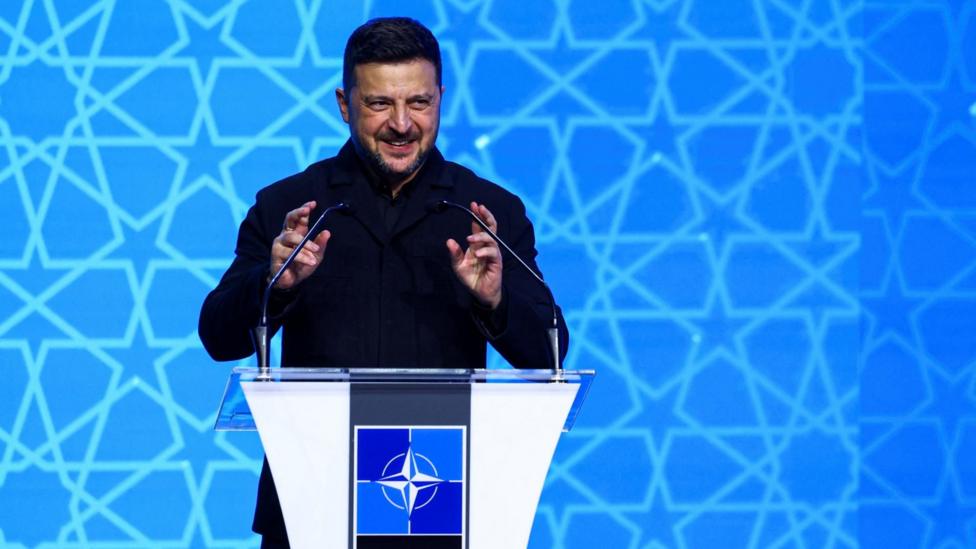
President Volodymyr Zelensky of Ukraine is present at the summit. He is acutely aware of the consequences when a country lacks adequate air defence capabilities.
In recent days, Russia's ballistic missiles have targeted residential buildings in Kyiv, resulting in dozens of civilian casualties. Ukrainian air defence teams have reported a critical shortage of interceptors.
President Zelensky stated:
"Europe needs its own effective anti-ballistic system and missiles. And this work is already under way and I urge you and all of our partners to give it the attention it deserves. And this cannot wait until 2030 or beyond, Europe needs affordable mass-produced anti-ballistic systems as soon as possible."
Urgency of European Air Defence Amid US Commitment Reduction
His call is timely. As the US gradually reduces its defence commitments to Europe, there is an urgent race to develop credible air defences against Russia's expanding arsenal of powerful missiles and drones.
While all parties express a desire for the war in Ukraine to end, there is also concern that once hostilities cease, Russia will rapidly rearm and be capable of threatening Nato territory within four years.