Record-Breaking Temperatures Across Germany and Europe
Extreme temperatures were recorded across Germany, with Saarbrücken experiencing the highest temperature. On Friday, June temperature records were broken in Germany, Belgium, and the Netherlands as Europe's heatwave caused an increasing death toll in Spain and France. Authorities cancelled concerts and other public events due to health concerns.
Germany recorded its highest ever temperature provisionally at 41.3°C in Saarbrücken, located in the south-west near the French border, where France had endured its hottest temperatures for three consecutive days earlier in the week.
Although the heatwave in France has peaked, Health Minister Stéphanie Rist expressed concern over the "emergence of deaths at home."
"We need to get used to it, unfortunately," said Clare Nullis, spokeswoman for the World Meteorological Organization, warning of the "major impacts" on health, ecosystems, agriculture, and labour.
Europe's deadly June heatwave has gradually moved north and east. Belgian forecaster David Dehenauw reported an unofficial temperature of 40°C in Kleine Brogel, near the Dutch border.
The southern Dutch province of Limburg recorded a top temperature of 39.4°C. In the UK, a provisional June record of 37.1°C was registered at Cavendish in Suffolk.
According to AFP news agency calculations, at least 150 million people across Europe faced temperatures exceeding 35°C on Friday.
Czech meteorologists anticipate that the 2012 record of 40.4°C may be surpassed on Saturday, while Austrian forecasters expect their national record to fall on Sunday. The Balkans are also experiencing extreme heat, with temperatures up to 39°C forecast in Serbia over the weekend.
Impact on Infrastructure and Environment
In Switzerland, the Beznau nuclear power plant disconnected both reactors from the grid on Friday because the River Aare's temperature reached 25°C, which is too high to cool the reactors effectively.
An unprecedented code red alert has been issued for a large portion of the Netherlands.
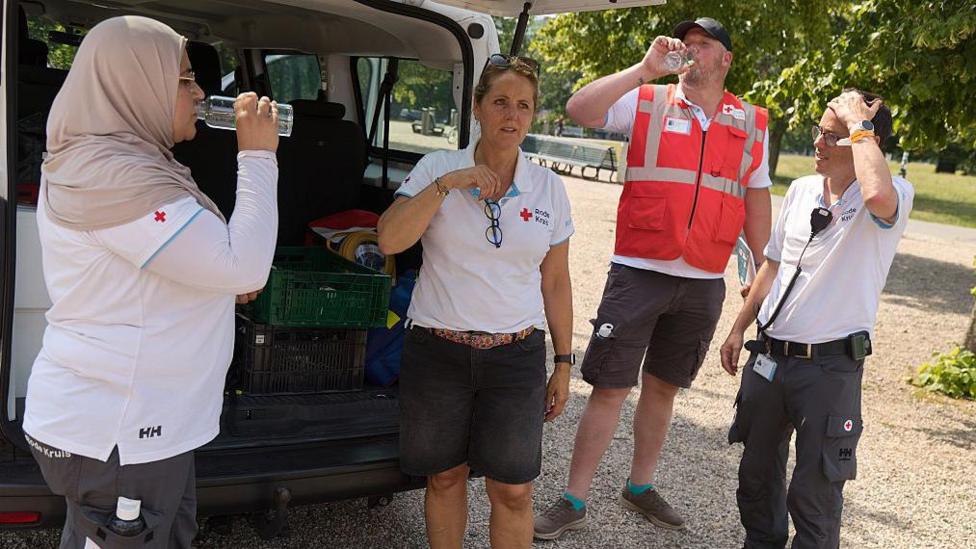
Across France, Germany, Italy, Spain, and southern England, temperatures are 5–12°C above seasonal averages due to a persistent high-pressure system, according to scientists at World Weather Attribution.
The group identified June as warming faster than any other month and described the current heatwave as "the most severe ever recorded" in the studied region.
Climate change is accelerating temperature increases worldwide, particularly in Europe, the fastest warming continent, heating twice as fast as the global average, according to the Copernicus climate service.
Transport Disruptions and Event Cancellations
The extreme heat caused a Eurostar rail service from Cologne to Paris to break down east of Brussels on Friday morning, with about 400 passengers on board. Three passengers were hospitalized as a precaution, according to the Belga news agency.

Health concerns led to the cancellation of two major Paris events over the weekend after the local prefecture reported that the hospital system was "saturated" and resources needed to focus on "helping the most vulnerable."
Organisers of Saturday's Paris Pride announced plans to reschedule the march for September. The Solidays music festival, scheduled to start on Friday at Longchamp racecourse and attract over a quarter of a million visitors last year, was also cancelled.
However, the Diamond League athletics meeting at Charléty stadium, initially threatened with cancellation, will proceed on Sunday with an "adapted format" involving a later start time.
Thousands had already arrived for the Dutch music festival Defqon.1 on Thursday night when organisers cancelled the event due to an unprecedented code red heat warning. The cancellation prompted angry reactions from festival-goers, leading to police intervention amid reports of unrest.
Numerous events in Germany were also cancelled, including Saturday's Hamburg Half Marathon.
Health Impacts and Emergency Measures
The extreme temperatures in Paris have caused health issues for both people and pets.

The French health minister warned that the heatwave would result in additional deaths. An emergency plan has been implemented across all hospitals in the Paris region due to "multiple tensions" in healthcare services.
In Marseille, an 18-month-old child died after being found in a car suffering from hyperthermia, marking the latest such incident in France within days. Earlier, a three-year-old was trapped in a car in Paris on Wednesday, and two young children died in a car in Carpentras on Monday.
The number of drowning deaths in France since the heatwave began has risen to 55, with an estimated two-thirds occurring in unsupervised swimming areas.
Spain's MoMo monitoring system reported 327 temperature-related deaths between Sunday and Thursday, most recorded in the past two days.
Although temperatures are beginning to subside in Spain, a forest fire northeast of Barcelona forced 16,000 residents to remain in their homes on Friday morning. A man was arrested on suspicion of arson.
Ongoing Heatwave and Environmental Concerns
Little relief from the heat is expected across much of Europe over the weekend. A glacier research team in Switzerland warned that the heatwave is affecting mountain regions as well.
The Zurich team reported that nearly all winter reserves on glaciers are about to be depleted, likely by Monday, at which point the glaciers will begin melting. This typically occurs in August, but current melting rates are nearly as severe as in 2022, the worst year on record when up to 6% of glacier mass was lost.