Rescue Efforts Amid Northern Australia Floods
Emergency service workers in the Northern Territory, accustomed to maritime rescues, faced unprecedented challenges last weekend when Katherine experienced flood levels not seen since the 1990s. Senior Constable Ben Parfitt played a crucial role in escorting two dozen school children from a caravan park submerged waist-deep in water. Following this, he was involved in a dramatic rescue of a couple and their German shepherd stranded on the roof of a four-wheel drive vehicle.
The group of high school students and their teachers were left without power, water, or food as their camping trip turned into a rescue operation. Parfitt and his search and rescue team transported them by boat to a temporary school shelter.
“That 24-hour period was worse than the worst-case scenario the Bureau of Meteorology had predicted,”
Parfitt said.
He added that most rescues involved people trapped in their homes, which had become isolated by floodwaters. The rescue teams conducted boat operations carrying up to 12 animals at once and even assisted a cow by guiding it through the water.
Flood Impact and Ongoing Weather Warnings
Two overseas backpackers were among those affected by the floods, with forecasts predicting an additional 200mm of rainfall across the Top End over the weekend. Emergency services responded to incidents such as a man entering floodwaters from a houseboat on the Burnett River north of Bundaberg.
Bureau of Meteorology senior meteorologist Dean Narramore warned that the forecasted rains could cause rapid river rises. Major flood warnings were issued for the Daly and Georgina rivers and Eyre Creek in the Northern Territory. In Queensland, warnings covered the Fitzroy, Flinders, Upper Balonne, Thomson, Alice, and Lower Condamine rivers, as well as Cooper Creek. The community of Longreach, located 1,200km northwest of Brisbane, was advised to prepare for evacuation.
“Pretty much all of western NT is under flood watches, from Darwin to the rock [Uluru], in anticipation of widespread heavy rainfall,”
Narramore stated.
Hundreds of homes, businesses, and cattle stations in parts of the Northern Territory and Queensland have been affected in the past week. Residents have been forced to seek refuge on rooftops and in evacuation centers across Katherine and remote Top End communities including Nauiyu (Daly River), Nganmarriyanga (formerly Palumpa), Beswick, and Jilkminggan.
Floodwaters have been observed flowing through residential streets in Katherine. In Bundaberg, numerous boats have been lost or swept away, with two trawlers found stranded in a cane field and three yachts abandoned on a rocky embankment. Debris such as gas bottles and kegs continues to travel downstream in the swollen rivers.
Dogs and Families Airlifted to Safety
LifeFlight, a regional helicopter service, has conducted daily rescue operations, including evacuating a woman bitten by a snake that her cat had brought into the house. The woman, in her 70s, was unreachable by local ambulance services due to flooded roads in North Bundaberg and was transported to hospital in stable condition.

Heli-Muster NT, typically assisting farmers with aerial cattle mustering, has temporarily shifted focus to emergency services, delivering supplies and evacuating stranded families and animals.
One family at the remote Munbililla campgrounds, approximately 300km east of Katherine, was cut off by rapidly rising floodwaters on Wednesday. The couple, their 22-year-old daughter, and their four German shepherds were airlifted to safety by Heli-Muster following police assistance.
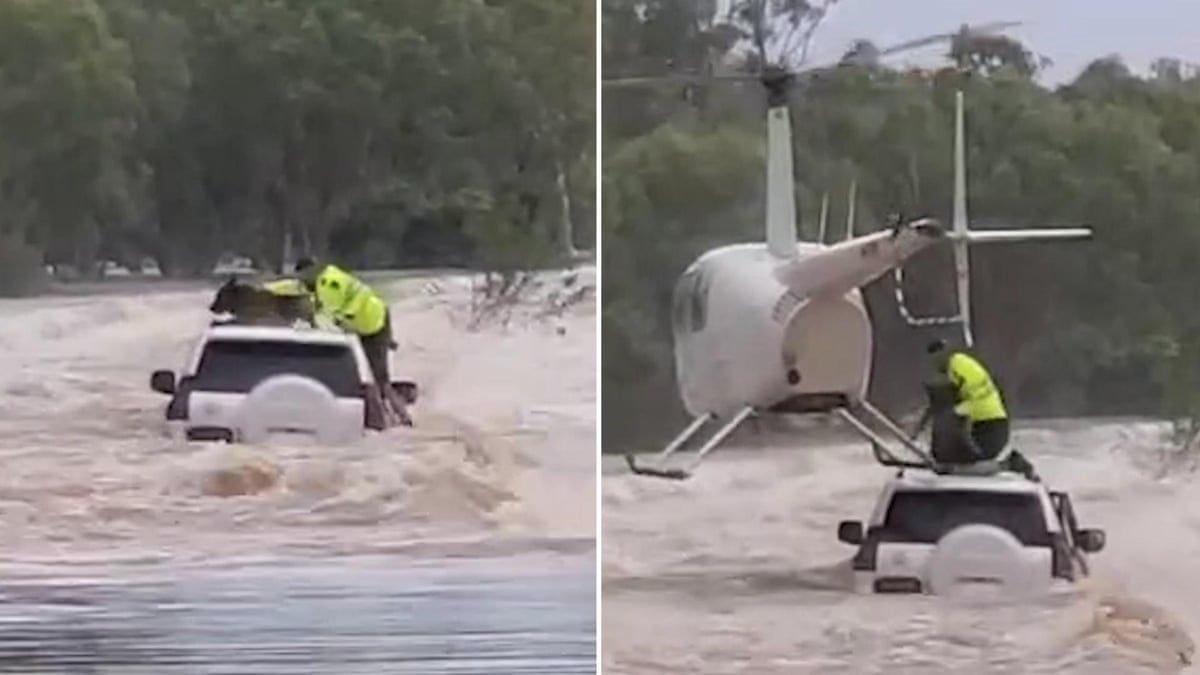
On the same day, Heli-Muster pilot John Armstrong aided police in rescuing a couple and their German shepherd from a four-wheel drive trapped on a creek crossing west of Katherine.
“The couple were standing on the guardrail on the road, which the car had been jammed up against, and were hanging onto the roof-rack of the Prado,”
Armstrong told the ABC.
“I just flew out and hovered … and Ben [Parfitt] reached out and helped the first lady in. She wasn’t the most mobile, but she did pretty well, and then we went back for the second fella.
“It wasn’t until we landed that a policeman came up and said: ‘Hey we’ve got a problem, we’ve got to go back and get the dog.’”
Parfitt, who had previously rescued the school children, helped devise a plan to rescue the dog named Seven. He was dropped onto the roof of the vehicle while the helicopter hovered nearby to avoid frightening the animal.
“It was an amazing dog,”
Parfitt said.“It was frightened but it could tell I was trying to help it. I introduced myself, gave it a quick pat, and it licked my hand.”
He then broke the window farthest from the dog and cleared the glass so it could exit.
“It was a bit of a struggle trying to persuade the dog to basically jump into my arms so I could put him on the roof, but then I jumped on top of the car, lay on top of him and John put the helicopter right next to me,”
Parfitt explained.“He got his front paws in, and then he was in.”
Community Impact and Recovery Efforts
More than 800 people remain in evacuation centers across the Northern Territory, unable to assess the damage to their homes.
Ben Hockey, a landscaping business owner in Katherine, has volunteered extensively over the past week. Initially, he delivered sandbags to residents, with police permitting entry into flood zones where he waded through waist-deep water to reach homes. Recently, he has been assisting with cleanup operations.
“Some people have lost absolutely everything,”
Hockey said.
“I’m 6’ 1”, we had one local electronics business that had 6’ 2” water going through his house, and all the properties around him. The payments by the federal government are amazing, but they won’t be enough.”
His daily routine involves entering flood-affected properties to remove unsalvageable items to the street for council pickup, followed by pressure washing and disinfecting mud and debris.
“A lot of the people’s houses we’re going to, they’re putting on a brave face, but you look into their eyes and can see so many are destroyed and don’t know what to do next,”
Hockey added.
“Do you give up? Do you leave town? Or do you stick it out and start again? Properties and resources can be replaced, but the mental effects of natural disasters can last a lifetime.”
Climate Context
Australia experienced its fourth-warmest year on record in 2025, according to the Bureau of Meteorology. Global warming, primarily driven by fossil fuel combustion, has increased the frequency and intensity of extreme weather events.