

Dolphin Census Engages Hundreds of Citizen Scientists Across NSW
From cliff sides, coastal lookouts, kayaks, and boats, hundreds of volunteers participated in New South Wales’ inaugural statewide dolphin census, counting every dolphin they observed for at least 15 minutes to support research into the state’s dolphin populations.
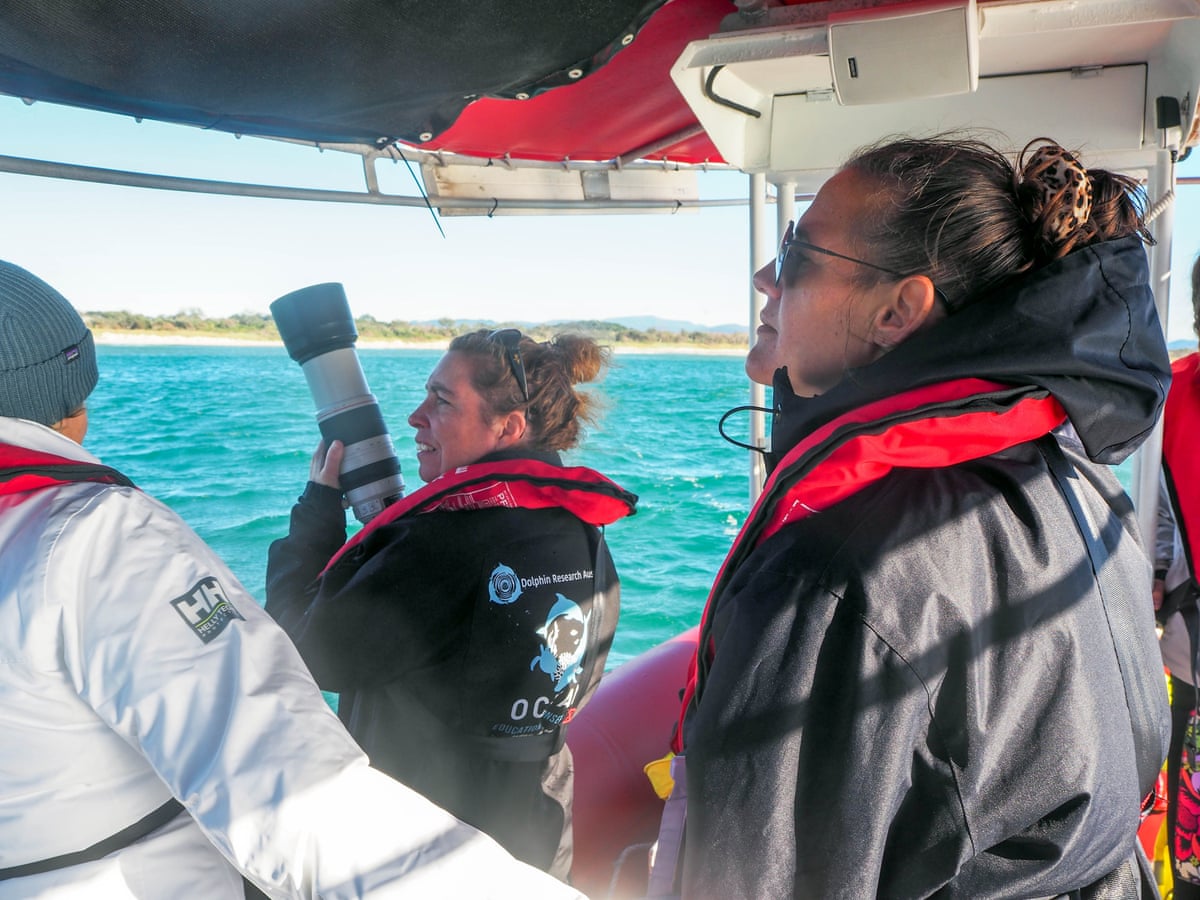
Looking through a telephoto lens, Dr Elizabeth Hawkins encourages the dolphins circling the research boat to present themselves for photographs.
“That’s it,” she says, joking to her crew. “Show us some fin. Don’t be shy. How about some tail? Oh that’s good. The camera loves you.”
This is the second pod encountered that day, consisting of 14 dolphins, including three older juveniles, comparable in age to human toddlers. Earlier, the team had observed a pod of 11 dolphins, which included a neonate, or newborn.
Photographing the dolphins creates a visual record that can be analyzed later to identify individual animals, explains Hawkins, chief executive of Dolphin Research Australia. The dorsal fin serves as a unique identifier due to a lifetime accumulation of notches, nicks, and scars.
“Some of these animals I’ve known for over 24 years, so effectively we’ve grown older together, and we’re now similar ages,” Hawkins says. “It’s quite a special relationship.
“It takes a long time to get to understand their ecology but also get to know them as individuals. Just like us, they all have individual personalities.”
These encounters were among several for Hawkins’ team, which also included two sightings of some of the first humpback whales of the season. These observations were part of a broader effort involving potentially hundreds of volunteers who gathered on Saturday morning to participate in the first statewide dolphin census in NSW.
Across the state, more than 500 people registered and completed a one-hour training module to count every dolphin they saw for a minimum of 15 minutes. Participants positioned themselves at cliff sides and coastal lookouts to observe the ocean, operated drones, or ventured onto the water in kayaks or boats.
“The data we will get from this is important,” Hawkins says. “We don’t have good information about the areas that are important to these animals and their health.”

It is estimated that between 400 and 500 dolphins inhabit the Byron Bay area alone, but the total number along the entire NSW coastline remains unknown. The most commonly recognized species along this extensive coast is the Indo-Pacific bottlenose dolphin, which forms distinct communities associated with specific coastal regions.
NSW is home to 19 different dolphin and small whale species, many of which are seasonal visitors, such as orcas and short-beaked common dolphins that migrate following their food sources.
Current knowledge about these populations is limited, a challenge that Hawkins and ranger Andy Marshall from the NSW National Parks and Wildlife Service aimed to address when they began organizing the dolphin census three years ago.
“The census was really about giving us the knowledge base to make well-informed, well-justified decisions about the populations in these locations,”Marshall says.
Marshall, who surveyed seven areas along the mid-north coast throughout the day, reported finding dolphins at three sites, including a group of 40 socializing in a bay. He noted this as a positive indicator, as dolphins prefer locations with abundant food, calm waters, and clear visibility.
“Dolphins are like the canary in the coalmine,”he says.
“If there are healthy dolphins, it’s a sign that it’s a healthy place. If they disappear, it’s a sign that something is going wrong.”
Dolphins face several risks and threats, including emerging diseases, pollution from runoff entering river systems, impacts from fishing, and the overarching threat of climate change.
“For our Byron dolphins in particular, climate change is going to be one of the biggest influences of change,” Hawkins says. “There are questions about how they are going to adapt to shifts in their environment. Things like current movement, prey movement and prey availability are all going to impact them in a variety of ways.”
The results of this extensive citizen science effort, supported financially by the NSW state government under the Marine Estate Management Strategy, will require at least a month to compile and analyze.
Hawkins and Marshall emphasize that the strong public participation reflects the deep, innate connection humans feel towards dolphins, which have long held significant cultural importance within Indigenous coastal communities.
“I think it comes from the recognition that these are high-level social beings, similar to us, with similar social systems to us, similar complexities in decision-making, sometimes in the same social context,” Hawkins says.
“The other thing that gets people is that these animals show curiosity to us … they seem to look back at us sometimes. There’s something there that solidifies that connection.”
With plans to repeat the census in future years, the goal is for coastal residents to become familiar with the dolphins sharing their environment, potentially to the extent of recognizing individual animals.
“To care for these animals, we really need our coastal communities to act as stewards,” Hawkins says. “If we’re not watching how they’re going, we won’t know anything until it’s too late. That’s where these citizen scientist programs can help take care of our dolphins and our oceans.”


