Blockade on Bamako Amid Rising Tensions
Mali's capital city Bamako, a key West African hub with a population exceeding three million, is currently experiencing a partial blockade imposed by Islamist militants. This development follows the assassination of the country's defence minister in the city.
"Our army isn't capable of protecting us, how are we going to get back home?"a mother-of-two told the BBC, after being unable to re-enter Bamako following a visit to her parents outside the city.
She, along with numerous others, has been stranded on the Bamako-Kéniéba highway, a principal route out of the capital, for nearly a day. This situation comes after a warning issued on Wednesday by fighters from Jama'at Nusrat al-Islam wal-Muslimin (JNIM) stating that
"no-one will be allowed in any more".
Last year, Islamist groups enforced a fuel blockade on Bamako, resulting in shortages and significant price increases. The current directive is a total blockade, intensifying concerns among residents.
Eyewitness accounts to the BBC indicate that at least three of the six main access routes into Bamako are closed for extended periods as militants patrol and then relocate. During intervals when militants are absent, some vehicles manage to pass slowly.
Recent Attacks and Political Context
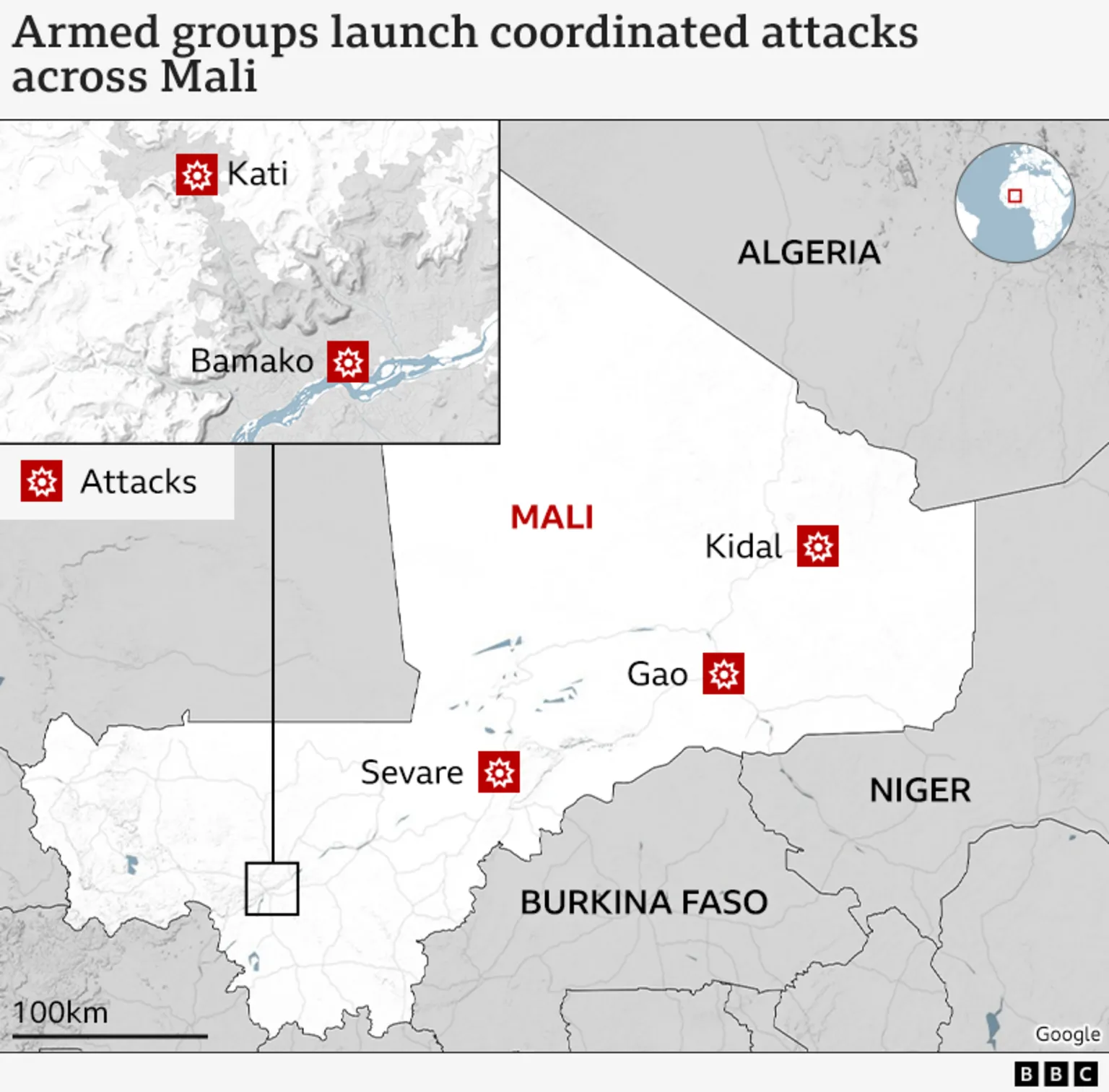
Last weekend, coordinated nationwide attacks were launched by an alliance of jihadists and separatist rebels in northern Mali. The Azawad Liberation Front (FLA), a separatist group, is among those seeking to overthrow the military regime led by General Assimi Goïta, who assumed power in a 2020 coup.
During these attacks, Defence Minister Sadio Camara was killed in an apparent suicide truck bombing at his residence near Bamako. His funeral took place on Thursday under tight security, attended by thousands including Goïta, as reported by AFP.
Mali's military has been collaborating with the Russian paramilitary group Africa Corps, which originated from the Wagner Group, in operations against insurgents.
Following the attacks, Russian forces withdrew from the northern city of Kidal, which is now under FLA control. The FLA has announced intentions to advance on additional northern cities and has demanded the withdrawal of Africa Corps from Mali entirely.

A Kremlin spokesperson stated on Thursday that Russian forces will remain in Mali
"to combat extremism, terrorism and other harmful phenomena and will continue to provide assistance to the current government".
Impact on Civilians and Transportation
A lorry driver attempting to reach Bamako told the BBC:
"I've never seen something like this before. I've been doing this job for so many years. I'm stuck here and it sounds dangerous. I would rather run away to save my life than fight for the goods I have to deliver. I've never thought like this before."
The town of Ségou, located less than 80 miles (approximately 50 kilometers) from Bamako, is under a total blockade. This has resulted in hundreds of vehicles, including trucks, buses, and cars, becoming stranded.
Passengers, comprising families and traders, have been trapped in Ségou for several days, facing difficulties in accessing water and food, according to a local reporter.
Government Response and Security Situation
State media reported that junta leader Goïta pledged strong measures against insurgents following an emergency security council meeting on Wednesday. He also claimed that armed and security forces had inflicted
"heavy losses"on rebel groups.
Alain Antil, director of the Sub-Saharan Africa Centre at the French foreign affairs think-tank Ifri, told the BBC that
"those moves show that the regime is weak and can't restore security."
In 2013, a similar alliance of jihadists and ethnic Tuareg separatists advanced on Bamako, prompting intervention by French forces alongside other African troops to protect the capital. While they succeeded in pushing insurgents back, attacks continued and instability persisted.
After seizing power, Goïta expelled French forces and sought support from Russia. However, the security situation has deteriorated, culminating in the recent attacks.
International Advisories and Local Perspectives
Several countries, including France, Canada, and the United Kingdom, have advised their citizens to leave Mali. The United States recommends that its nationals remain at home.
A French resident expressed her commitment to stay, telling the BBC:
"I won't leave. I love Mali. It has become a part of me since I came here in 2002. We'll stay with my family. We know things will be OK."