Innovative Data Centres in Unconventional Locations
Over the years, there have been numerous efforts to situate data centres in unconventional environments. Microsoft, for instance, deployed a data centre underwater, while Elon Musk has proposed placing them in space.
Now, a UK-based company is pioneering the use of thousands of interconnected smart lampposts as mini data centres. The firm has formalized an agreement with a Nigerian state to install 50,000 such units.
Conflow Power Group's Solar-Powered iLamps
Warwickshire-headquartered Conflow Power Group Limited (CPG) claims that when networked, its solar-powered iLamp units function as a "revenue-generating distributed AI data centre."
However, some experts have indicated to the BBC that this technology is not a replacement for the large, powerful data centres required to execute the most demanding AI tasks, though it may be suitable for less intensive applications.
Each iLamp is equipped with batteries charged by a cylindrical solar panel, providing energy to a low-powered computer capable of handling AI workloads.
"NVIDIA is the company that's created a small enough chip, powered with 15 watts of power, so it can be powered by solar, and we can put that inside a street light," CPG chairman Edward Fitzpatrick told the BBC's Tech Life programme.
Fitzpatrick explained that by scaling thousands of these units, the collective processing power would be equivalent to that of a conventional data centre, with the added environmental benefit of not drawing power from the electrical grid.
Security Concerns and Hardware Protection
Industry veteran Professor Ian Bitterlin expressed concerns to the BBC regarding the physical security of the streetlights housing the computing units.
"If people realise that there's a $2,000 unit inside there they might try and steal it," Fitzpatrick acknowledged, adding that the lampposts are designed so that the chip would be "fried" if removed.
AI-Powered Surveillance Capabilities
The lampposts also function as AI-enabled surveillance cameras. In Nigeria, each unit will be equipped with AI cameras capable of detecting parking violations, speeding vehicles, and seatbelt non-compliance, according to the company.
iLamps with cameras are already operational in a car park at Warwick Hospital, providing "CCTV monitoring and number plate recognition," CPG states.
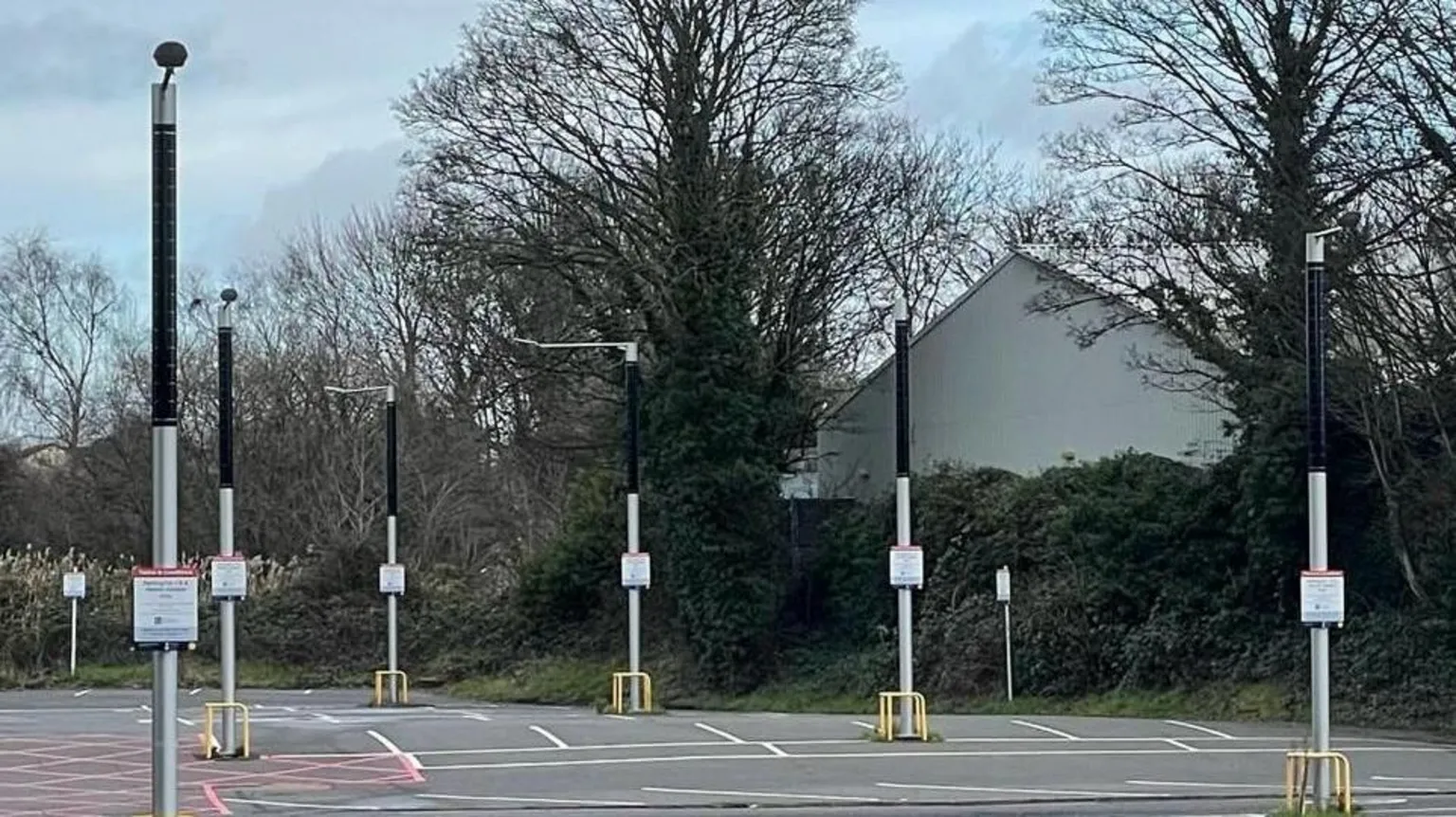
Fitzpatrick mentioned that the streetlights might also be used to identify wanted or missing persons through facial recognition technology.

While no such deployments currently exist, the company is in "final stage negotiations" with state schools and local authorities in Florida to implement these features.
Concerns about potential bias, misuse, and privacy violations related to facial recognition technology may provoke criticism of these capabilities.
CPG asserts that it will only deploy this technology in partnership "with the relevant authority" and in full compliance with applicable laws and regulations.
Fitzpatrick envisions the lights as a means of public interaction: "you could walk past the streetlight, put your two fingers up like a victory sign and that could be voting for something. That could be a poll which you could put out onto social media."
Energy Efficiency and AI Processing
Estimates suggest that the energy consumption of AI systems is approaching levels comparable to the entire UK, with similar concerns regarding water usage.
Experts suggest that solar-powered streetlights are best suited to supplementing large data centres rather than replacing them, as the latter offer concentrated computing power and economies of scale.
John Booth, Managing Director of consultancy Carbon3IT Ltd and a member of BCS the Chartered Institute for IT, told the BBC that in his view the iLamps could have value as "a relatively low-cost solution that can be used for small AI applications in conjunction with other larger sites."
Bitterlin believes AI streetlighting cannot substitute the largest data centres used to train leading large language models, particularly due to communication speed limitations caused by the distance between posts.
However, applications and software utilizing AI require numerous systems closer to users. The lampposts could serve as "access points, just like mobile phone masts" connecting to more powerful data centres running extensive AI models, he added.
Economic Model and Deployment in Nigeria
The Nigerian state of Katsina, which is adopting the devices, plans to generate revenue by leasing the iLamps' processing power to AI companies. After three years, CPG will begin receiving a 20% share of the revenue generated.
Fitzpatrick sees Africa as a key region to validate the technology and expand the business: "Africa is our prime target because there's plenty of sunshine which is great, they've got more relaxed rules and regulations, they want us to put the street lights on the street."
The iLamps will be manufactured in Morocco, Taiwan, and Latvia, with an assembly factory under construction in Katsina.
Local Impact and Official Statements
Dr Hafiz Ibrahim Ahmad, Special Adviser on Power and Energy for Katsina State, welcomed the agreement, stating that the state is now "home to the only distributed AI data centre of its kind anywhere on the African continent."
He suggested the iLamps could result in "safer streets, real-time crime and terrorism prevention, free public internet and a revenue stream that flows back into the state."
for our Tech Decoded newsletter to follow the world's top tech stories and trends. Outside the UK? here.