

Discovery of a Unique Spider Species in Northern Australia
A newly identified species of spider has been found in the remote rainforests of northern Australia, notable for its distinctive hunting technique. This spider constructs a catapult-like silk trap specifically designed to capture a single species of ant.
Researchers suggest that this nocturnal predator evolved this specialized method to prey on aggressive ants, which are considered dangerous and uncommon targets for spiders.
Exceptional Power of the Spider's Trap
The trap exerts an "exceptionally high power," propelling the ant into a larger web with an acceleration reaching "15 times the most extreme g-forces experienced by jet pilots," according to lead researcher Professor Ajay Narendra.
Although the spider has not yet been formally named, scientists have given it the nickname "ballista," inspired by the ancient weapon used to launch stones in warfare.
Specialized Hunting Mechanism
"The snare mechanism seems to have evolved as a highly specialised way of allowing the spider to 'pick off' potentially hazardous prey one at a time and transport them a safe distance away from ant trails and nests,"said researcher Dr Jonas Wolff.
Ants possess chemical defenses, including the ability to sting in some species, and can quickly summon large numbers of other ants to overpower predators, explains Narendra.
Research Methodology and Habitat
The research team from Macquarie University in Australia spent ten nights in the tropical rainforests of northern Queensland, documenting the spider's behavior using high-speed and infrared cameras.
Their study, published in the journal Current Biology, reveals that the ballista spider inhabits trees occupied by the aggressive and territorial green tree ant, Oecophylla smaragdina. During the day, it remains in webs concealed beneath the undersides of leaves.

Trap Construction and Hunting Behavior
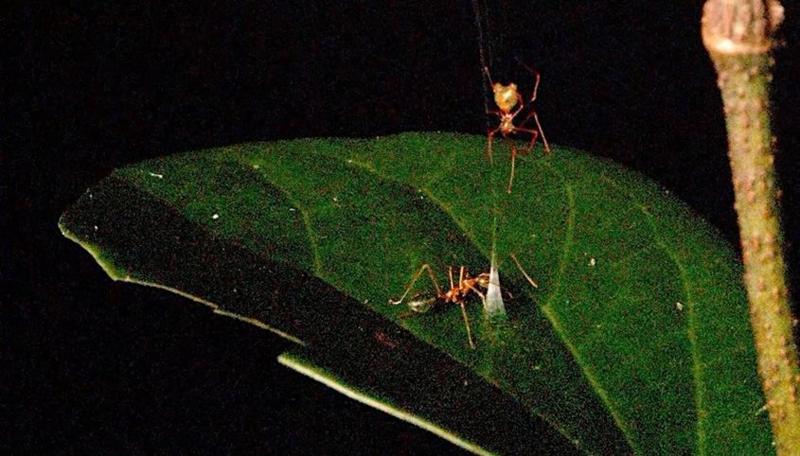
After nightfall, the spider descends approximately 50 centimeters to a leaf, branch, or the forest floor, where it establishes an anchor point with a silk line.
It then spends several hours constructing a cone-shaped "scaffold" composed of dozens of tension lines, around which it wraps a finer type of silk before retreating upwards.
Within moments, green ants approach the trap and bite it, triggering the snare to spring and launch the prey into the spider's web with "extreme" acceleration.
Prey Specificity and Luring Mechanism
The scientists observed that green ants were the only prey captured by the spider, even when other nocturnal ants were released near the trap. They hypothesize that the spider applies pheromones to the trap to attract and provoke the green ants exclusively.
This behavior is unprecedented, Narendra notes.
"This seems to be the only case where a spider's web is designed to catch a single prey species, and where the mechanism is triggered by the prey rather than by the predator."
Taxonomy and Initial Observation
The spider belongs to the genus Propostira and was first observed by biomedical researcher Greg Anderson, who is also a spider researcher and photographer.


