

AI to Boost Human Labor Demand, Says Jeff Bezos
Artificial intelligence (AI) will generate a greater need for human workers rather than render them obsolete, predicted Amazon founder Jeff Bezos during his appearance at a technology conference in Paris.
Bezos addressed widespread concerns that AI could replace large numbers of jobs, countering this narrative by emphasizing AI's potential to create new opportunities and increase the demand for human labor.
This perspective contrasts with statements from other technology and political figures, including former UK Prime Minister Rishi Sunak, who now advises Microsoft and AI company Anthropic. Sunak recently expressed concerns about AI's impact on young people's employment prospects.
"I know there's a lot of concern that many people have, including many smart people, that AI is going to make humans redundant and so on," Bezos said.
"I totally disagree with this point of view. And I think, in fact, AI is going to create a labour shortage."
Bezos painted an optimistic vision for AI's role in society, suggesting that human limitations are not due to a lack of ambition but rather barriers that technology can help overcome.
The billionaire entrepreneur spoke about his new AI venture, Prometheus, which aims to accelerate physical manufacturing—a sector increasingly embracing automation.
The UK's Trades Union Congress (TUC) has issued warnings that AI technology might replicate "the disaster of deindustrialisation," where shareholders benefit financially while jobs are degraded or displaced. However, the TUC also acknowledges AI's transformative potential if developed responsibly, with workers potentially benefiting from productivity gains.
Permanent Base on the Moon
During his appearance at VivaTech Paris, Europe’s largest technology expo, Bezos also shared his long-term vision for space exploration.
He described space as "supply constrained, not demand constrained," emphasizing that access to space remains the primary challenge for future development.
Bezos identified the Moon as a natural starting point for humanity’s expansion beyond Earth due to its proximity and resource availability.
"We're going to the Moon to stay, not just to visit," Bezos told the audience, adding that technologies such as electrolysis could eventually enable lunar resources to refuel rockets and support a permanent presence beyond Earth.
The discussion also included Bezos’s space travel company Blue Origin, which recently experienced a setback when an uncrewed New Glenn rocket exploded during a ground test at Cape Canaveral, Florida, in May.

"It was a gut punch for the whole team. But what we've learned since then is we got really lucky," Bezos said.
No injuries resulted from the explosion, and Bezos noted that several critical pieces of launch infrastructure survived, including propellant and fuel systems that would have taken much longer to replace.
On the same stage, Blue Origin CEO Dave Limp stated that reconstruction work at the launch site is already underway, with the company expecting to resume launches before the end of the year.
Blue Origin is competing with Elon Musk’s SpaceX to establish itself as a major player in commercial spaceflight and lunar exploration, targeting the growing market for extraterrestrial infrastructure.
Advances in Robotics and AI Interaction
Aside from the main presentations, Unitree’s humanoid robot attracted significant attention at the exposition, drawing constant queues of visitors eager to see the latest advancements in robotics.
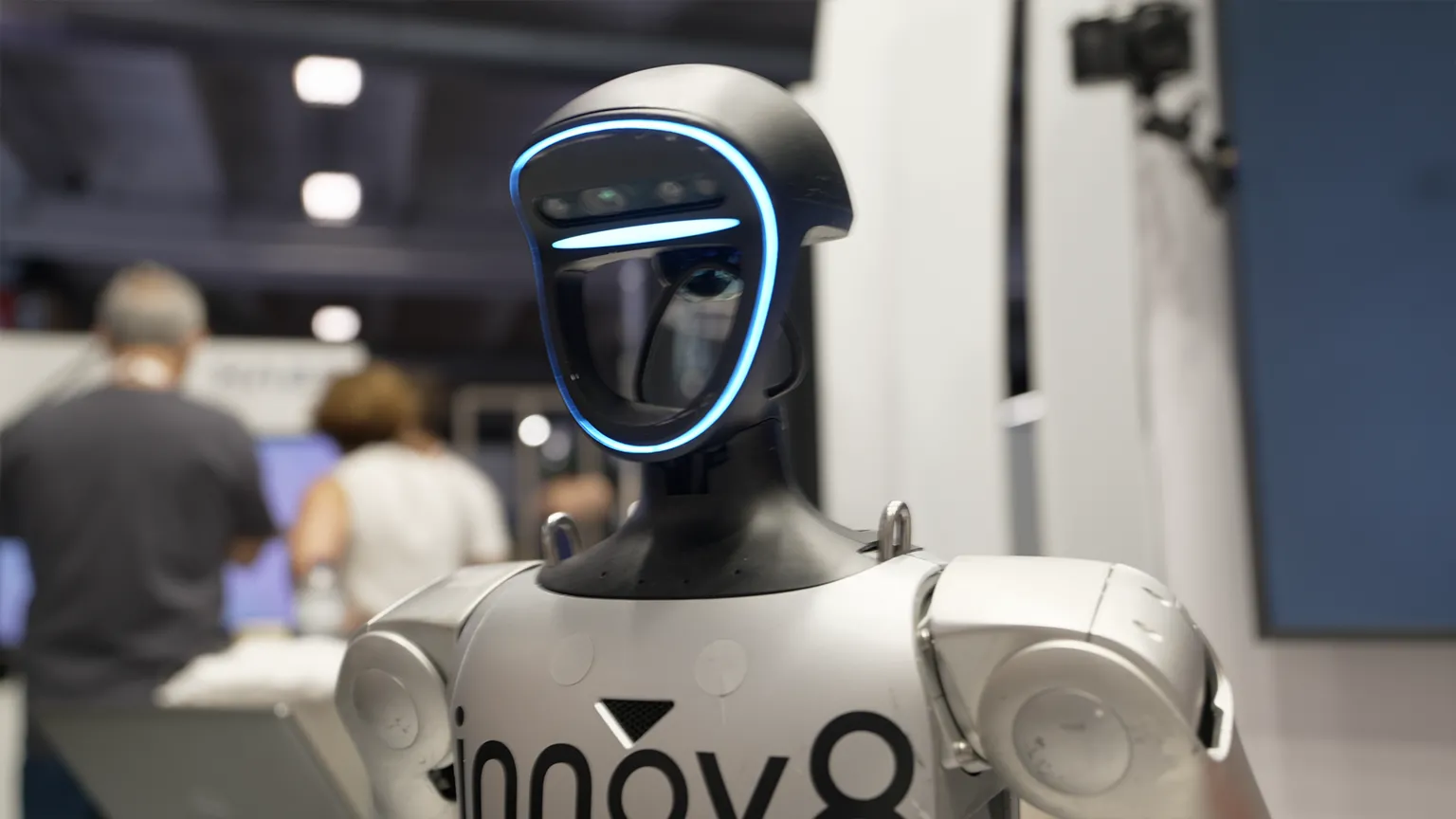
This time, the robot collaborated with French neuro-AI company HABS, which demonstrated technology enabling humans to interact with machines using cognitive signals rather than spoken commands.
The robot responded to commands generated through brain activity, detected via a headband equipped with an electroencephalogram (EEG). This device uses small metal probes called electrodes that contact the scalp to capture neural signals.
The demonstration offered a glimpse into how humans and machines might collaborate in the future.
It also reflected a broader trend at this year’s event: AI expanding beyond chatbots into the physical realm.
Humanoid robots are increasingly becoming viable, with companies racing to develop machines capable of working alongside humans in sectors such as healthcare, manufacturing, and hospitality.

for our Tech Decoded newsletter to follow the world's top tech stories and trends. Outside the UK? here.


