Distinguishing Human and AI Writing
As allegations regarding the use of large language models (LLMs) disrupt the literary and media landscapes, linguists clarify the true distinctions between human and machine-generated writing. Novelists such as Jennifer Egan and Jeanette Winterson share their perspectives on fiction's future in the era of ChatGPT.
Consider these three paragraphs extracted from different hotel reviews. Can you identify which, if any, were generated by AI?
“The hotel is in a great location for everything. Lots of places to eat and drink. The hotel itself is always abuzz. The tavern located on the ground floor is definitely a must. Food, service, prices and atmosphere were great.”
“A good hotel, though the room had the proportions of a well-appointed lift. Slept well, shower was excellent, staff were friendly. Breakfast was busy but competent. Would return, though probably not with a very large suitcase.”
“Excellent base for a London trip. The room was quiet, the bed comfortable, and everything worked exactly as it should. Staff were helpful without hovering. A smooth, unfussy stay from start to finish.”
How accurate were your judgments? According to Claire Hardaker, professor of forensic linguistics at the University of Lancaster, most people correctly identify AI-generated text only about 60% of the time. Her online test challenges users to spot fakes among 15 reviews. This moderate success rate may surprise those confident in detecting AI writing instantly. When doubts surfaced in May about the authenticity of Jamir Nazir’s prizewinning short story, social media users were swift to condemn it. One commented,
“If you know, you know.”Nazir later told The Atlantic that he did not use AI.
Hardaker notes that respondents often rely on simple heuristics to identify AI language, such as spotting clichés, frequent use of dashes, and the “rule of three,” where words or phrases are grouped in threes.
“People have learned very simplistic rubrics and now just madly apply them everywhere,”she explains.
However, these indicators are also common in human writing, which LLMs are trained on.
“You could go back to Charles Dickens and say he had AI, because he used the em dash too,”Hardaker says. Orators have employed the rule of three since Julius Caesar’s famous phrase Veni, vidi, vici. Among the hotel reviews, only the first one was authentic. Were you able to identify it?
Suspicion and Controversy in Literature and Media
Because it is difficult to definitively distinguish AI-generated text, suspicion has become widespread. In the literary world, accusations of AI use increasingly trouble authors, sometimes with little evidence. For example, the debut horror novel Shy Girl was withdrawn by publisher Hachette after online rumors suggested AI involvement, which the author denies. Steven Rosenbaum’s book The Future of Truth, a serious examination of AI’s impact on reality, contained numerous fabricated quotations, which the author apologized for.
Media organizations, including , receive growing numbers of complaints about allegedly AI-generated content. These concerns range from unusual phraseology to typographical and grammatical errors. In one instance, a duplicated word “after” in a sentence prompted a reader to comment,
“I can’t imagine a human editor/proofreader missing something like this,”reflecting faith in human editorial standards.
The challenge is compounded by the reciprocal influence between AI and human writing styles, creating a linguistic hall of mirrors. Without an author’s admission, it is often impossible to determine if a text is AI-generated, fostering paranoia.
Commercial AI detection tools also have limitations. Hardaker warns,
“Given that some of us naturally write in a way that would be seen as AI-like”—citing neurodivergent individuals as an example—
“that will be detected as AI. And you can modify AI output to make it seem more human-like. You put that kind of content into an AI detector, you’re going to get wacky results.”Having served as an expert witness, she remains
“extremely sceptical”about these tools’ reliability.
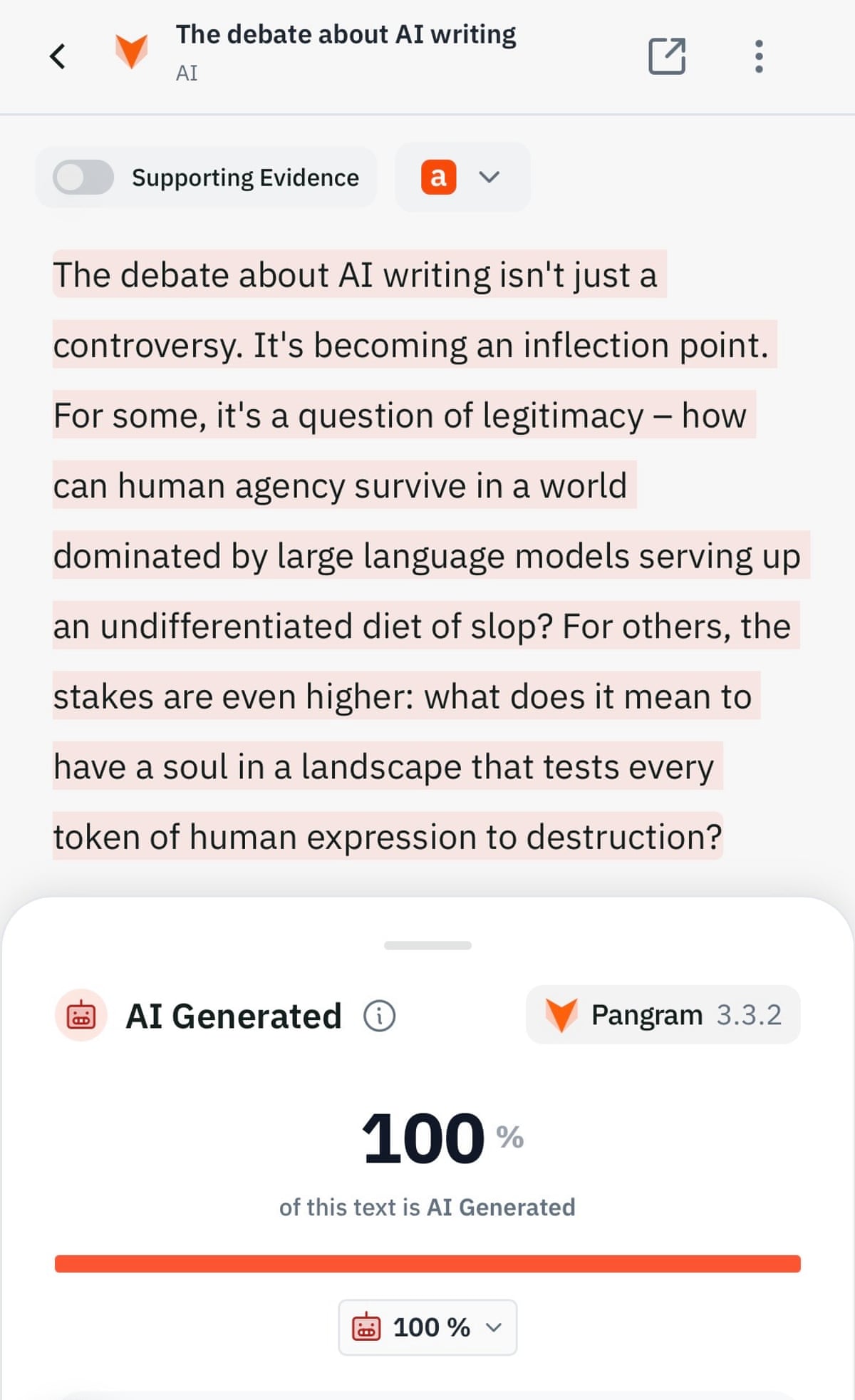
The recently popular detector Pangram claims false positive rates around 5%, but independent tests show it is only about 80% accurate at detecting AI writing, even after AI-generated text is processed through “humanizer” apps designed to disguise its origin. The author was able to fool Pangram on the first attempt by adopting a bombastic style that could be attributed either to AI or to a human influenced by LLM outputs such as ChatGPT, Claude, or Gemini—tools increasingly pervasive in everyday life.

AI’s Growing Influence on Language
Massive volumes of AI-generated writing are published daily, spanning advertising copy, academic abstracts, and fiction. AI also increasingly shapes everyday communication through auto-generated email suggestions, AI-curated search results, and chatbot interactions. At this scale, AI’s impact on language—both spoken and written—is undeniable. The central question now is how AI is changing language and whether society should resist or embrace these changes.
Researchers have observed that LLM-generated text often differs subtly from human writing, especially when analyzing large datasets. One researcher linked the sudden rise in the use of the word “delve” to LLMs after examining scientific paper databases. Other words AI tends to overuse include “showcase,” “boast,” “underscore,” “garner,” “align,” “surpass,” and “intricate.” Yet any individual text might naturally include these terms.
Interestingly, some researchers suggest that the “delve” phenomenon may result not from the models themselves but from the humans involved in reinforcement learning with human feedback (RLHF). Workers, often underpaid and stressed, may treat certain words as proxies for quality, inadvertently training models to use them more frequently. Thus, “delve” might be popular because it does not appear AI-like. A separate hypothesis attributing its rise to Nigerian English usage, where many RLHF workers reside, is unsupported by data.
Other linguistic patterns distinguish LLMs: they favor nouns but use fewer pronouns than humans, possibly reflecting less self-reference or social discourse. LLMs prefer attributive adjectives (“the uncomfortable chair”) over predicative ones (“the chair was uncomfortable”), favoring concise information delivery. Different models exhibit distinct linguistic “dialects”: Gemini often uses phrases like “here’s a breakdown,” while Deepseek responds with cheerful affirmations such as “Certainly!” When editing formal English worldwide, AI tends to homogenize language toward an Anglo-American standard, a process termed “linguistic leveling.” For example, the Indian English phrase “Kindly do the needful & revert back at the earliest” is often “corrected” to “Please complete the task & respond promptly.”
Evidence is mounting that AI-influenced language has permeated human communication. One study analyzing thousands of unscripted conversations found spikes in words like “delve” and “boast” following ChatGPT’s release. Another study noted that “delve” usage in academic abstracts increased even after social media attention, indicating complex dynamics in AI’s linguistic influence.
Human Concerns and the Unique Qualities of Writing
Language naturally evolves, with words rising and falling in popularity, often influenced by new technologies. However, AI’s impact has generated pronounced anxiety. Hardaker suggests this stems from fears of AI encroaching on sentience and supplanting humans. Since 2023, she has expanded her Bot or Not project to include speech and music, observing strong emotional reactions when people discover that songs they enjoy were machine-composed.

Novelist Gary Shteyngart, who teaches creative writing at Columbia University, has witnessed similar reactions among students confronted with AI literature.
“When one of my graduate students said ‘as an experiment, I’m going to be writing a part of this piece with AI’, the other students became so angry, they wrote letters to me saying how awful this was.”
He explains,
“There’s a kind of implicit bargain between writer and reader where you know the work that you’re getting is generated by a human being, and I think it felt like an assault on that. Reading literary fiction is this incredible Vulcan mind meld with another human being, entering someone else’s consciousness. With AI I’m entering the simulacrum of another person’s consciousness, one degree removed, or many degrees removed. How sad is that by comparison?”
For Hardaker, AI challenges what we consider uniquely human and valuable. Yet she admits that AI-generated music can be enjoyable:
“The music-generation model I use has generated some absolute bangers. I listen to them, unironically, in my car, and I enjoy them quite a lot.”
Could AI-authored literature achieve similar acceptance? Peter Stockwell, professor of literary linguistics at the University of Nottingham, believes AI can handle basic writing tasks but cannot reach literary heights.
“If you want something that’s very familiar and very mediocre and entirely functional, it’s amazingly good at that.”
He describes language as layered, from words to phrases, clauses, compound sentences, and narrative structure.
“AI is really good at the lower levels. It’s learned lots of our syntactic structures and so everything looks well formed and grammatical. But, the higher up you go, the less good it is.”Story arcs are especially challenging for AI to execute convincingly.
“If you’ve got an AI to write a narrative, it can do a pretty good job of having a sequence of events and something happen at the end. But it wouldn’t be a very tellable narrative,”he says.
“Nothing startling or interesting would happen. And if there is anything startling, it will generally look like a mistake, rather than a brilliant twist.”
The essence of great writing remains elusive, even to scholars.
“Linguists don’t understand, really, how language works at its higher levels,”Stockwell explains, referring to discourse, storytelling, and enchantment.
“We can’t build a machine to do something when we don’t know how it works.”He suggests that human social nature and embodiment—our physical bodies with their biochemical responses—shape language’s structure and use.
Two linguistic models exist: one views the brain as a computer parsing grammar and meaning, the other as fundamentally embodied. This embodiment is reflected in language metaphors, such as associating “up” with good feelings.
“One of the key things is that the current AIs don’t have a body, they don’t exist in the world, so they don’t know what it feels like to be in the world as a human.”
Shteyngart emphasizes the importance of sensory experience:
“Today is the first warm day in New York. And if I was to start writing a novel, I think that [it] would be warmer. I think I would filter what I know through the warmth of the day. I think if I ate a really wonderful lunch and sat down to write, there would be more sensuousness in my writing.”
“The love of the body and its encounters with the physical world are what drives some of the best of literature. So I almost feel sorry for these LLMs, as I’m talking about them, because they’re pushed into some horrible machine in the Bay Area, and they just don’t know how wonderful life is.”
Concerns Over Linguistic Homogenization and Innovation
A major concern regarding widespread LLM use is their potential to homogenize language, erasing variety and idiosyncrasy into a bland uniformity. This concern is valid but not unprecedented. Similar anxieties have accompanied the global spread of American film and television accents and vocabulary. Subgenres such as political euphemism, customer-service jargon, and therapy-speak have also expanded beyond their original contexts. Historically, such influences provoke backlash, and there is no reason to expect a different outcome with AI.
Human creativity and innovation may ultimately distinguish human writing, especially literary work, from AI.
“The whole point of an LLM is that it’s trained on existing language. So it’s always retro,”Stockwell says.
“I could get an AI and say ‘write me a short story in the style of Virginia Woolf’ and it’ll do a decent job. But what you can’t say is ‘write me a story in the unique style of the next great, serious literary innovator’. It couldn’t possibly do that.”
This limitation stems from AI’s lack of social environment and embodiment, which foster uniquely human motivations.
“Why does somebody do something new in an art form like literary writing? It can be out of annoyance or irritation with what’s gone before. Or it’s because somebody sees things in a different way than the run of the mill, or sometimes just because people are antsy and wanting to do something different, or a little bit crazy or isolated.”
Historical examples abound.
“After the bureaucracy and uniformity of the first world war, you’ve got this sudden, huge, antithetical artistic movement in the rise of surrealism and Dada; similarly, after the austerity of the second world war you get the psychedelic movement, art and literature changes again, quite radically. So there always seems to be that sort of kicking against the norms. It’s hard to think how you would program an AI to do that, because AI works on an existing large body of material. It’s the embodiment of the conservative-with-a-small-c status quo.”
Authors’ Perspectives on AI and Writing
Novelist Jennifer Egan values originality so highly that she has completely avoided AI technology.
“I feel a danger of infection, to use a kind of loaded metaphor,”she says.
“I know they stole some [of my] stuff, and there’s nothing I can do about that, but I’m not giving them one more word voluntarily.”Anthropic, a company that trained its chatbot Claude using a large corpus of books including Egan’s novels, exemplifies how most LLMs incorporate language from individual queries as additional training data. Egan expresses frustration:
“I don’t want to partake of this kind of language spam that they’re offering.”
Her zero-tolerance stance does not prevent paranoia.
“I’ve been told a couple of stylistic things that are tells of AI, and they happen to be things I like. For example, I love , but I now find myself interrogating every one way more than I used to. I’ve also noticed that I’m prone to collections of three. So I find myself interrogating those as well. I don’t mind that, actually, because the entire point is to not write something that anyone else could have.”
Asked what advice she would offer younger writers navigating this landscape, she says,
“I’m gonna now sound like the totally generic boomer that AI could probably have written, and my advice is: stay the fuck away. I mean, OK, use it to write emails. Even use it to get research ideas. But if you want to be a writer: learn to write. Come on. I would really question why the impulse would be there to use it.”
In contrast, Jeannette Winterson, who has extensively written about AI and art, adopts a more open stance.
“Every writer can make their own choice. Humans are tool-using animals. That has been our success story. At present all AI, including generative AI, is a tool. Would I work with an LLM? Of course! Why not?”
However, she warns against equating AI’s linguistic ability with human expression.
“Beyond the basics, meaning becomes a series of inner realities and language is wonderful at conveying those inner realities. Machines do not share our reality, not least because they don’t have a limbic system. Humans cannot have a thought without a feeling … literature is brilliant at revealing these layers.”
While compiling her quotes, the author noticed an AI suggestion within Google Docs offering to adjust Winterson’s words to better “match the style” of the surrounding text, effectively smoothing the idiosyncrasies of one of English literature’s most distinctive voices. The prompt was dismissed with haste.