WHO Director General Addresses Tenerife Residents
The director general of the World Health Organization (WHO), Tedros Ghebreyesus, has reassured residents of Tenerife that their risk of infection remains low ahead of the arrival of the MV Hondius cruise ship, which experienced an outbreak of hantavirus.
In a personal message to the people of the Canary Island, Ghebreyesus emphasized that
"this is not another Covid"and confirmed that no symptomatic passengers are currently aboard the vessel.
Arrival of MV Hondius and Local Concerns
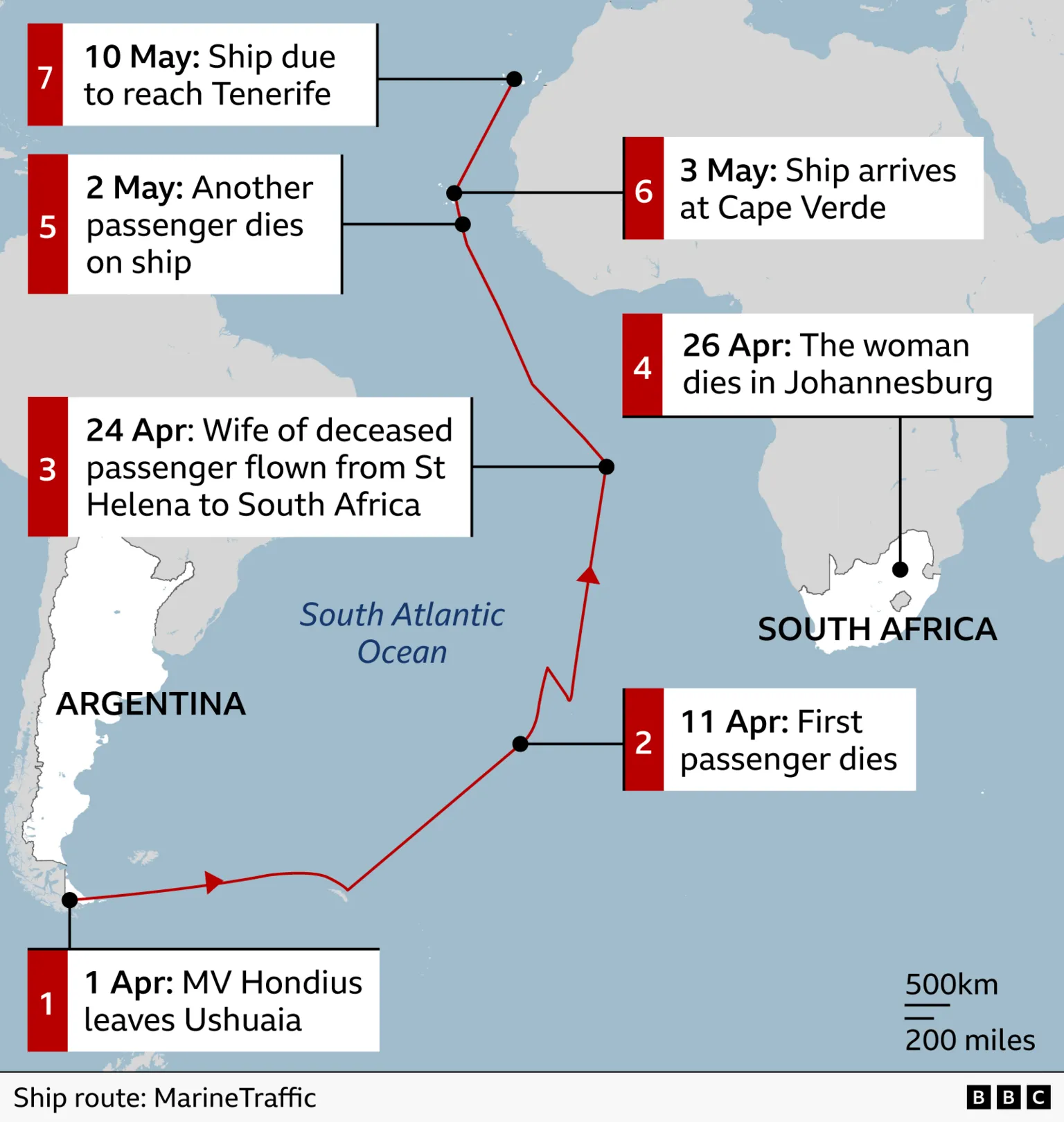
The MV Hondius is scheduled to dock at the port of Granadilla in the early hours of Sunday morning, prompting concern among local residents.
To date, six cases of hantavirus have been confirmed among the ship's passengers, including one of the three fatalities that occurred while the Dutch vessel was en route from South America.
Spanish authorities have sought to alleviate fears by detailing the containment measures in place for the ship's arrival.
Hantavirus Background and Transmission
Hantaviruses are typically transmitted by rodents; however, the Andes strain, which the WHO believes some passengers contracted in South America, can be transmitted between humans.
Symptoms associated with hantavirus infection include fever, extreme fatigue, muscle aches, stomach pain, vomiting, diarrhea, and shortness of breath.
WHO's Message to the Public
Addressing the residents on Sunday, Ghebreyesus stated:
"I know you are worried. I know that when you hear the word 'outbreak' and watch a ship sail toward your shores, memories surface that none of us have fully put to rest. The pain of 2020 is still real, and I do not dismiss it for a single moment.
But I need you to hear me clearly: this is not another Covid. The current public health risk from hantavirus remains low."
Medical Assessments and WHO Presence on Board
Ghebreyesus noted that WHO expert Dr. Freddy Banza-Mutoka is currently aboard the MV Hondius, conducting medical and exposure assessments alongside two Dutch physicians.
The WHO reports that no additional passengers are exhibiting hantavirus symptoms at this time.
Ghebreyesus has traveled to Tenerife to oversee the operation in person, according to the international agency.
Arrival Timing and Passenger Management
Spanish Health Minister Mónica García announced on Saturday that the ship is expected to anchor in the Canary Islands between 04:00 and 06:00 GMT on Sunday.
Passengers will remain on board and will only disembark onto smaller boats when repatriation flights are ready to receive them on the tarmac.
Flights have been arranged to return passengers to the UK, the US, France, Germany, Belgium, and Ireland, with the European Union providing two additional planes for other European citizens.

Regional Political Response and Public Reaction
The arrival of the MV Hondius has been met with opposition from the region's president, Fernando Clavijo, who questioned why the final response phase could not have been conducted in Cape Verde, the ship's previous port of call.
This has sparked local protests and criticism of the central government by the far-right party Vox.
Ghebreyesus expressed gratitude to Spanish Prime Minister Pedro Sánchez, describing the decision to accept the ship as
"an act of solidarity and moral duty".
He explained that Tenerife was chosen due to its medical capacity, infrastructure, and humanitarian commitment to ensuring the passengers' safety.
Preventive Measures to Protect Local Population
Spanish authorities have outlined strict precautions to prevent contact between passengers and the local population.
Minister García stated that all passengers will wear FFP2 masks when disembarking, as will all personnel involved in their transfer, including bus drivers and logistical staff.
Passengers will disembark according to nationality, with Spanish nationals expected to leave first.
"Those disembarking will only be allowed to take with them a small, sealed bag containing essential items such as their documentation, mobile phone, charger, basic necessities and personal belongings."
She added that the body of one deceased passenger will remain on board while the ship is in the Canary Islands.
The vessel will then proceed to the Netherlands, where the body and belongings will undergo disinfection before removal.
Details of Fatalities and Cases
The first death occurred on 11 April, followed by another on 2 May. A 69-year-old Dutch woman who disembarked in St. Helena on 24 April later died in South Africa two days afterward.
Two British men with confirmed hantavirus cases are receiving treatment in the Netherlands and South Africa, while a third British individual with a suspected case is being treated on Tristan da Cunha, a remote Atlantic island where the ship stopped in mid-April.
Ongoing Investigations and Outbreak Origins
The precise cause of the outbreak remains unclear, as does whether additional passengers or crew members may have been infected.
Ghebreyesus previously indicated that the first two cases had
"travelled through Argentina, Chile and Uruguay on a bird-watching trip which included visits to sites where the species of rat known to carry the virus was present".