French MPs Approve Assisted Dying Law with Strict Conditions
France's National Assembly has voted to establish a right to assisted dying under stringent conditions, concluding years of debate and multiple revisions to the proposals.
Members of Parliament approved the bill by 291 votes to 241. The legislation had previously been rejected three times by the Senate, the upper house of parliament.
Prime Minister Sébastien Lecornu plans to submit portions of the bill to France's Constitutional Council for review before it can be enacted into law.
The law would permit assisted dying for French adults suffering from a "serious and incurable" life-threatening illness that is in an advanced or terminal stage. The illness must cause constant physical or psychological suffering that is unbearable or resistant to treatment.
The patient must "freely manifest his or her intention" to a doctor, who will then make a decision following a consultation period of 15 days.
After a mandatory two-day reflection period, the patient would be required to self-administer a lethal substance. If the patient is unable to do so, a doctor or nurse may perform the administration.
The physician must verify the patient's decision to proceed with the procedure on the day it is carried out.
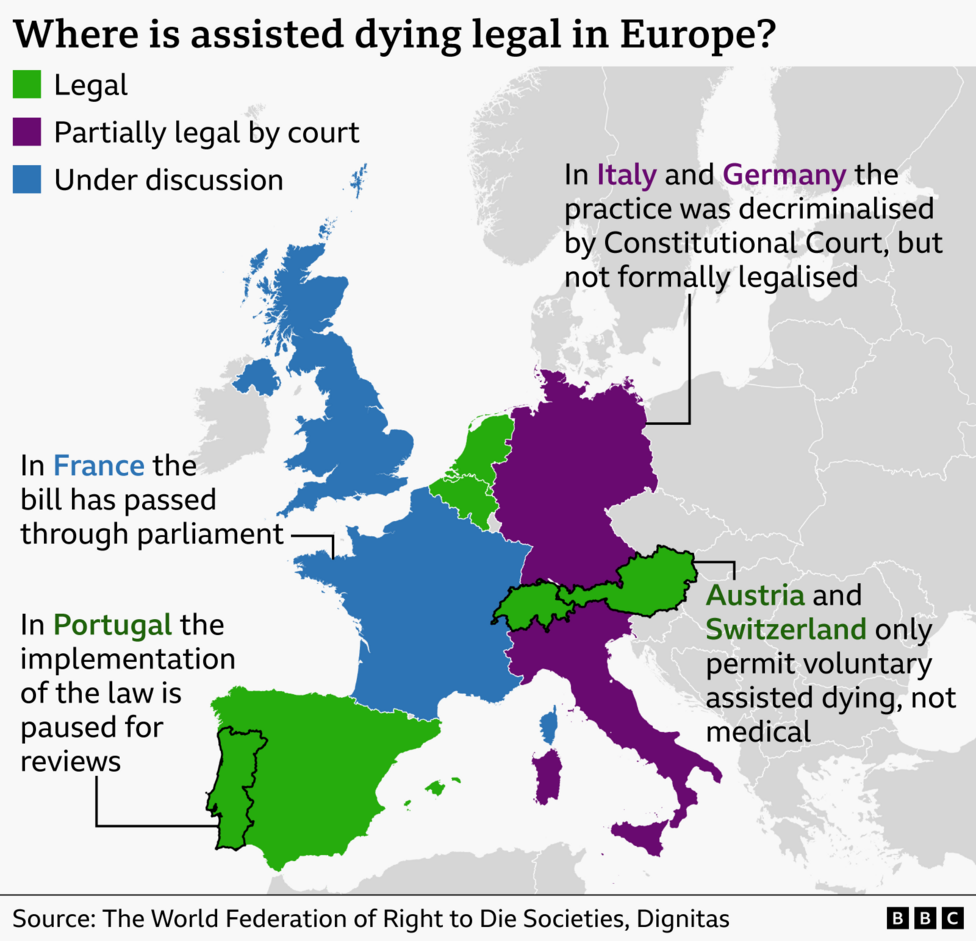
Wednesday's vote positions France to join several other European nations that have decriminalised assisted dying in some form.
European Context and Comparisons
A similar extensive debate has been ongoing in the United Kingdom. A bill to legalise assisted dying in England and Wales stalled earlier this year but is scheduled to return to Parliament in September.
The Netherlands and Belgium legalised assisted dying in 2002 for individuals experiencing unbearable suffering from incurable illnesses, allowing the procedure to be administered by physicians.

Several other European countries have since enacted legislation permitting assisted dying, while Switzerland has long allowed assisted suicide provided the assisting party acts without self-interest.
Political and Social Opposition in France
In France, the issue remains highly contentious politically, facing opposition from the Catholic Church and segments of the medical community.
Despite approval four times in the National Assembly, the Senate—dominated by right-wing parties—has rejected the bill three times.
Opinion polls indicate that a significant majority of the French population supports granting terminally ill individuals the choice between palliative care and assisted dying.
Constitutional Review and Government Position
On the eve of the vote, Prime Minister Lecornu clarified his intention to refer certain provisions of the bill to the Constitutional Council, a nine-member body responsible for ensuring laws comply with the constitution.
President Emmanuel Macron has been a long-time supporter of end-of-life legislation; however, his decision to call snap elections two years ago caused considerable delays in the legislative process.
Since 2024, there has been some hesitation among France's prime ministers regarding the assisted dying bill, and Lecornu is known to have reservations about specific terms of the legislation.
In a statement prior to the vote, Lecornu's office noted that while the lower house had thoroughly debated the bill, the Senate had not provided scrutiny that addressed "both the aspirations of its supporters and concerns of those worried about its implementation."
Lecornu has requested that the Constitutional Council focus on three key aspects of the law:
- The two-day reflection period given to patients to confirm their request after a doctor's decision, which opponents argue is too brief
- The capacity of patients under legal protection due to impaired judgment to provide free and informed consent
- The role of health and social care facilities in offering assisted dying services, particularly where their primary mission is to provide palliative care to terminally ill patients
Public Debate and Ethical Considerations
Polls indicate public support for changing the law, though political opposition remains significant. Some critics argue that the legislation positions eligible individuals as a "burden," reflecting ongoing ethical and societal concerns.
"The two-day period of reflection given to patients to confirm their request once it has been decided by a doctor, which opponents argue is too short"
"The ability of patients under legal protection because of impaired judgement to exercise free and informed consent"
"The role of health and social care facilities in providing assisted dying services where their reason for existence is to provide palliative care to those who are terminally ill."
- Portuguese MPs vote to allow limited euthanasia
- Jersey to legalise assisted dying after Royal Assent
- How assisted dying has spread across the world and how laws differ