

Ebola Outbreak in Ituri Province Demands Urgent Response
The military governor of the Democratic Republic of Congo's Ituri province, the epicentre of the current Ebola outbreak, has described the efforts to contain the virus as a "war" for which they lack sufficient resources.
"People in affected areas are not receiving enough food," Johnny Luboya Nkashama told French broadcaster RFI, adding that "other diseases" and "overcrowding" are also issues.
He emphasized the need for a "swift response," including enhancing the capacity of personnel to prevent Ituri "from descending into catastrophe." Officials report more than 900 suspected Ebola cases and 223 suspected deaths since the outbreak was declared on 15 May.
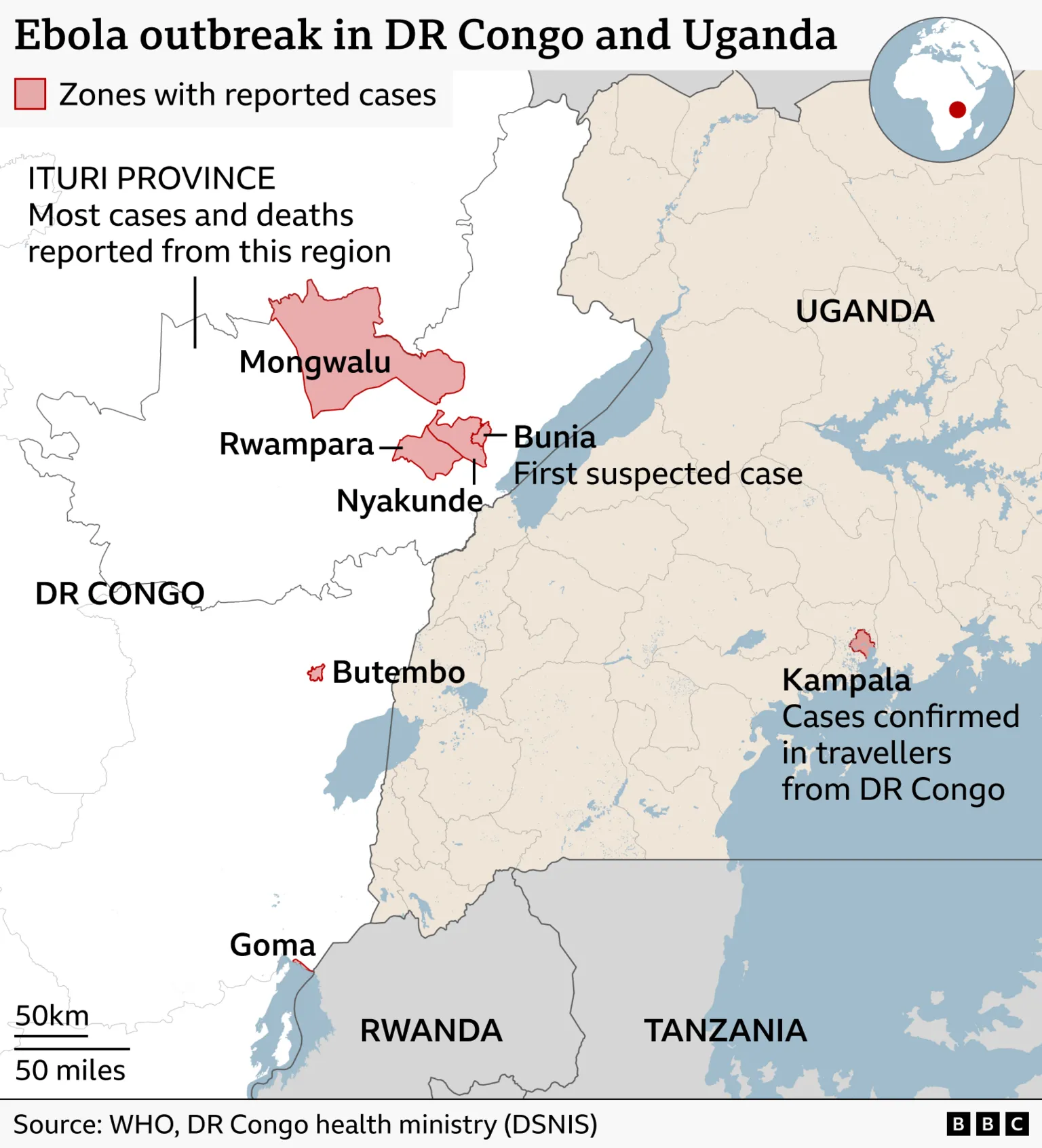
The World Health Organization (WHO) has indicated that the disease may be spreading faster than initially anticipated and has declared the outbreak a public health emergency of international concern.
On Monday, WHO Director-General Tedros Adhanom Ghebreyesus, who is scheduled to visit DR Congo, stated that the Ebola outbreak is outpacing urgent efforts to scale up the response, noting that responders are "playing catch-up." Ebola cases have also been reported in DR Congo's North and South Kivu provinces, as well as in neighbouring Uganda, where seven cases have been confirmed.
Calls for Qualified Personnel and Secure Treatment Centres
Governor Nkashama elaborated on the province's needs, stating that "qualified personnel" should be deployed promptly and "secure treatment centres" established. He also highlighted incidents where relatives, attempting to claim bodies of loved ones who reportedly died of Ebola, have targeted two treatment centres.
"Our existing resources were dedicated to the war, and this second war that is now upon us demands even more," he said on RFI.
Ituri has been under military rule since 2021, when civilian authority was replaced by a military general to neutralize numerous armed groups operating in the area for many years, including the Allied Democratic Forces (ADF), which is affiliated with the Islamic State group.

"And lastly, we need to mobilise financial resources - they must be made available," the governor said. "The more time we lose, the closer we come to disaster."
Regional Coordination and Funding Efforts
On Saturday, the head of Africa Centres for Disease Control and Prevention (Africa CDC) met with health ministers from DR Congo, Uganda, and South Sudan to finalize cross-border coordination in response to the outbreak.
Africa CDC Director-General Dr Jean Kaseya announced an agreed budget of $319 million (£236 million) to contain the outbreak. He told BBC World Service's Newsday on Monday that 10% of the funds had been secured from the affected countries.
On the same day, South African President Cyril Ramaphosa pledged an initial $5 million to support the plan. Kaseya added that African businessmen will convene later in the week to "raise additional funds," while international partners are also committing resources.
Africa CDC has warned that other African countries, including Angola, Burundi, the Central African Republic, Ethiopia, Kenya, Rwanda, South Sudan, Tanzania, and Zambia, are at risk of an outbreak.
Details on the Ebola Strain and Vaccine Development
This outbreak marks the 17th Ebola emergence in DR Congo since the virus was first identified in 1976. It is only the third global occurrence of the rare Bundibugyo species of Ebola, which has not been seen in over a decade.
Currently, there are no vaccines or medications specifically targeting the Bundibugyo strain, but vaccines are under development. Last week, the WHO indicated that it could take up to nine months for a vaccine to become available.

For more news from the African continent, visit BBCAfrica.com. Follow updates on Twitter @BBCAfrica, Facebook at BBC Africa, or Instagram at bbcafrica.


