Monday briefing: Will a new alliance of nations guide the world towards a post-fossil fuel future?
In today’s newsletter: As oil prices surge and geopolitical tensions escalate, a diverse coalition of governments is striving to build momentum and reshape the global energy landscape.
Good morning. The rising cost of fossil fuels threatens to strangle the global economy once again. Last week, oil prices soared after the US president warned that a blockade of Iranian ports could last for months, pushing oil prices to their highest level since Russia’s invasion of Ukraine. This escalation raises the spectre of a global recession.
However, on Colombia’s Atlantic coast last week, a coalition of willing nations gathered to attempt to break this cycle. Nearly 60 governments convened in Santa Marta for the world’s first conference dedicated to transitioning away from fossil fuels. At the summit, each country committed to developing roadmaps to reduce fossil fuel dependency.
For today’s First Edition, I spoke with ’s environment editor Fiona Harvey, who attended the summit, about whether the conflict involving Iran has inadvertently accelerated renewable energy adoption. But first, the headlines.
Five big stories
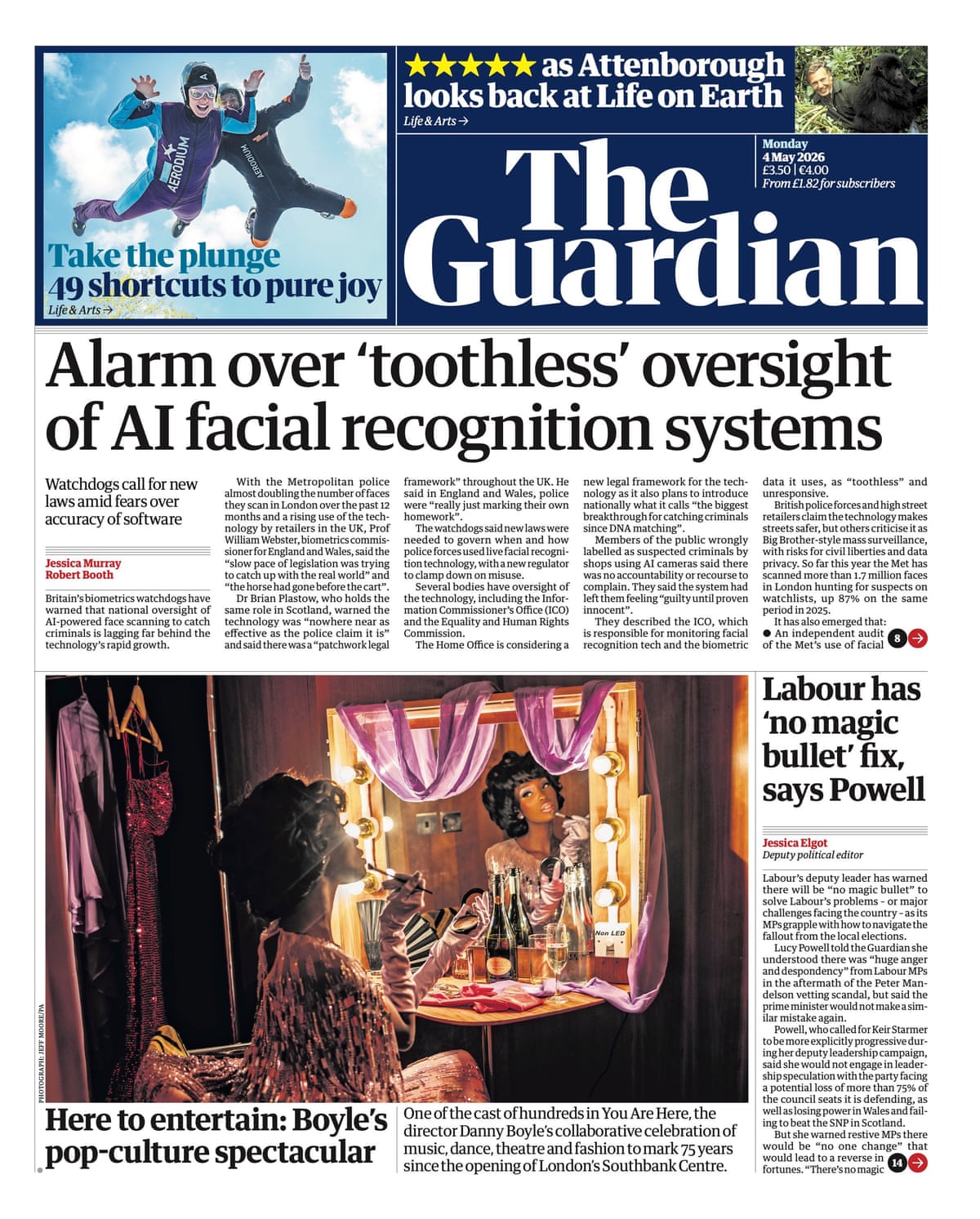
AI: The biometrics commissioner for England and Wales reported that national oversight of AI-powered facial recognition technology used to apprehend criminals is lagging behind the rapid advancement of the technology.
UK politics: Labour’s deputy leader, Lucy Powell, warned there will be no quick fixes to Labour’s internal challenges or the major issues facing the country as MPs navigate the fallout from local elections.
Iran: Donald Trump announced that the US will "guide" ships trapped by the Iran conflict starting Monday morning and claimed his representatives were engaged in "very positive" discussions with Iran.
Europe: Canada is set to become the first non-European country to attend a meeting of the European Political Community, with Prime Minister Mark Carney joining the summit in Armenia today.
Israel: Spain’s foreign ministry expressed concern over a Spanish national it said was being "held illegally" by Israel following the interception of a Gaza-bound flotilla.
In depth: An immense irony seems to be unfolding
During Donald Trump’s second presidency, the climate crisis has largely vanished from the global agenda. The administration has launched a coordinated attack on the green movement: the US government has withdrawn from the Paris Agreement once again, exited the UN climate convention, defunded numerous global projects aimed at resilience and adaptation, and pressured other nations to follow suit. At the recent International Monetary Fund (IMF) and World Bank Group (WBG) spring meetings, the US actively sought to prevent countries from even mentioning climate change.
Yet, the US appears increasingly out of step with global trends. As the UN’s climate chief noted on Thursday, an "immense irony is unfolding" due to the war in Iran: the soaring oil prices, driven by US-Israeli attacks on Iran, have accelerated the boom in renewable energy. Governments, businesses, and households worldwide are turning to solar and wind power to escape the rising costs of fossil fuels.
While oil and gas companies, especially those based in the US, may benefit in the short term, the genie is out of the bottle. Fatih Birol, executive director of the International Energy Agency (IEA), stated that the conflict has permanently altered the fossil fuel industry’s image of reliability and boosted nuclear power and renewables. Although fossil fuels will still be needed and used, countries appear to be losing trust.
"The vase is broken, the damage is done – it will be very difficult to put the pieces back together. This will have permanent consequences for the global energy markets for years to come," he said.
This irony is not lost on those advocating for stronger climate action.
The summit in Colombia, organised jointly with the Netherlands, emerged from deep frustration with the UN climate process. Though voluntary and lacking participation from many of the world’s largest emitters, the conference maintains momentum in efforts to prevent extreme temperature rises, according to Fiona Harvey.
"This summit is not going to solve the problems of the world, or replace the official UN climate process, but in its own way, it can help solve some of the current problems in the climate movement. You need to get buy-in from countries who want action on this issue. They also need to find a way to communicate with governments who do not, which are largely autocracies," she said.
Ultimately, 59 countries participated in the talks, representing over half of global GDP, nearly a third of energy demand, and a fifth of fossil fuel supply. One country, in particular, loomed large over the discussions.
"We have never seen a United States government like this before," Fiona told me.
"When I first started writing about the climate, George W Bush was in charge and he wasn’t keen on the climate. But he didn’t go around saying things to the tune of we’re going to smash up renewables, halt investment in them, and say that climate change is a hoax.
"It’s a very different landscape with Trump in charge – and Santa Marta is an expression of how countries are responding to that."
Petrostates versus electrostates
The Trump administration’s rejection of climate action and the energy transition has created a technological divide. On one side is the US, which has achieved energy independence through fossil fuels and under Trump seeks to continue relying on technologies that have dominated the past century. On the other side is China, emerging as the world’s first "electrostate," dominating the production of solar panels, wind turbines, affordable electric vehicles, and the supply chains necessary to produce them.
"The petrostate v electrostate division has been an issue for the last year or so. The idea is that you’re either hooked on oil, gas and coal, or you move to an electrified future. The discourse has been precipitated by Donald Trump as he has made things very stark," Fiona said. "We always knew that electrification was the only way to get out of the climate conundrum. It’s much easier to get off fossil fuels if you electrify everything first."
Many governments are cautious about potential dependence on China if they pursue this transition, with European governments particularly keen to avoid complete reliance on Beijing for the energy transition. They will need to balance relations between the US and China moving forward.

As representatives departed Colombia’s Atlantic coast, many left with renewed hope for the first time in years. Momentum had already been difficult to find in official UN climate talks before Trump’s return to the presidency, but the coalition achieved enough to agree to meet annually alongside Indigenous leaders, scientists, and other experts.
Despite overwhelming scientific evidence that human activity, particularly fossil fuel consumption, drives global heating, the official UN climate process still struggles to reach consensus on this fundamental fact. Now, a significant minority have accepted it—and it is up to them to build the future.
"We decided not to resign ourselves to an economy built on the destruction of life," said Colombia’s environment minister and chair of the talks. "We decided that the transition away from fossil fuels could no longer remain a slogan but must become a concrete, political and collective endeavour."
What else we’ve been reading
Jenny Kleeman explores a rare phenomenon where twins Lavinia and Michelle discovered they have different fathers, a condition known as heteropaternal superfecundation.

For five years, ’s You Be the Judge has attempted to resolve domestic disputes. This week, they revisit some of the most memorable cases—such as arguments over shared toothbrushes—to find out what happened next.
Simon Hattenstone’s interview with Danny Dyer is, as expected, exceptional.
Five authors, including Yomi Adegoke and Bella Mackie, reflect on the impact of throwaway comments.
Rowan Jacobsen investigates the diminishing appeal of nudism, questioning whether he would ever give up his clothes for a story.
Sports updates
Football: Tottenham moved out of the bottom three after goals from Conor Gallagher and Richarlison secured a 2-0 victory.

Formula One: Kimi Antonelli held off Lando Norris to claim victory, with Oscar Piastri finishing third. Antonelli’s third consecutive win this season extends his championship lead to 20 points over George Russell.
Tennis: Jannik Sinner became the champion, defeating Alexander Zverev 6-1, 6-2 in 56 minutes.
The front pages
"Alarm over ‘toothless’ oversight of AI facial recognition systems" leads the Monday print edition of . The Times features "Britain told to pay £1bn a year to EU after ‘reset’," while the Mirror runs with "Reform in new race row." The Mail warns of a local elections scare with "Labour’s plan to double parking fine fee."
The Telegraph reports "Welfare pays more than work for 600k households." The i paper highlights "State pension triple lock under threat if UK goes to war with Putin," and the Financial Times covers "Banks in danger of ‘choking’ on data centre financing seek to offload risk." The Express celebrates a campaign to help second world war veterans with "Cheers to you." The Metro is on bank holiday edition.
Today in Focus
The women who took their own lives after domestic abuse
Geraldine McKelvie and Hannah Al-Othman investigate the cases of women who died after enduring sustained campaigns of cruelty.

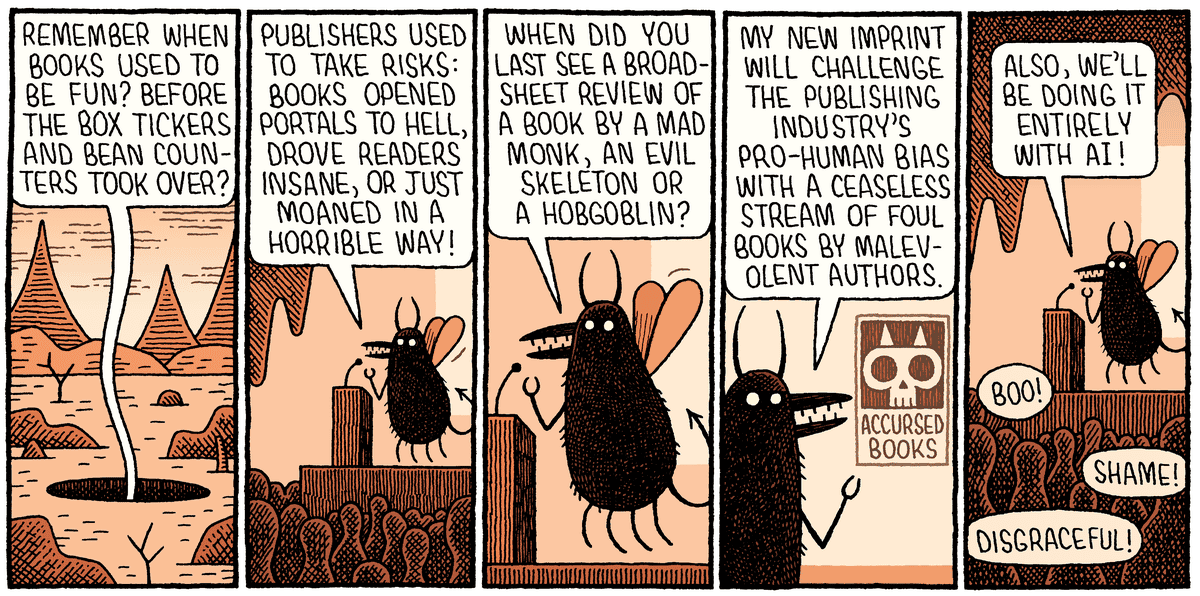
Cartoon of the day | Tom Gauld
The Upside
A bit of good news to remind you that the world’s not all bad.
Whether it is the timeless joy of sitting in the front seat at the top of a bus, doing a cartwheel, cooking from scratch, or simply getting lost, a variety of writers recommend activities to enjoy this bank holiday. Some require a small budget, but many, such as challenging family members to "draw your own nose," counting dogs on a day out, or learning to play a favourite song, can be done on a shoestring.

for a weekly roundup of The Upside, sent every Sunday.
Bored at work?
Finally, ’s puzzles are here to keep you entertained throughout the day. Until tomorrow.