Rising Costs of Everyday Essentials
Many consumers have consistently purchased the same supermarket staples over the years. However, it has become increasingly evident that the total at the checkout is higher now than in the past, even when discretionary items such as wine or biscuits are excluded from the basket.
It may come as a surprise to learn the extent to which prices for everyday essentials like milk, bread, and eggs have increased over recent years. This report examines the price changes, the factors driving these increases, and whether any parties are profiting from the situation.
Back in 2022, the average cost of a box of six supermarket own-brand free-range eggs was £1. Today, that same box costs approximately £1.80, according to market researchers Assosia, who compared average prices across Tesco, Sainsbury's, Asda, and Morrisons for the BBC.
The surge in egg prices followed the culling of millions of hens during the UK's most severe avian flu outbreak between 2021 and 2023. The significant reduction in laying hens, combined with increased energy costs associated with keeping birds indoors due to restrictions, led to supply shortages.
Supermarkets responded by limiting the number of eggs customers could purchase, while producers and retailers raised prices to offset their financial losses.
A substantial portion of egg production costs stems from purchasing grain for feed, heating hen sheds, and transportation. Ukraine, a major grain supplier, experienced sharp price increases following Russia's full-scale invasion in 2022. This conflict also contributed to rising energy prices, a trend that has reemerged due to the war in the Middle East.
Despite these pressures, demand for eggs remains strong, partly driven by the popularity of high-protein diets.
Milk prices have also increased. In 2022, four pints of semi-skimmed milk cost £1.29 on average; today, the price is around £1.65, according to Assosia's data on supermarket budget ranges.
Dairy production is energy-intensive, involving milking, processing, and transportation. The energy price hikes following the Ukraine conflict significantly impacted the industry, pushing prices upward.
After an initial spike, milk price increases have moderated due to global oversupply. Agricultural analysts at The Andersons Centre report that dairy farmers are currently paid 25% less per litre of milk, with many operating at a loss.
Farmers and producers play a crucial role in maintaining supermarket stock of eggs, milk, and bread, yet their costs have risen well above inflation rates over the past year.

According to the Office for National Statistics (ONS), prices paid by producers for materials and goods rose by 7.7% in the year to April, marking the largest increase in over three years. However, during the same period, factory gate prices—the amounts producers charge retailers or wholesalers—increased by only 4%.
AJ Bell's head of financial analysis, Danni Hewson, explains the challenges producers face with pricing contracts.
"Without a crystal ball nobody can know what is going to happen to producers' and farmers' costs at the moment these contracts are signed."
She adds that while farmers can negotiate higher prices when contracts are renewed, mid-contract price adjustments are uncommon, even when energy or fuel costs surge.
"So there will be a degree of some of these price increases, obviously, having to be swallowed by some of these producers," Hewson states.
The price of a basic medium slice white bread loaf has also risen, from 65p in 2022 to approximately 74p today in major supermarkets. While Assosia does not have data for discount retailers like Aldi and Lidl, other supermarkets tend to match prices due to intense competition.
Wheat prices increased following Russia's invasion of Ukraine, contributing to rising bread costs. Although these prices have stabilized, ongoing conflicts in the Middle East have raised global supply concerns, according to The Andersons Centre.
Hewson describes the situation as a "perfect storm" involving increased costs for raw materials, energy, labor, and changes in packaging regulations, all contributing to higher prices for essential goods.
Consumers may feel frustrated seeing rising totals at checkout while supermarkets appear to be profiting. Sales at the UK's main supermarkets increased from approximately £130 billion in 2020 to about £160 billion in 2024.
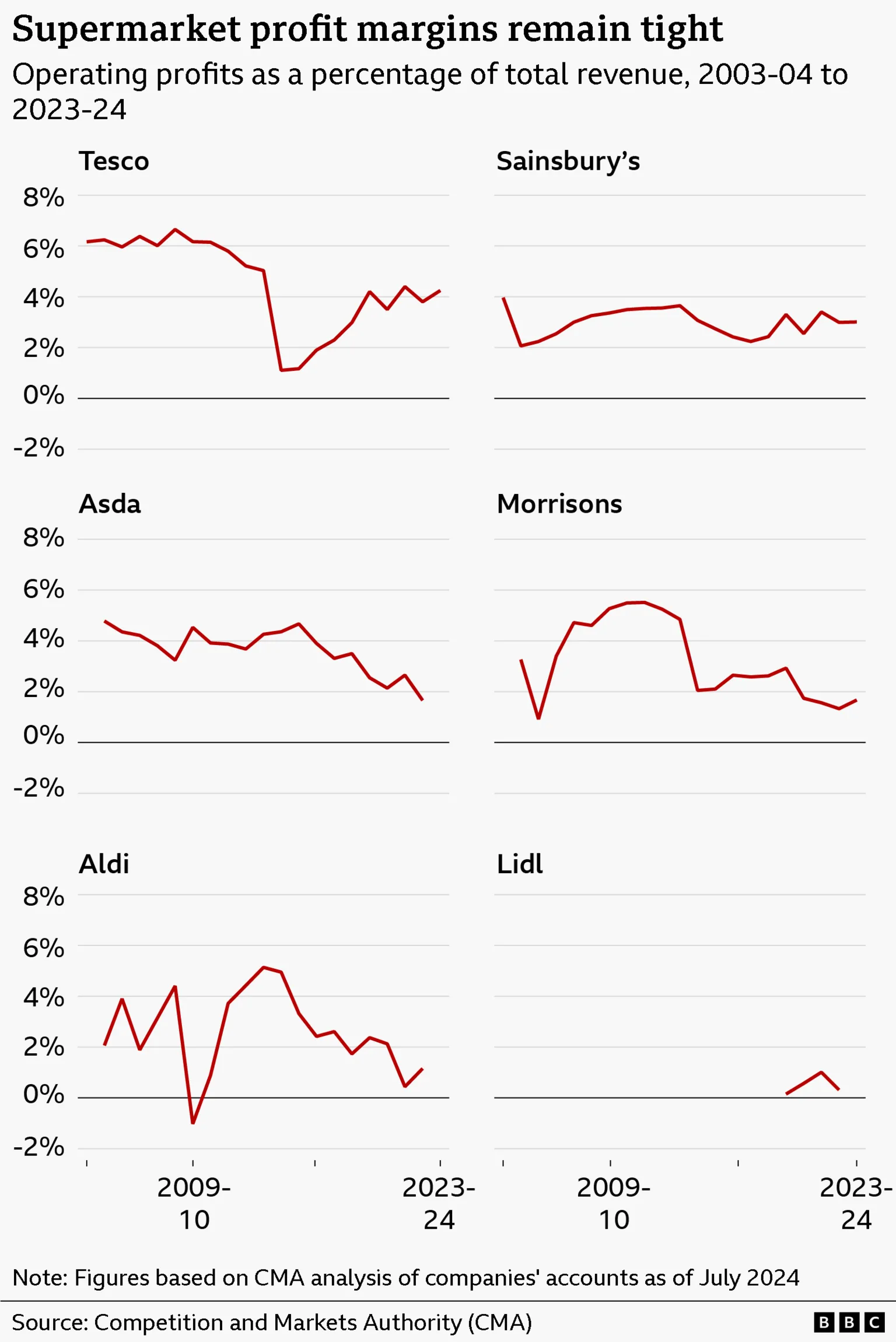
However, when accounting for sales and operating expenses, none of the leading retailers' profit margins have increased over the past 20 years.
While these figures do not specify the proportion of sales from food or profits from fresh produce, meat, or dairy, experts suggest they illustrate the highly competitive nature of the UK supermarket industry.
The Competition and Markets Authority's July 2024 investigation into the grocery sector found no evidence of supermarkets artificially inflating prices. Notably, there was no price spike in 2022 and 2023 despite soaring food prices linked to the global energy crisis following Russia's invasion of Ukraine.
Hewson emphasizes the competitiveness of the UK supermarket sector.
"The UK supermarket sector is massively competitive, and most will sell some staple products at a loss to get people through the door."
She explains that supermarkets often absorb losses on certain staples, which impacts their profit margins.
"These are not businesses that are making huge amounts for every pound that they sell. They have to work hard to make their money."
Andrew Opie, director of food and sustainability at the British Retail Consortium, which represents supermarkets, states that the UK remains "one of the most affordable places in Western Europe for grocery shopping."
He adds:
"As food inflation has risen in recent years, supermarkets have ramped up their focus on offering value on everyday staples - in some cases selling products below cost and absorbing the impact through their own margins to deliver savings for customers."