

Introduction: Wheat Price Heading for Biggest Jump in Two Months
Good morning, and welcome to our continuous coverage of business, financial markets, and the global economy.
A significant rise in wheat prices is intensifying concerns that the ongoing conflict in the Middle East will exacerbate food inflation this year.
Chicago wheat futures have increased by nearly 4.5% this week, marking their largest weekly gain since February. Factors contributing to this surge include dry weather conditions in the US and the war involving Iran.
The escalation in fertiliser and diesel prices since the conflict began at the end of February has increased costs for farmers, potentially leading to reduced harvest yields.
A recent report from the humanitarian organisation Mercy Corps highlights that disruptions to fuel, fertiliser, and shipping have swiftly impacted import-dependent economies, affecting planting seasons currently underway in Somalia, Ethiopia, and Pakistan.
Mercy Corps warns that food insecurity outcomes for 2026 and 2027 are effectively "locked in" for some of the world's most vulnerable countries.
Global fertiliser prices have surged during critical planting periods, while fuel prices have risen by as much as 150% within days in certain markets, driving up transportation and water costs.
Commercial shipping through the Strait of Hormuz has decreased by more than 90%, constraining agricultural supply chains.
In Somalia, fuel price spikes have doubled water costs in drought-affected regions.
Humanitarian shipments to Sudan are being rerouted via the Cape of Good Hope, adding approximately 6,000 miles and up to three weeks to transit times.
The World Food Programme estimates that an additional 45 million people worldwide could face acute hunger.
These developments coincide with dry conditions in the US Plains threatening to reduce wheat yields following low rainfall.
Similarly, dry weather in Australia and the Black Sea growing region is adversely affecting wheat yields.
The Agenda
- 10am BST: Eurozone trade data for February
- 1.30pm BST: IMF Europe Department press briefing
- 6pm BST: Baker Hughes count of US oil rigs
Jet Fuel Shortage Could Lead to Flight Cancellations in Europe, IATA Warns
Concerns are mounting that European airlines may begin cancelling flights this summer unless jet fuel supplies return to pre-Iran war levels.
Willie Walsh, director general of the International Air Transport Association (IATA), indicated today that flight cancellations in Europe could occur due to jet fuel shortages starting at the end of May.
"Along with doing everything possible to secure alternative supply lines, it’s important that authorities have well-communicated and well-coordinated plans in place in case rationing becomes necessary, including for slot relief."
Yesterday, the head of the International Energy Agency warned that Europe has only six weeks of jet fuel remaining before shortages begin.
The recent decline in motor fuel prices and mortgage rates offers some relief to UK families grappling with the cost-of-living crisis.
New data from the Office for National Statistics reveals that two-thirds (67%) of adults reported an increase in their cost of living compared to the previous month, up from 56% in February 2026.
"Among those reporting that their cost of living had increased compared with a month ago, the price of food shopping remained the most commonly reported reason (91%); the proportion reporting the price of fuel (75%) as a reason for increased living costs increased from February 2026, when it was 38%."
RAC: Fuel Prices Start to Drop
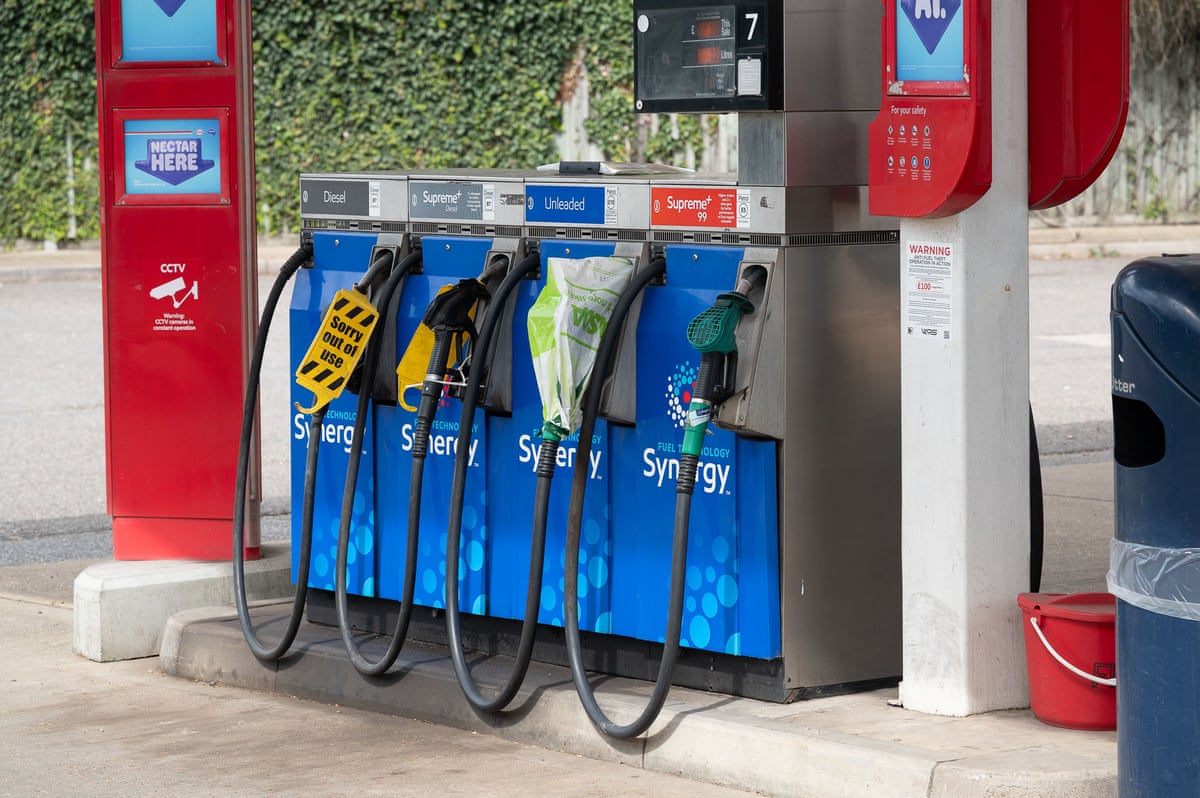
Motorists are finally seeing some relief at the pumps after weeks of rising prices.
Petrol and diesel prices fell yesterday for the first time since the Iran conflict began and have decreased slightly today as well.
Petrol prices have dropped to just below 158p per litre on average, although this remains 19% higher than before the conflict, when petrol cost 132.83p per litre.
The average diesel price has decreased to 190.94p per litre, still 48% higher than at the end of February.
This follows a decline in wholesale fuel costs earlier this week.
Simon Williams, head of policy at the RAC, commented:
"After 46 days of rising prices, the cost of both petrol and diesel across the country has finally begun to drop very slightly. Wholesale prices are still lower, so we’re hopeful there will be further reductions amounting to several pence a litre in the coming days. After record rises, drivers will be relieved to finally see prices going the other way. While we’re a long way from a return to the prices we had at the start of the conflict, there’s now a glimmer of light at the end of the tunnel."
Key Charts: How Insolvencies Rose in March
The conflict in Iran is already impacting UK businesses and their financial health, warns Matthew Richards, joint head of restructuring & insolvency at accountancy and advisory firm Azets.
Richards notes an increasing number of company directors are seeking financial advice due to fears they may not withstand the economic consequences of the Iran war, stating:
"Directors who were previously surviving have been concerned about the impact the war will have on their finances, and the increase in costs it caused has been the tipping point for many firms. The longer this carries on, the bigger impact it will have on margins, access to finance and affordability of funding, as well as consumer spending as households attempt to manage their own costs and cut back on anything that isn’t essential. With the war likely to continue, cost pressures continuing to be a problem and additional expenses like the new business rates and the changes to national minimum wage taking effect this month, it’s very likely demand for insolvency support will increase in the coming months."
Insolvencies in England and Wales Up 7% in March
The UK may be confronting a "mountain" of insolvencies, according to restructuring experts, as the Iran conflict drives up costs.
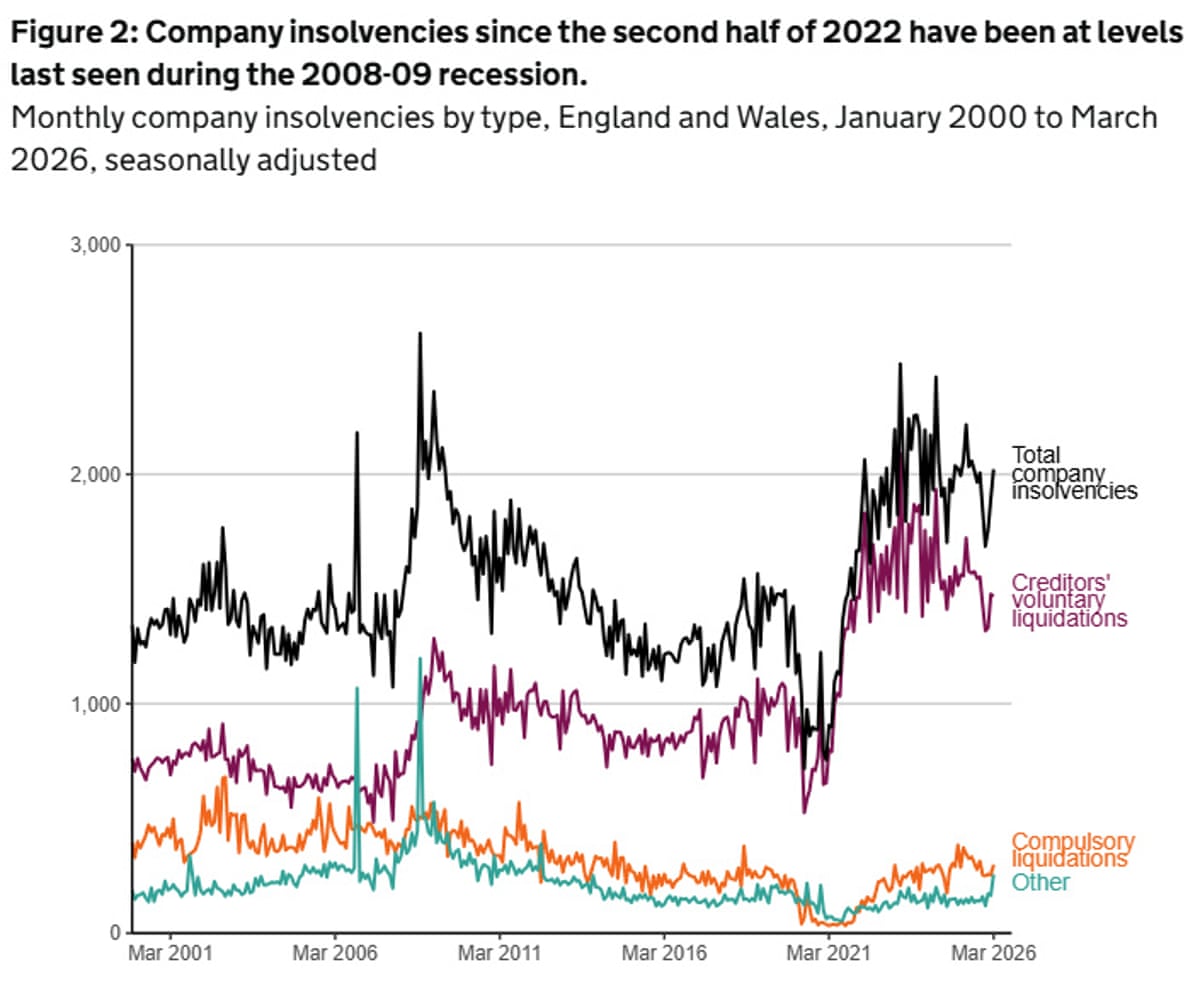
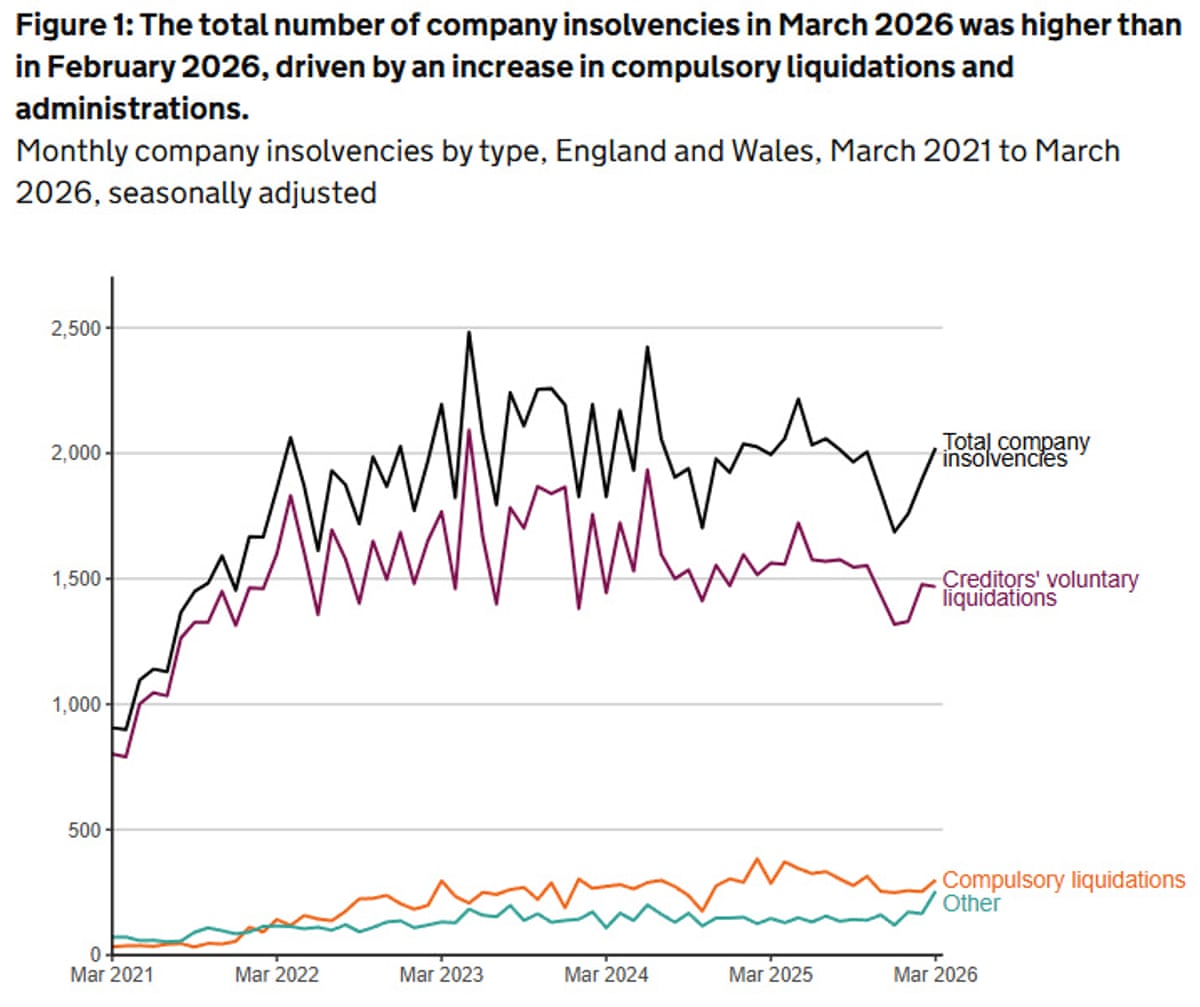
New data shows a 7% increase in company insolvencies in England and Wales in March, rising to 2,022 from 1,895 in February.

This rise is largely attributed to the collapse of mortgage lender Market Financial Solutions last month, which failed after borrowing £1.3bn from multiple financial firms.
"The increase in March 2026 was mostly driven by more than 100 connected companies in the Real Estate sector entering administration," the Insolvency Service noted.
This suggests March's insolvency rise may be a "one-off event." However, experts caution that the geopolitical crisis in the Middle East and increasing tax burdens on businesses could push more firms into insolvency.
Giuseppe Parla, restructuring & insolvency director at , commented:
"Ongoing tensions in the Middle East are driving up energy and fuel costs, disrupting supply chains, and keeping inflation stubbornly above the Bank of England’s 2% target. The UK economy is expected to be among the most exposed in the developed world - yet much of this impact has not yet filtered through to company balance sheets or the latest insolvency data. Compounding this, the new tax year has brought a fresh wave of cost pressures. While there have been no headline rate rises, frozen thresholds, reduced reliefs and tighter allowances are quietly intensifying ‘fiscal drag’ - steadily increasing the tax burden on both businesses and consumers. Together, these twin pressures are squeezing margins and suppressing demand which risks driving more businesses into the red. This combination means we are likely at the foot of a mountain of insolvencies, rather than sitting at its peak. With cost pressures still building, consumer demand under strain, and uncertainty persisting, insolvency numbers are likely to remain elevated, or rise further, in the months ahead, posing a serious threat to the wider British economy."
UK Mortgage Rates Drop Slightly
UK mortgage rates have decreased marginally today as some lenders reduce their offerings.
Moneyfacts reports the average two-year fixed residential mortgage rate is 5.87%, down from 5.88% on Thursday.
The average five-year fixed residential mortgage rate is 5.76%, down from 5.77% yesterday.
Santander, TSB, and the Coventry and Skipton building societies have announced cuts to some fixed-rate mortgages, following optimism about a potential Middle East peace deal reducing borrowing costs.
Oil prices are slightly lower today but remain near the $100 per barrel mark.
Brent crude futures have declined 0.75% to $98.70 per barrel after former US President Donald Trump stated last night:
"We’re going to see what happens. But I think we’re very close to making a deal with Iran."
Even if a deal were reached immediately, it would take weeks for oil and gas supplies to normalize.
Before the crisis, oil traded around $72 per barrel and surged to nearly $120 during March.
Electricity Producers' Shares Fall as UK Considers Breaking Pricing Link with Gas
Britain’s blue-chip share index has declined slightly, led by falls in electricity producers.
The FTSE 100 index is down 15 points, or 0.14%, at 10,577.
SSE (-4%) and Centrica (-3.5%) are among the biggest decliners after the UK government indicated it is considering severing the link between electricity and gas prices.
This link means gas prices typically determine electricity prices under Britain’s marginal cost pricing model, causing high gas prices to increase electricity costs for consumers while benefiting electricity producers.
Speaking in Washington yesterday, Chancellor Rachel Reeves said she and Energy Secretary Ed Miliband are exploring this issue:
"So, this is something that I’ve been attracted to for quite some time, delinking electricity and gas prices. At the moment, when gas prices are high, we end up paying more for our electricity, even though the cost of producing it doesn’t change. And so myself and Ed Miliband are now working to come up with a practical way that we can delink those prices."
European Markets Open Calmly Amid Middle East Truce
European stock markets opened with little volatility following a truce between Lebanon and Israel announced yesterday.
With indications that the next US-Iran meeting might occur over the weekend, hopes for de-escalation in the Middle East are supporting modest gains in shares.
Germany’s DAX index is flat, France’s CAC 40 has risen 0.15%, and Italy’s FTSE Mib index has increased by 0.25% in early trading.
This positions the pan-European Stoxx 600 index to achieve its fourth consecutive weekly gain.
Derren Nathan, head of equity research at Hargreaves Lansdown, stated:
"Events in the Middle East remain the key market driver, and President Trump’s overnight comments on the potential for further peace talks between the US and Iran could boost equity markets today. A ceasefire between Israel and Iranian proxy Hezbollah after Israeli/Lebanese talks in Washington provides further hope for de-escalation."
The surge in wheat prices occurs as food inflation is forecast to rise in the coming months.
Capital Economics predicts UK food inflation could nearly double by mid-2027, advising clients:
"Outside of fuel and utilities, the prices of flights, other forms of transport, flowers and food are likely to rise the most in response to the Iran war. In our baseline scenario, food price inflation rises from 3.3% in February to 6.0% in the middle of next year."
Cuts to Overseas Aid Will Worsen Global Economic Shocks, David Miliband Warns
Reductions in overseas aid by countries including the US and the UK risk exacerbating global economic instability amid the humanitarian crisis caused by the Iran war, David Miliband has told my colleague Richard Partington.
The former British foreign secretary and head of the International Rescue Committee (IRC) said that policies under Donald Trump would intensify shocks to the global economy, affecting both poor and wealthy nations.
Miliband also expressed regret that Keir Starmer’s government is reducing aid, emphasizing that supporting the world’s poorest is both morally right and a "good investment for Britain."
The former Labour minister commented:
"An untended humanitarian crisis is an incubator of political instability. We are in a more connected world than ever before. The Iran war shows how connected we are, but the connections go the other way [from poor to rich countries], too."


